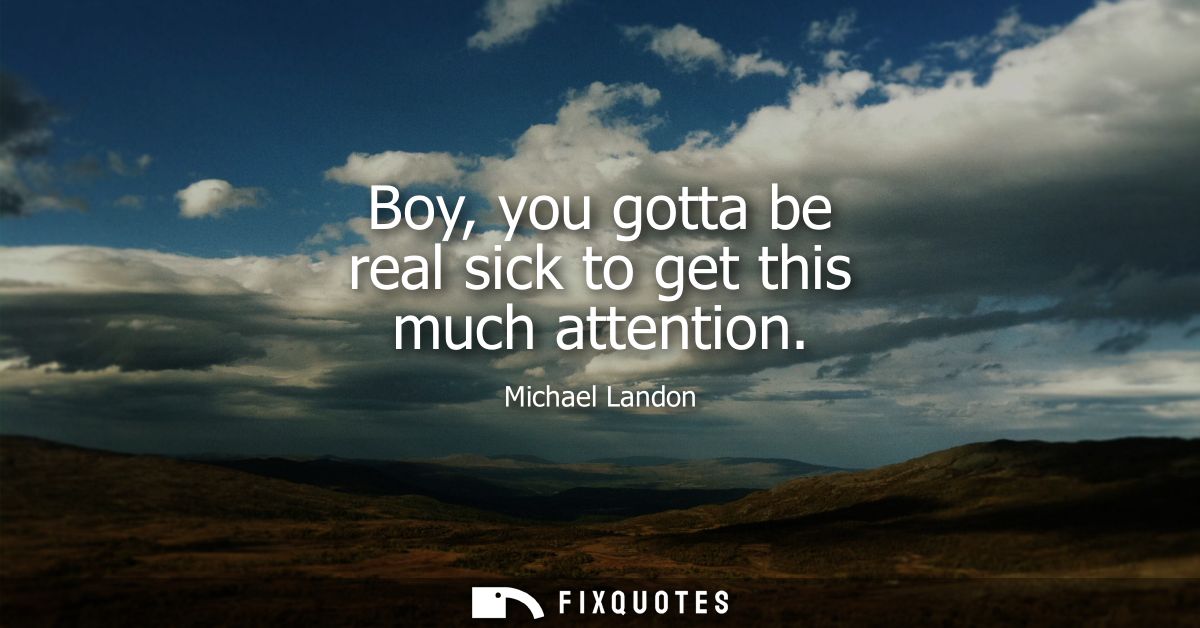
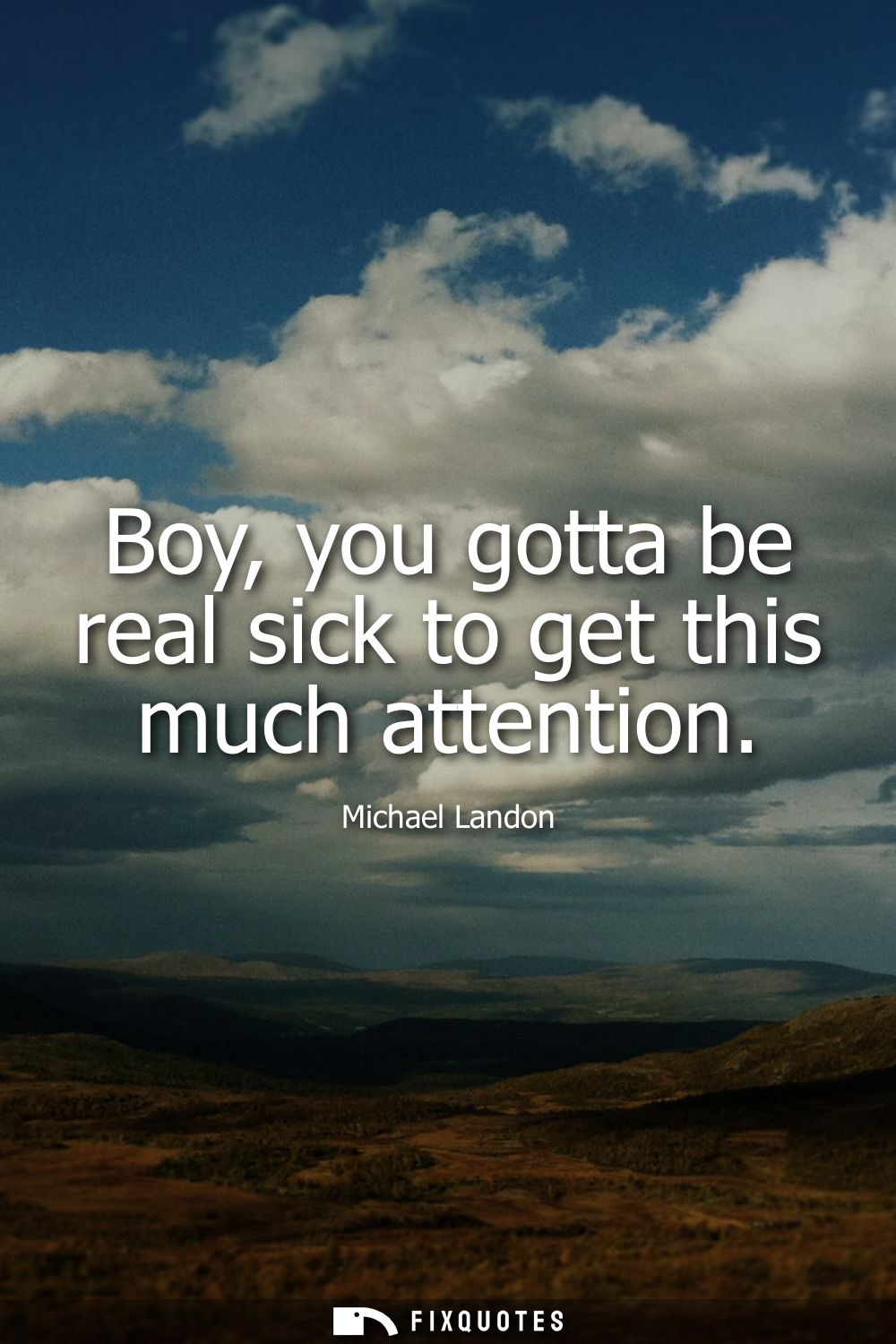
"Boy, you gotta be real sick to get this much attention"
About this Quote
“Boy, you gotta be real sick to get this much attention” lands like a throwaway line, but it’s really a jab at the economy of sympathy. Landon frames attention as something you don’t earn through ordinary decency or talent, but through visible suffering. The “Boy” and “you gotta” give it that plainspoken, locker-room intimacy he was good at on screen: not a lecture, a rueful aside. That’s the trick. It sounds casual enough to be harmless, which makes the indictment sharper.
As an actor whose persona traded in earnestness (Little House, Highway to Heaven), Landon understood how American culture rewards the legible kind of pain: the hospital bed, the tragic diagnosis, the public struggle. The line suggests a world where being quietly okay is socially invisible, and being unwell turns you into a communal project. It’s less about illness itself than about the attention system around it - who gets comfort, who gets airtime, who gets forgiven.
The subtext also cuts both ways: it’s a critique of audiences who only show up for calamity, and of the performer’s reality that crisis can become the only reliable spotlight. In a pre-social-media era, it anticipates the modern dopamine loop of trauma-as-content, when vulnerability becomes currency and health reads as boring. Landon’s point isn’t that attention is bad; it’s that we’ve built a culture where the quickest route to being seen is to be broken in public.
As an actor whose persona traded in earnestness (Little House, Highway to Heaven), Landon understood how American culture rewards the legible kind of pain: the hospital bed, the tragic diagnosis, the public struggle. The line suggests a world where being quietly okay is socially invisible, and being unwell turns you into a communal project. It’s less about illness itself than about the attention system around it - who gets comfort, who gets airtime, who gets forgiven.
The subtext also cuts both ways: it’s a critique of audiences who only show up for calamity, and of the performer’s reality that crisis can become the only reliable spotlight. In a pre-social-media era, it anticipates the modern dopamine loop of trauma-as-content, when vulnerability becomes currency and health reads as boring. Landon’s point isn’t that attention is bad; it’s that we’ve built a culture where the quickest route to being seen is to be broken in public.
Quote Details
| Topic | Sarcastic |
|---|---|
| Source | Help us find the source |
| Cite |
Citation Formats
APA Style (7th ed.)
Landon, Michael. (2026, January 15). Boy, you gotta be real sick to get this much attention. FixQuotes. https://fixquotes.com/quotes/boy-you-gotta-be-real-sick-to-get-this-much-155631/
Chicago Style
Landon, Michael. "Boy, you gotta be real sick to get this much attention." FixQuotes. January 15, 2026. https://fixquotes.com/quotes/boy-you-gotta-be-real-sick-to-get-this-much-155631/.
MLA Style (9th ed.)
"Boy, you gotta be real sick to get this much attention." FixQuotes, 15 Jan. 2026, https://fixquotes.com/quotes/boy-you-gotta-be-real-sick-to-get-this-much-155631/. Accessed 30 Mar. 2026.
More Quotes by Michael
Add to List