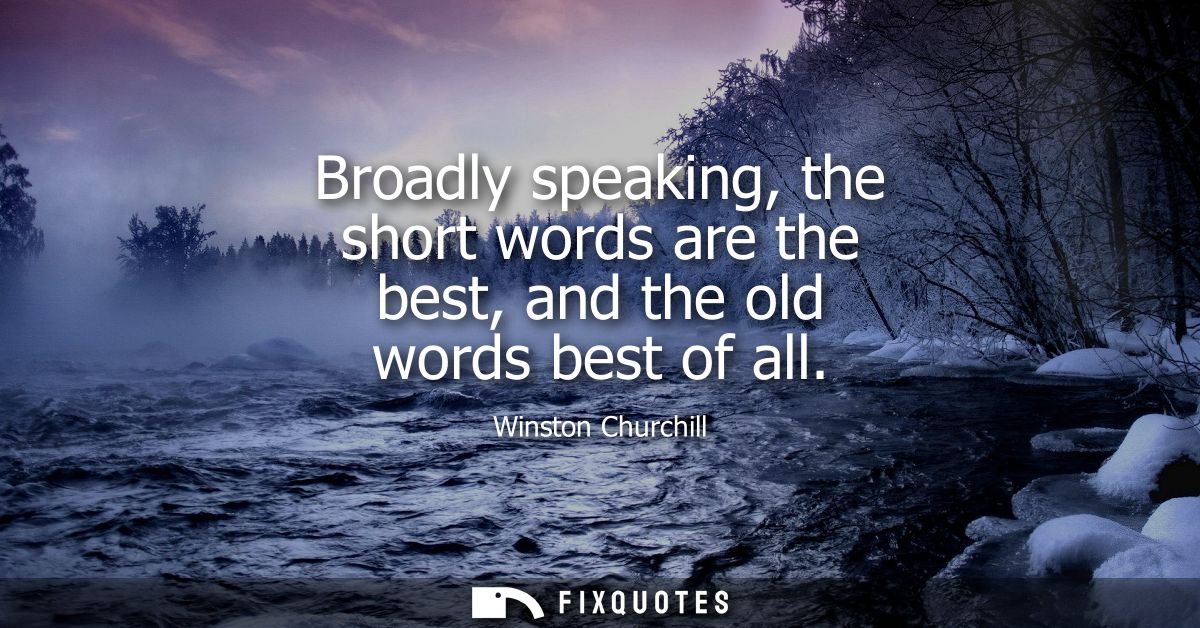
"Broadly speaking, the short words are the best, and the old words best of all"
About this Quote
The praise of “old words” is doing double duty. On the surface it’s a stylistic preference: Anglo-Saxon plainness over Latinate fog, “fight” over “combat,” “help” over “assistance.” Underneath, it’s a conservative argument about legitimacy. Old words carry inherited authority; they sound like the nation talking to itself across generations. For a statesman whose job was to convert fear into resolve, that lineage matters. If the vocabulary feels native, the message feels inevitable.
Context sharpens the intent. Churchill’s finest hours were also Britain’s most vulnerable ones, when rhetoric had to function as equipment: portable, durable, immediately usable. His speeches didn’t just describe reality; they organized it into verbs people could act on. This aphorism is the craft note behind the craft: in crisis, clarity isn’t a virtue. It’s a weapon.
Quote Details
| Topic | Writing |
|---|---|
| Source | Help us find the source |
| Cite |
Citation Formats
APA Style (7th ed.)
Churchill, Winston. (2026, January 15). Broadly speaking, the short words are the best, and the old words best of all. FixQuotes. https://fixquotes.com/quotes/broadly-speaking-the-short-words-are-the-best-and-25078/
Chicago Style
Churchill, Winston. "Broadly speaking, the short words are the best, and the old words best of all." FixQuotes. January 15, 2026. https://fixquotes.com/quotes/broadly-speaking-the-short-words-are-the-best-and-25078/.
MLA Style (9th ed.)
"Broadly speaking, the short words are the best, and the old words best of all." FixQuotes, 15 Jan. 2026, https://fixquotes.com/quotes/broadly-speaking-the-short-words-are-the-best-and-25078/. Accessed 9 Mar. 2026.