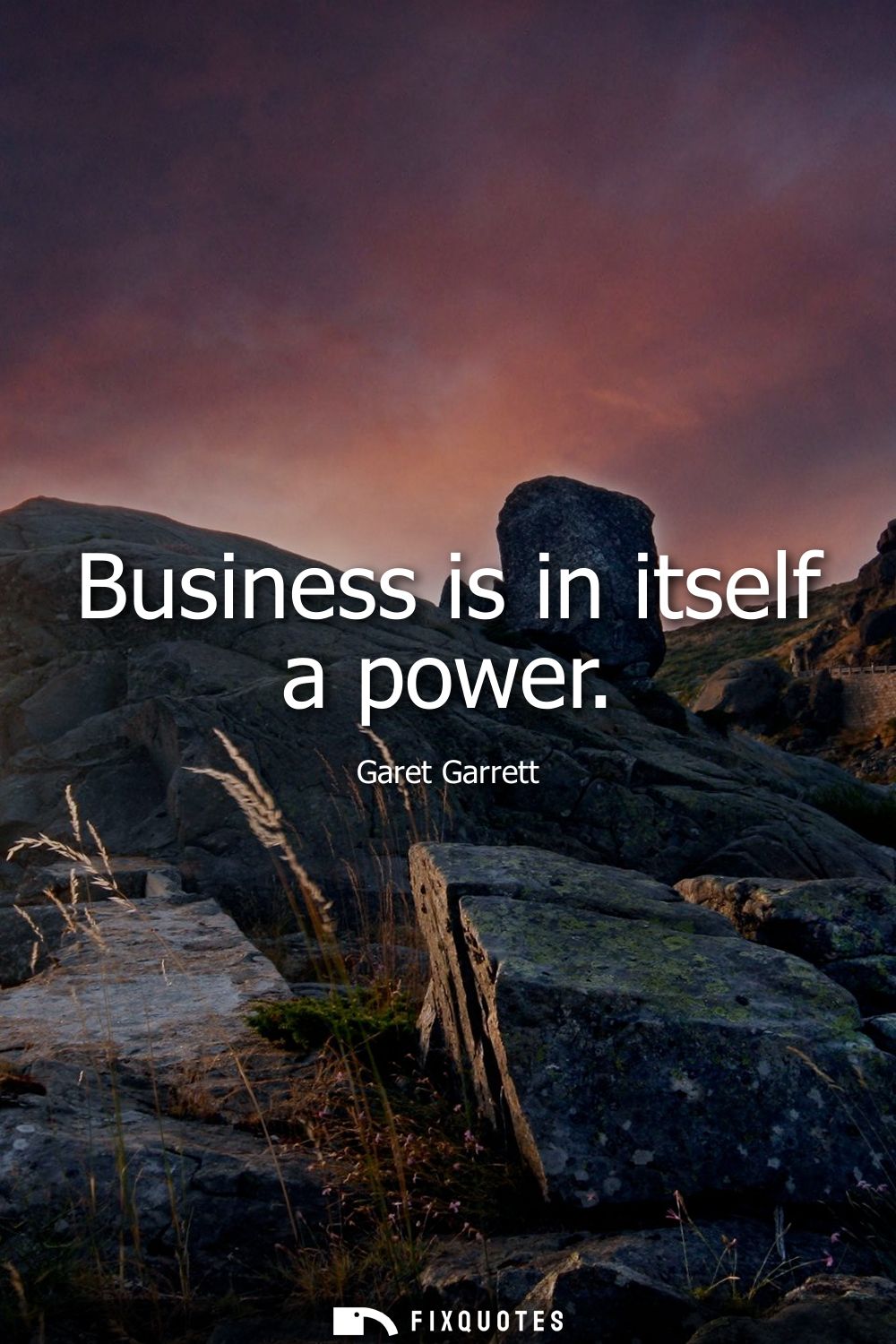
"Business is in itself a power"
About this Quote
“Business is in itself a power” reads like a corrective aimed at people who pretend commerce is merely technical - a neutral machine that turns effort into goods. Garrett, a journalist steeped in early 20th-century American political economy, is reminding readers that business doesn’t just operate inside society; it reorganizes society. It hires and fires, sets wages, shapes cities, funds ideas, dictates what counts as “practical,” and quietly trains citizens to see the world in terms of incentives and efficiency. That’s power even before it ever lobbies a legislator.
The line’s force comes from its insistence on self-contained agency. “In itself” implies business doesn’t need to capture the state to matter politically; its everyday choices already distribute opportunity and risk. It also carries a warning: if you treat business as apolitical, you’ll miss how it governs by default. Markets aren’t just arenas; they’re rule-sets backed by capital, contracts, and the ability to exclude.
Garrett’s context sharpens the edge. Writing across the boom years, the Great Depression, and the New Deal, he watched corporate scale and federal power grow in tandem, each claiming to be the necessary manager of modern life. The subtext isn’t a simple pro- or anti-business slogan; it’s a diagnosis of plural authority in a mass economy. When business becomes large enough, it starts acting like a sovereign: coordinating labor, controlling information, setting norms. The sentence lands because it refuses the comforting fiction that only governments wield power - and asks who we’re letting rule when we say “it’s just business.”
The line’s force comes from its insistence on self-contained agency. “In itself” implies business doesn’t need to capture the state to matter politically; its everyday choices already distribute opportunity and risk. It also carries a warning: if you treat business as apolitical, you’ll miss how it governs by default. Markets aren’t just arenas; they’re rule-sets backed by capital, contracts, and the ability to exclude.
Garrett’s context sharpens the edge. Writing across the boom years, the Great Depression, and the New Deal, he watched corporate scale and federal power grow in tandem, each claiming to be the necessary manager of modern life. The subtext isn’t a simple pro- or anti-business slogan; it’s a diagnosis of plural authority in a mass economy. When business becomes large enough, it starts acting like a sovereign: coordinating labor, controlling information, setting norms. The sentence lands because it refuses the comforting fiction that only governments wield power - and asks who we’re letting rule when we say “it’s just business.”
Quote Details
| Topic | Business |
|---|
More Quotes by Garet
Add to List