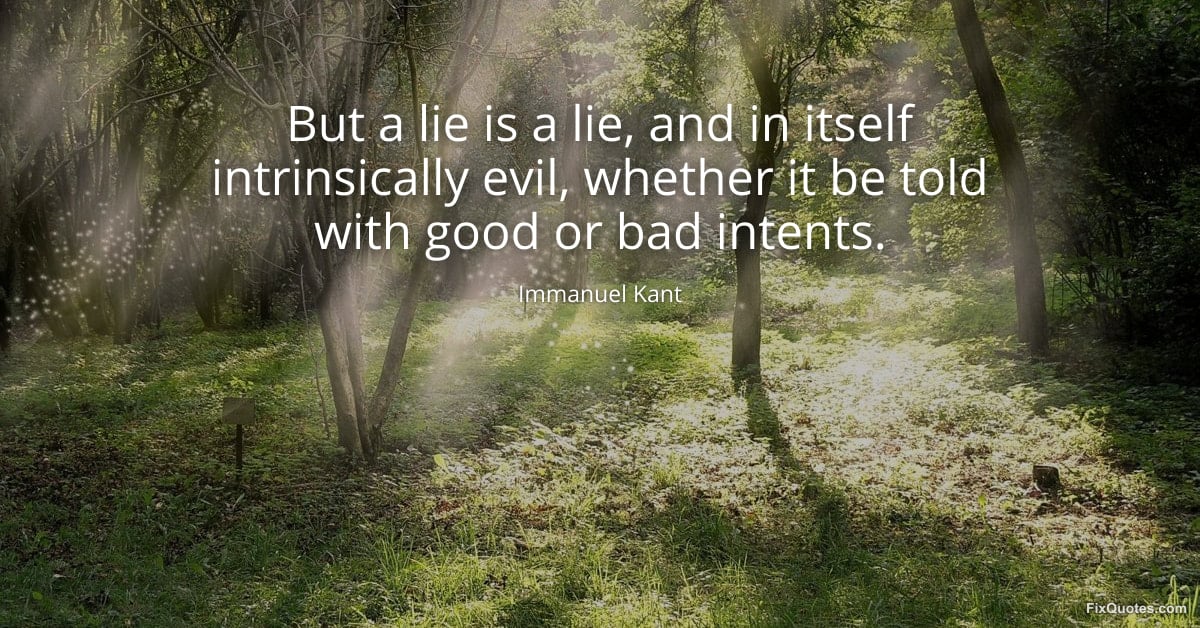
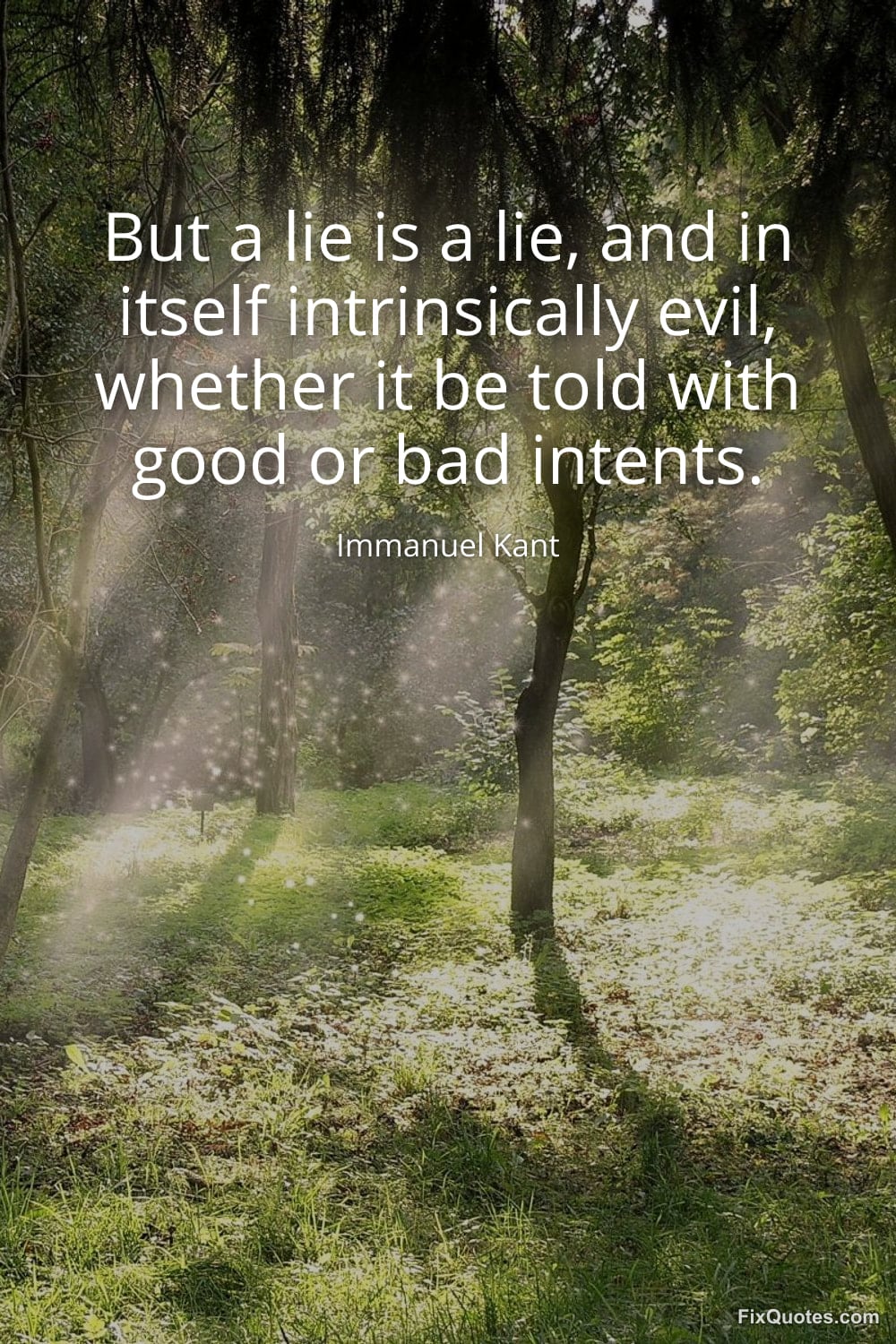
"But a lie is a lie, and in itself intrinsically evil, whether it be told with good or bad intents"
About this Quote
The subtext is a rebuke to the common modern defense of dishonesty: that motives can launder means. Kant is warning that once you let “good intentions” justify lying, you’ve handed morality over to whoever tells the best story about their motives. He’s building an ethics that won’t collapse under rationalization. If the standard is “I meant well”, then every con artist gets a halo.
Context matters: Kant is writing against consequentialist thinking (and, more pointedly, against the idea that morality is a tool for maximizing welfare). His famous hardline example - the debate about whether you may lie to a murderer at the door - shows how far he’s willing to take the claim. The rhetorical wager is that truth-telling isn’t just polite behavior; it’s the backbone of a world where promises, rights, and responsibility can mean anything at all. Once lies become situationally acceptable, trust becomes a market commodity, and morality turns into cost-benefit math with better branding.
Quote Details
| Topic | Honesty & Integrity |
|---|---|
| Source | Help us find the source |
| Cite |
Citation Formats
APA Style (7th ed.)
Kant, Immanuel. (2026, February 10). But a lie is a lie, and in itself intrinsically evil, whether it be told with good or bad intents. FixQuotes. https://fixquotes.com/quotes/but-a-lie-is-a-lie-and-in-itself-intrinsically-185058/
Chicago Style
Kant, Immanuel. "But a lie is a lie, and in itself intrinsically evil, whether it be told with good or bad intents." FixQuotes. February 10, 2026. https://fixquotes.com/quotes/but-a-lie-is-a-lie-and-in-itself-intrinsically-185058/.
MLA Style (9th ed.)
"But a lie is a lie, and in itself intrinsically evil, whether it be told with good or bad intents." FixQuotes, 10 Feb. 2026, https://fixquotes.com/quotes/but-a-lie-is-a-lie-and-in-itself-intrinsically-185058/. Accessed 12 Feb. 2026.