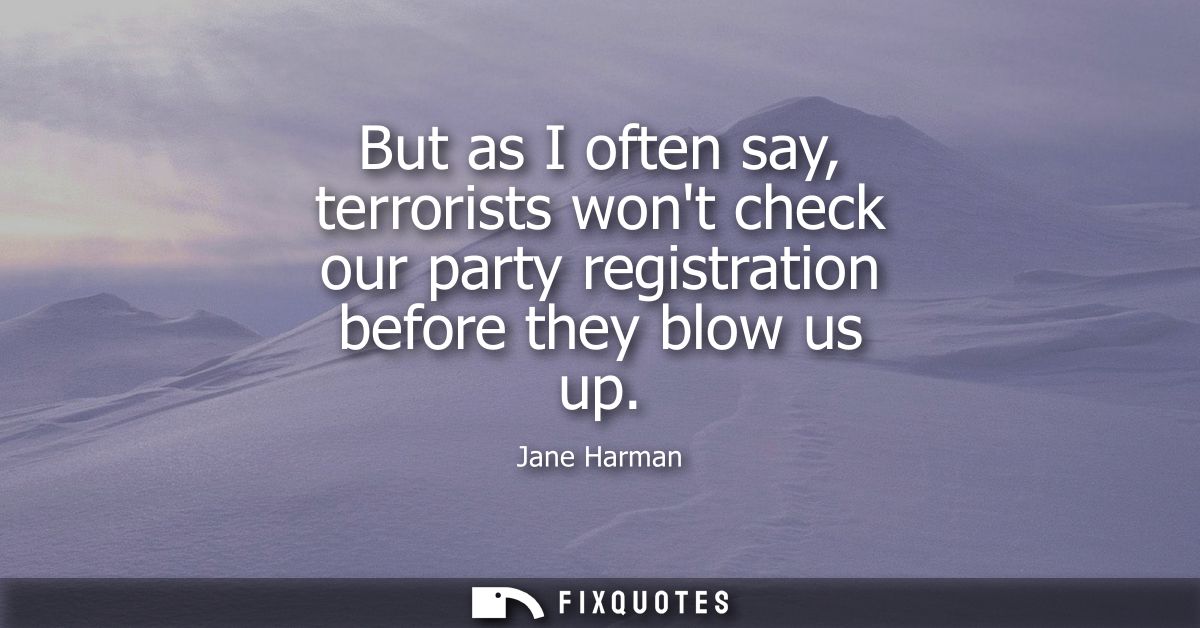
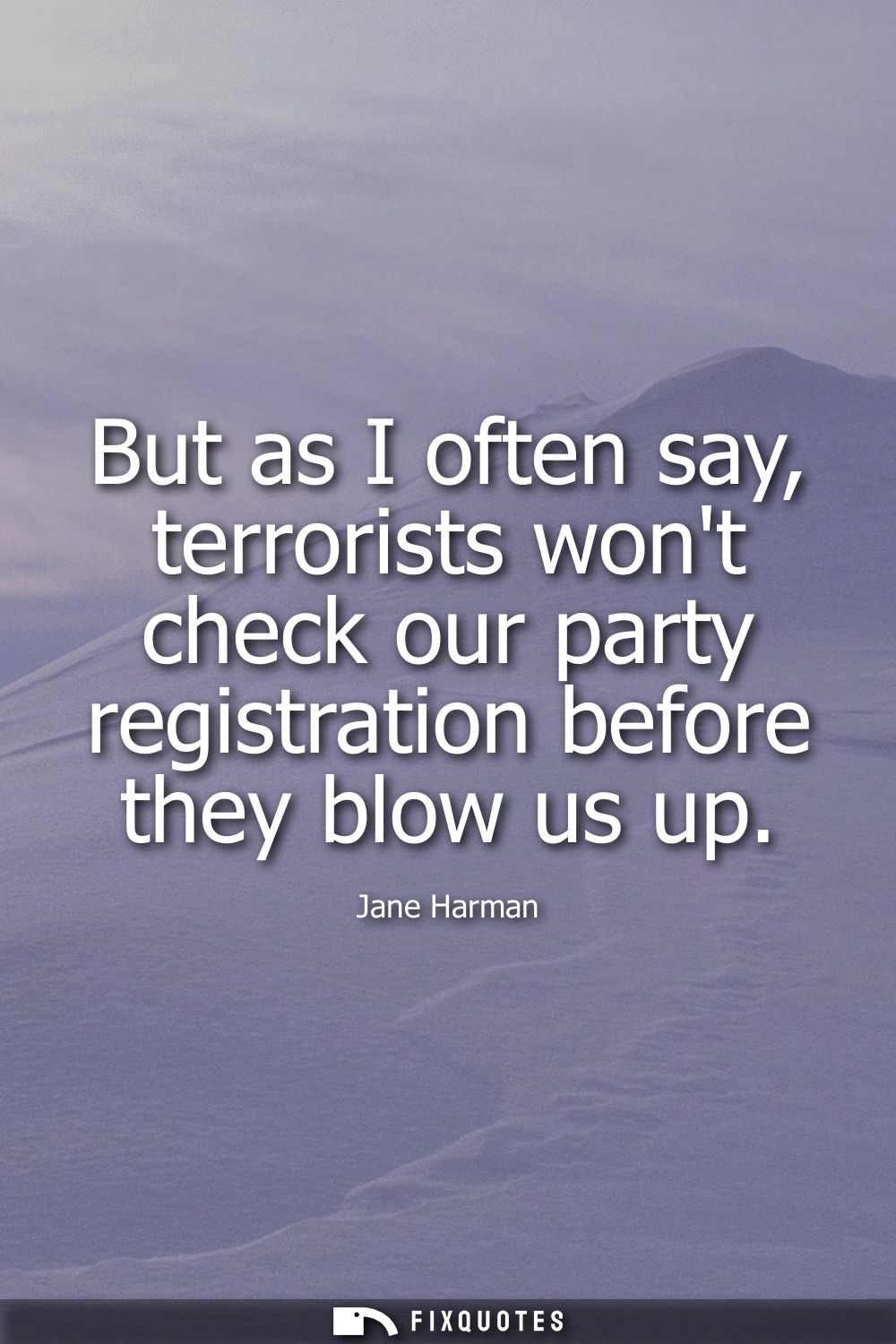
"But as I often say, terrorists won't check our party registration before they blow us up"
About this Quote
The specific intent is coalition-building under threat: a call for unity, or at least for a truce, around counterterrorism and intelligence policy. Harman, a Democrat long associated with hawkish national security positions, is also insulating herself from the “soft on terror” stereotype by sounding tougher than the room. It’s an argument for seriousness, not just solidarity.
The subtext is less kumbaya than it appears. By implying that partisan divides are a luxury terrorists don’t recognize, she reframes dissent as potentially irresponsible. It pressures opponents to temper criticism: if you fight the security agenda too hard, you’re squabbling while the house is on fire.
Contextually, it fits the post-9/11 political landscape where fear became a governing language and bipartisan posture was both moral claim and tactical weapon. Harman’s line sells pragmatism, but it also disciplines the conversation: disagree if you must, it suggests, but don’t pretend the world will wait for our primaries.
Quote Details
| Topic | War |
|---|---|
| Source | Help us find the source |
| Cite |
Citation Formats
APA Style (7th ed.)
Harman, Jane. (2026, January 17). But as I often say, terrorists won't check our party registration before they blow us up. FixQuotes. https://fixquotes.com/quotes/but-as-i-often-say-terrorists-wont-check-our-68736/
Chicago Style
Harman, Jane. "But as I often say, terrorists won't check our party registration before they blow us up." FixQuotes. January 17, 2026. https://fixquotes.com/quotes/but-as-i-often-say-terrorists-wont-check-our-68736/.
MLA Style (9th ed.)
"But as I often say, terrorists won't check our party registration before they blow us up." FixQuotes, 17 Jan. 2026, https://fixquotes.com/quotes/but-as-i-often-say-terrorists-wont-check-our-68736/. Accessed 3 Apr. 2026.