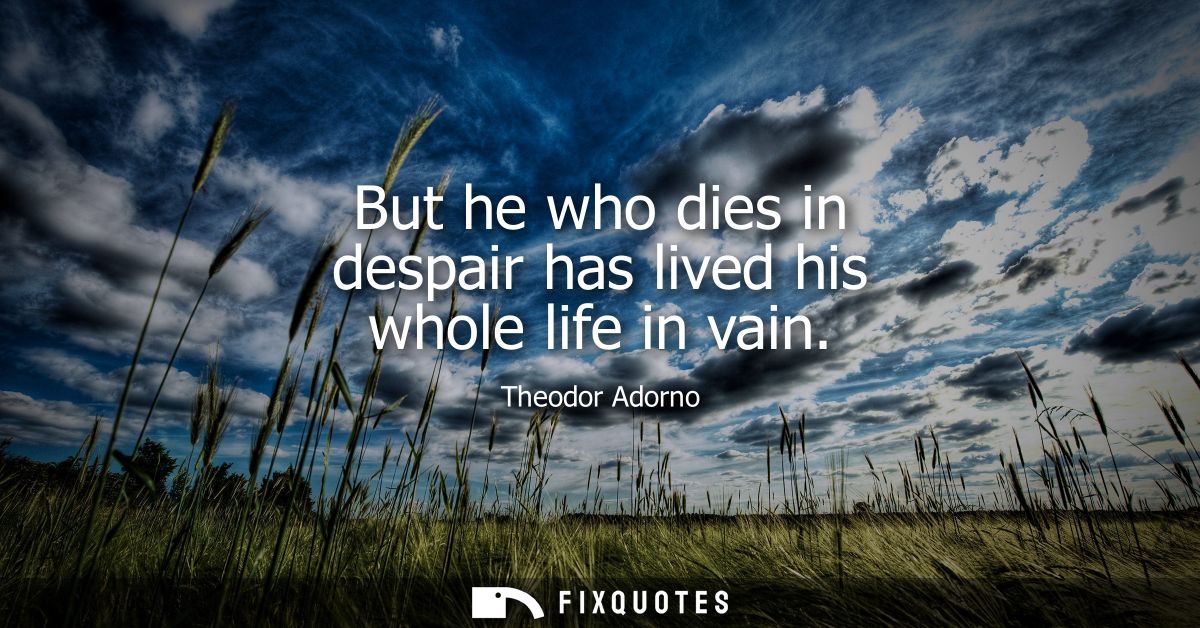
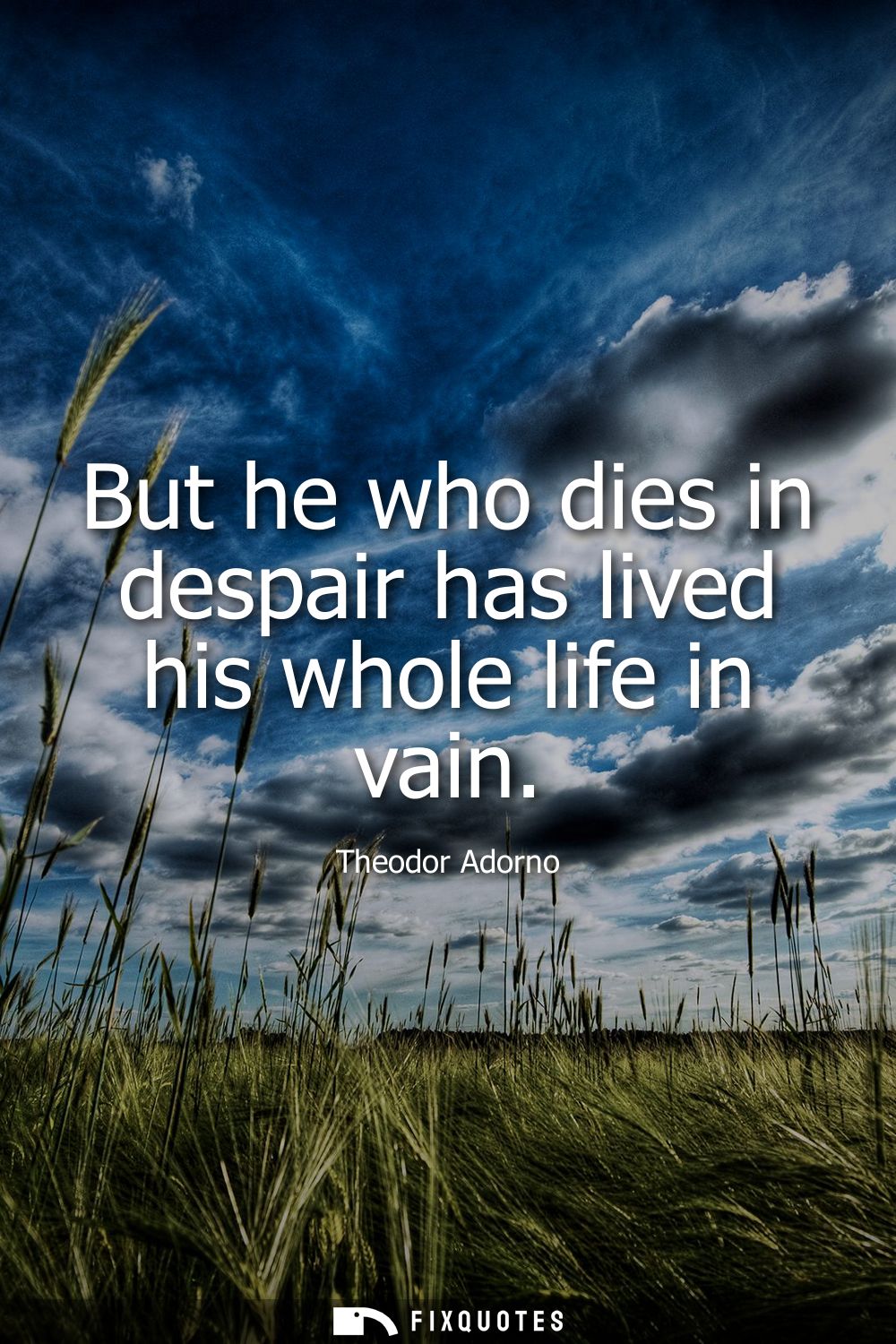
"But he who dies in despair has lived his whole life in vain"
About this Quote
A gut-punch of moral accounting disguised as a single sentence, this line carries Adorno's signature refusal to let suffering be aesthetically redeemed. "Dies in despair" isn't mere sadness; it's the terminal verdict that the world has become, for the subject, uninhabitable. Adorno is not sentimental about resilience. He's measuring a life by its final relation to meaning - and the measure is brutal: if despair wins at the end, the entire biography retroactively collapses into "vain."
The intent is less self-help than indictment. Adorno wrote in the shadow of fascism, exile, and the Holocaust, where the old consolations (progress, culture, even "civilization") had shown their teeth. In that context, despair is not a private mood but evidence of a society that has trained people to experience their own existence as futile. When he frames despair as life-wasting, he puts pressure on any culture that normalizes hopelessness, that treats psychic ruin as an individual's failure rather than a political symptom.
The subtext is also characteristically Adornian: he mistrusts easy optimism, yet he can't give up on the demand that life be more than survival under domination. The sentence performs that tension. It denies comforting narratives ("you tried, so it mattered") while smuggling in a stubborn ethical claim: a life should be capable of ending without capitulation. Not because happy endings are owed, but because a world that manufactures despair is a world that must be refused.
The intent is less self-help than indictment. Adorno wrote in the shadow of fascism, exile, and the Holocaust, where the old consolations (progress, culture, even "civilization") had shown their teeth. In that context, despair is not a private mood but evidence of a society that has trained people to experience their own existence as futile. When he frames despair as life-wasting, he puts pressure on any culture that normalizes hopelessness, that treats psychic ruin as an individual's failure rather than a political symptom.
The subtext is also characteristically Adornian: he mistrusts easy optimism, yet he can't give up on the demand that life be more than survival under domination. The sentence performs that tension. It denies comforting narratives ("you tried, so it mattered") while smuggling in a stubborn ethical claim: a life should be capable of ending without capitulation. Not because happy endings are owed, but because a world that manufactures despair is a world that must be refused.
Quote Details
| Topic | Meaning of Life |
|---|---|
| Source | Help us find the source |
| Cite |
Citation Formats
APA Style (7th ed.)
Adorno, Theodor. (2026, January 18). But he who dies in despair has lived his whole life in vain. FixQuotes. https://fixquotes.com/quotes/but-he-who-dies-in-despair-has-lived-his-whole-453/
Chicago Style
Adorno, Theodor. "But he who dies in despair has lived his whole life in vain." FixQuotes. January 18, 2026. https://fixquotes.com/quotes/but-he-who-dies-in-despair-has-lived-his-whole-453/.
MLA Style (9th ed.)
"But he who dies in despair has lived his whole life in vain." FixQuotes, 18 Jan. 2026, https://fixquotes.com/quotes/but-he-who-dies-in-despair-has-lived-his-whole-453/. Accessed 3 Apr. 2026.
More Quotes by Theodor
Add to List