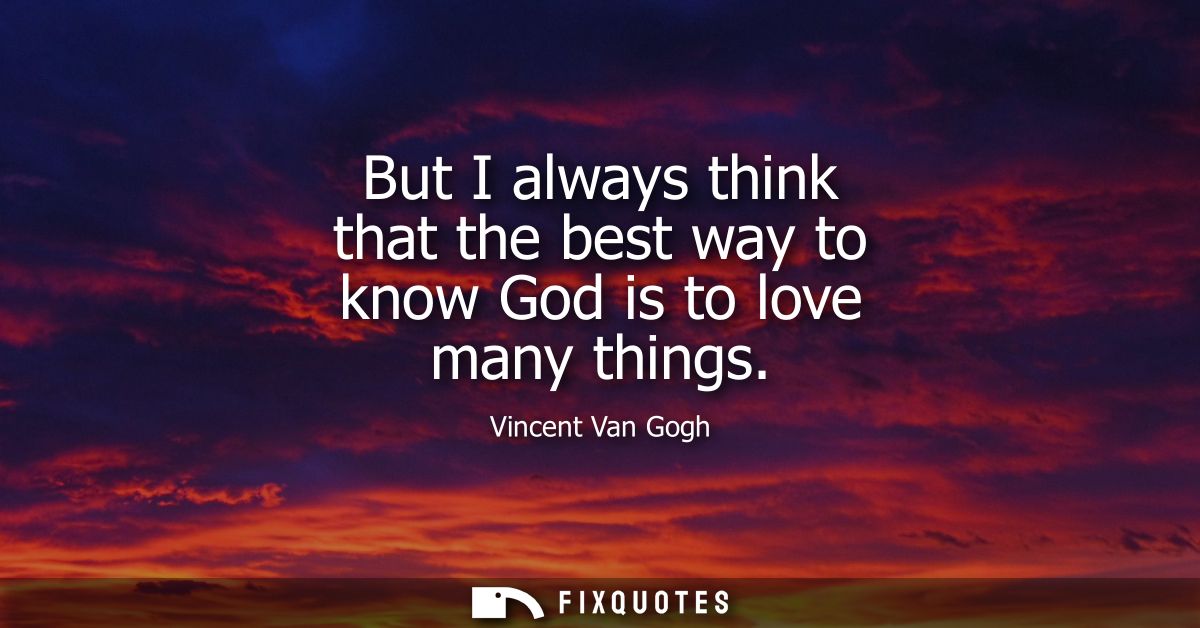
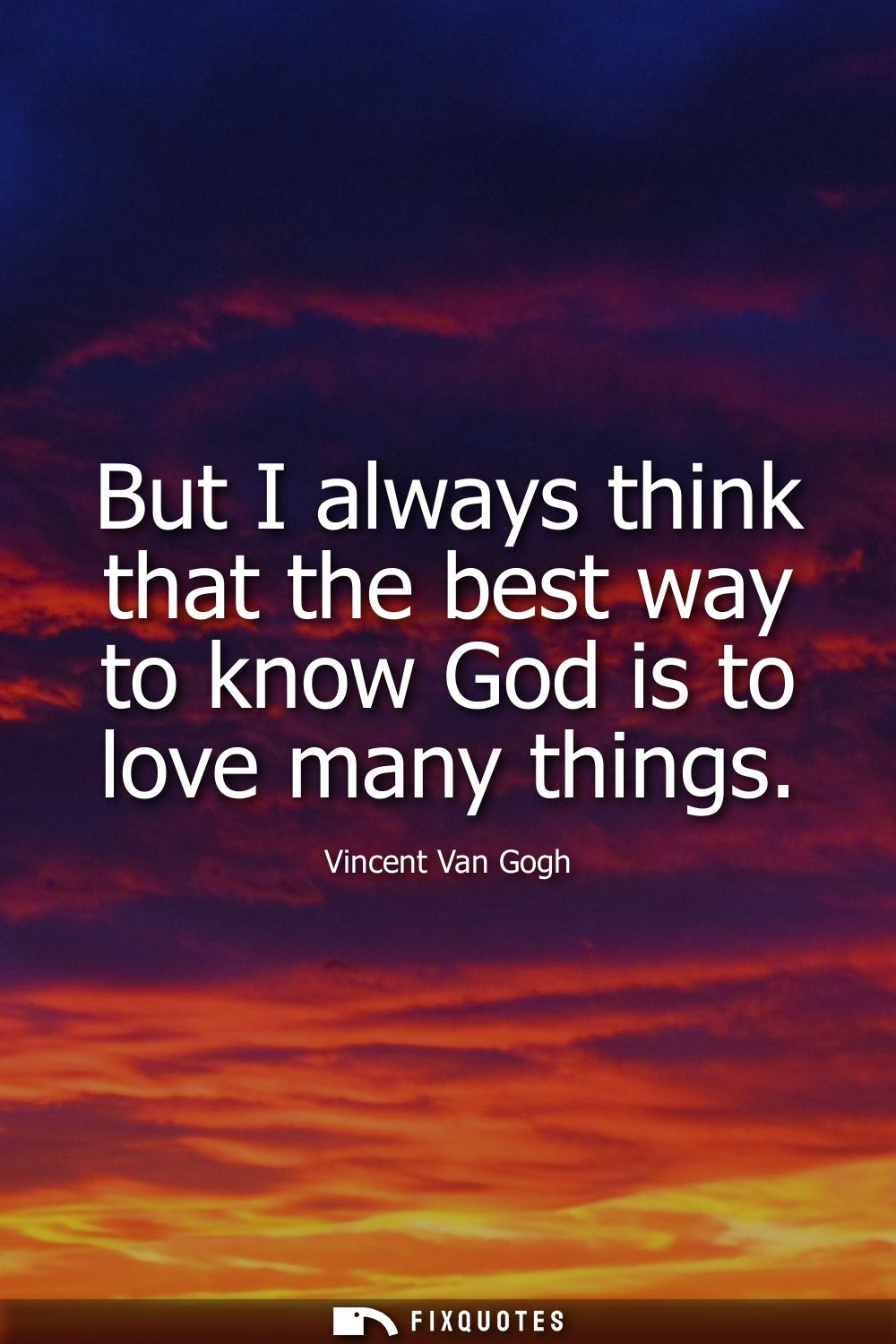
"But I always think that the best way to know God is to love many things"
About this Quote
The subtext is almost a self-defense. Van Gogh was forever being judged: too intense, too unstable, too poor, too wrong for polite society and for the institutions that claimed spiritual authority. He’d tried formal religion (even preaching) and found it inadequate to the scale of his feeling. So he proposes an alternative route: love as practice, not doctrine. “Many things” matters - plural, messy, worldly. It’s an ethic of attention that dignifies ordinary objects and working people, the very subjects he painted with near-religious seriousness.
Context sharpens the stakes. In the late 19th century, modernity was fraying old certainties; industrial life and bourgeois morality were tightening their grip. Van Gogh answers with a kind of radical tenderness: if you want God, don’t withdraw from the world; risk attachment to it. There’s tragedy baked in too. Loving many things is generous, but it’s also a recipe for hurt when you’re that porous. The sentence reads like a credo for his art: brushwork as prayer, obsession as a form of faith.
Quote Details
| Topic | God |
|---|---|
| Source | Verified source: The Letters of Vincent van Gogh (Vincent Van Gogh, 1880)
Evidence: But I cannot help thinking that the best way of knowing God is to love many things. Love this friend, this person, this thing, whatever you like, and you will be on the right road to understanding Him better, that is what I keep telling myself. (Letter to Theo van Gogh, July 1880 (webexhibits letter/8/133.h; in Van Gogh Letters this content is in letter 133 to Theo, Cuesmes, 1880)). This wording comes from Vincent van Gogh’s own letter to his brother Theo, dated July 1880, in English translation. The commonly-circulated version you provided (“But I always think that the best way to know God is to love many things”) is a slightly smoothed/paraphrased variant of this passage (“cannot help thinking… best way of knowing God…”). This is a primary-source statement by Van Gogh (a private letter), not a later quote compilation. Note: different editorial numbering systems exist for Van Gogh’s letters across editions/sites; the Van Gogh Museum’s ‘Vincent van Gogh Letters’ site also has a ‘letter 133’ but that is a different (1877) letter in that system, so don’t rely on the number alone, use the date/content match. Other candidates (1) The Letters of Vincent Van Gogh (Vincent van Gogh, 1997) compilation95.0% Vincent van Gogh Mark Roskill. that is bad and wrong in men and in their works is not of God , and God does not appro... |
| Cite |
Citation Formats
APA Style (7th ed.)
Gogh, Vincent Van. (2026, February 16). But I always think that the best way to know God is to love many things. FixQuotes. https://fixquotes.com/quotes/but-i-always-think-that-the-best-way-to-know-god-14994/
Chicago Style
Gogh, Vincent Van. "But I always think that the best way to know God is to love many things." FixQuotes. February 16, 2026. https://fixquotes.com/quotes/but-i-always-think-that-the-best-way-to-know-god-14994/.
MLA Style (9th ed.)
"But I always think that the best way to know God is to love many things." FixQuotes, 16 Feb. 2026, https://fixquotes.com/quotes/but-i-always-think-that-the-best-way-to-know-god-14994/. Accessed 7 Apr. 2026.