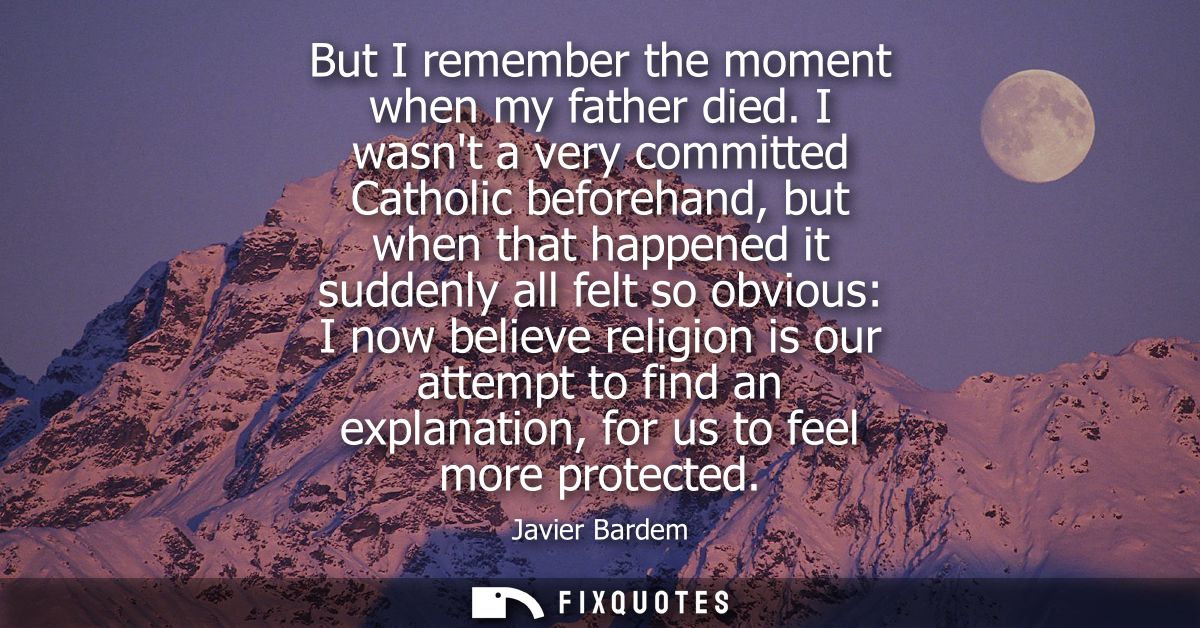
"But I remember the moment when my father died. I wasn't a very committed Catholic beforehand, but when that happened it suddenly all felt so obvious: I now believe religion is our attempt to find an explanation, for us to feel more protected"
About this Quote
His pivot - “it suddenly all felt so obvious” - is doing two jobs at once. On the surface, it’s the familiar language of revelation. Underneath, it’s a confession that the mind hates the senselessness of death. “Obvious” becomes a psychological shorthand: when the person who anchored your life disappears, the idea of an order bigger than you stops sounding optional. He doesn’t argue God into existence; he narrates the moment the argument becomes irrelevant.
Then he subtly redefines religion away from truth-claims and toward function: “our attempt to find an explanation… to feel more protected.” That’s disarmingly non-combative in a culture war era that demands you pick a side - believer or skeptic, rational or irrational. Bardem makes religion sound like a human technology for survivable meaning, a shelter built from story, ritual, and community. The subtext is adult and unsentimental: protection is not certainty, and explanation is not proof. It’s what you reach for when reality refuses to soften.
Coming from an actor, the candor lands because it’s about motivation: the moment the stakes become personal, the script of faith stops being inherited and starts being chosen.
Quote Details
| Topic | Faith |
|---|---|
| Source | Help us find the source |
| Cite |
Citation Formats
APA Style (7th ed.)
Bardem, Javier. (2026, January 15). But I remember the moment when my father died. I wasn't a very committed Catholic beforehand, but when that happened it suddenly all felt so obvious: I now believe religion is our attempt to find an explanation, for us to feel more protected. FixQuotes. https://fixquotes.com/quotes/but-i-remember-the-moment-when-my-father-died-i-164874/
Chicago Style
Bardem, Javier. "But I remember the moment when my father died. I wasn't a very committed Catholic beforehand, but when that happened it suddenly all felt so obvious: I now believe religion is our attempt to find an explanation, for us to feel more protected." FixQuotes. January 15, 2026. https://fixquotes.com/quotes/but-i-remember-the-moment-when-my-father-died-i-164874/.
MLA Style (9th ed.)
"But I remember the moment when my father died. I wasn't a very committed Catholic beforehand, but when that happened it suddenly all felt so obvious: I now believe religion is our attempt to find an explanation, for us to feel more protected." FixQuotes, 15 Jan. 2026, https://fixquotes.com/quotes/but-i-remember-the-moment-when-my-father-died-i-164874/. Accessed 1 Apr. 2026.