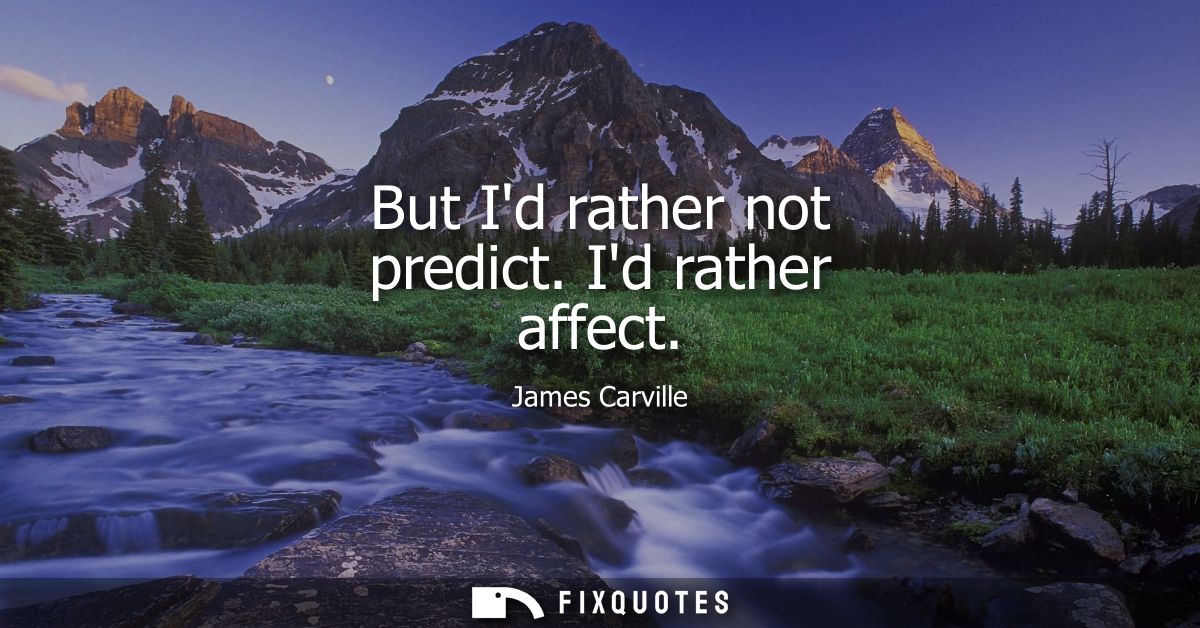
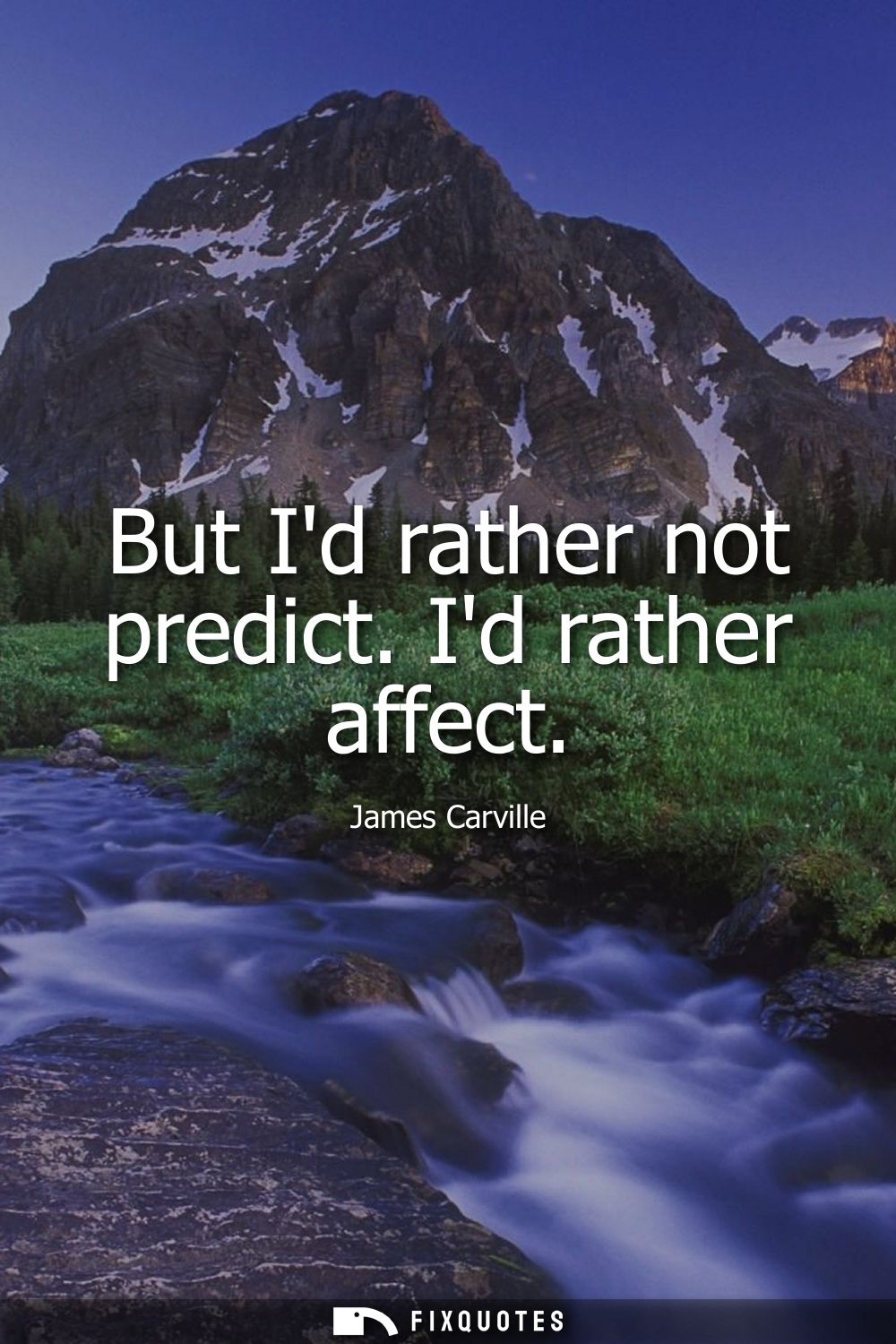
"But I'd rather not predict. I'd rather affect"
About this Quote
Carville’s line is political realism disguised as a shrug. “I’d rather not predict” swats away the pundit reflex to turn politics into weather forecasting: lots of models, little accountability. Prediction flatters the speaker as a seer; it also launders passivity. If you’re busy “calling” the future, you’re not responsible for building it.
“I’d rather affect” is the tell. Carville isn’t rejecting analysis; he’s rejecting analysis as performance. The verb choice matters: not “influence,” which sounds polite and incremental, but “affect,” which implies contact, pressure, consequence. It’s a credo from the campaign war room: politics isn’t a seminar, it’s an intervention. The subtext is almost a rebuke to spectatorship, the way cable news and social media turn elections into a sport where being early is valued more than being right, and being right is valued more than doing anything.
Contextually, it fits Carville’s brand as the profane strategist from the Clinton era, when message discipline and tactical aggression were treated as virtues, not moral compromises. He’s also insulating himself against the trap that eats operatives: forecasts can be disproven, but agency can’t be audited in the same clean way. Still, that’s the honest part of the quote. Carville is admitting what many political professionals won’t: the job isn’t to interpret democracy, it’s to steer it. That candor is why the line lands, and why it’s unsettling.
“I’d rather affect” is the tell. Carville isn’t rejecting analysis; he’s rejecting analysis as performance. The verb choice matters: not “influence,” which sounds polite and incremental, but “affect,” which implies contact, pressure, consequence. It’s a credo from the campaign war room: politics isn’t a seminar, it’s an intervention. The subtext is almost a rebuke to spectatorship, the way cable news and social media turn elections into a sport where being early is valued more than being right, and being right is valued more than doing anything.
Contextually, it fits Carville’s brand as the profane strategist from the Clinton era, when message discipline and tactical aggression were treated as virtues, not moral compromises. He’s also insulating himself against the trap that eats operatives: forecasts can be disproven, but agency can’t be audited in the same clean way. Still, that’s the honest part of the quote. Carville is admitting what many political professionals won’t: the job isn’t to interpret democracy, it’s to steer it. That candor is why the line lands, and why it’s unsettling.
Quote Details
| Topic | Vision & Strategy |
|---|---|
| Source | Help us find the source |
| Cite |
Citation Formats
APA Style (7th ed.)
Carville, James. (2026, January 15). But I'd rather not predict. I'd rather affect. FixQuotes. https://fixquotes.com/quotes/but-id-rather-not-predict-id-rather-affect-146372/
Chicago Style
Carville, James. "But I'd rather not predict. I'd rather affect." FixQuotes. January 15, 2026. https://fixquotes.com/quotes/but-id-rather-not-predict-id-rather-affect-146372/.
MLA Style (9th ed.)
"But I'd rather not predict. I'd rather affect." FixQuotes, 15 Jan. 2026, https://fixquotes.com/quotes/but-id-rather-not-predict-id-rather-affect-146372/. Accessed 25 Mar. 2026.
More Quotes by James
Add to List