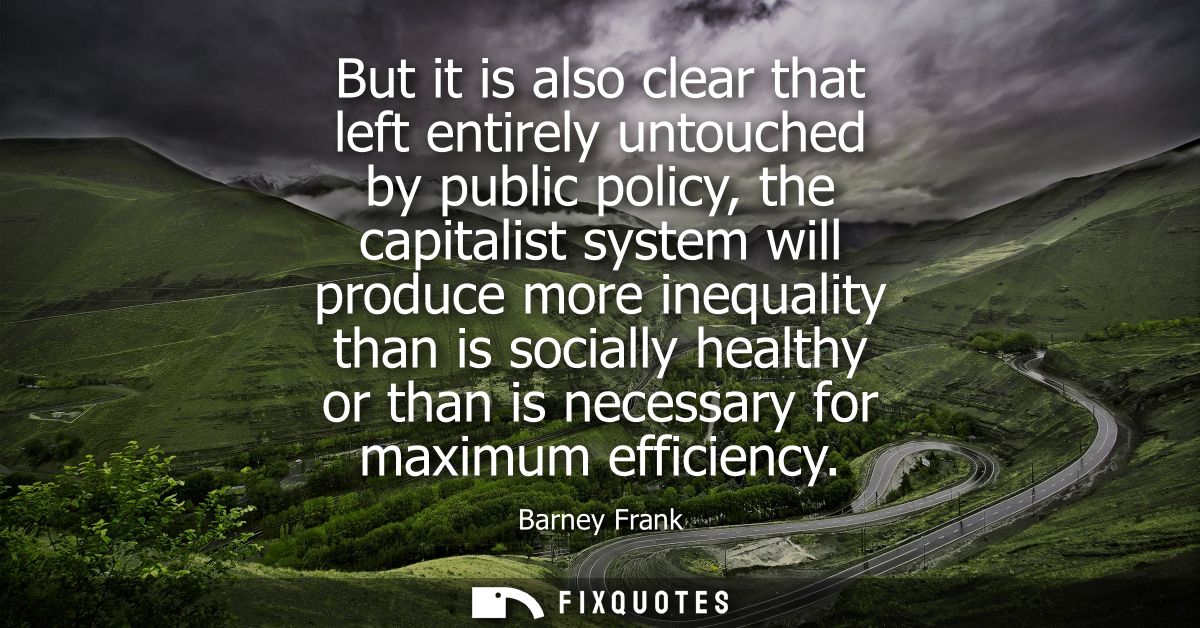
"But it is also clear that left entirely untouched by public policy, the capitalist system will produce more inequality than is socially healthy or than is necessary for maximum efficiency"
About this Quote
The subtext is a two-front attack. First, he frames inequality not as an abstract moral scandal but as something “socially healthy” societies can’t metabolize indefinitely. That’s a warning about cohesion: crime, resentment, gated prosperity, democratic rot. Second, he refuses to let market fundamentalists keep the efficiency card to themselves. By adding “or than is necessary for maximum efficiency,” he implies inequality isn’t just unfair; it’s economically sloppy. Concentrated wealth can mean underinvestment in human capital, weaker demand, and rent-seeking that rewards leverage over productivity.
Context matters: Frank’s career arc runs through the late-20th-century triumphalism of deregulation and the subsequent hangover, especially the financial crisis era when “the market” stopped sounding like an invisible hand and started sounding like an unaccountable one. His intent is to make intervention feel less like redistribution and more like maintenance: public policy as a stabilizer, not an intruder.
Rhetorically, the line works because it’s framed as obvious (“it is also clear”), inviting the listener to treat the premise as settled reality. It’s a politician’s move with a technocrat’s edge: a moral argument smuggled inside an efficiency argument.
Quote Details
| Topic | Equality |
|---|---|
| Source | Help us find the source |
| Cite |
Citation Formats
APA Style (7th ed.)
Frank, Barney. (2026, January 15). But it is also clear that left entirely untouched by public policy, the capitalist system will produce more inequality than is socially healthy or than is necessary for maximum efficiency. FixQuotes. https://fixquotes.com/quotes/but-it-is-also-clear-that-left-entirely-untouched-45906/
Chicago Style
Frank, Barney. "But it is also clear that left entirely untouched by public policy, the capitalist system will produce more inequality than is socially healthy or than is necessary for maximum efficiency." FixQuotes. January 15, 2026. https://fixquotes.com/quotes/but-it-is-also-clear-that-left-entirely-untouched-45906/.
MLA Style (9th ed.)
"But it is also clear that left entirely untouched by public policy, the capitalist system will produce more inequality than is socially healthy or than is necessary for maximum efficiency." FixQuotes, 15 Jan. 2026, https://fixquotes.com/quotes/but-it-is-also-clear-that-left-entirely-untouched-45906/. Accessed 12 Feb. 2026.