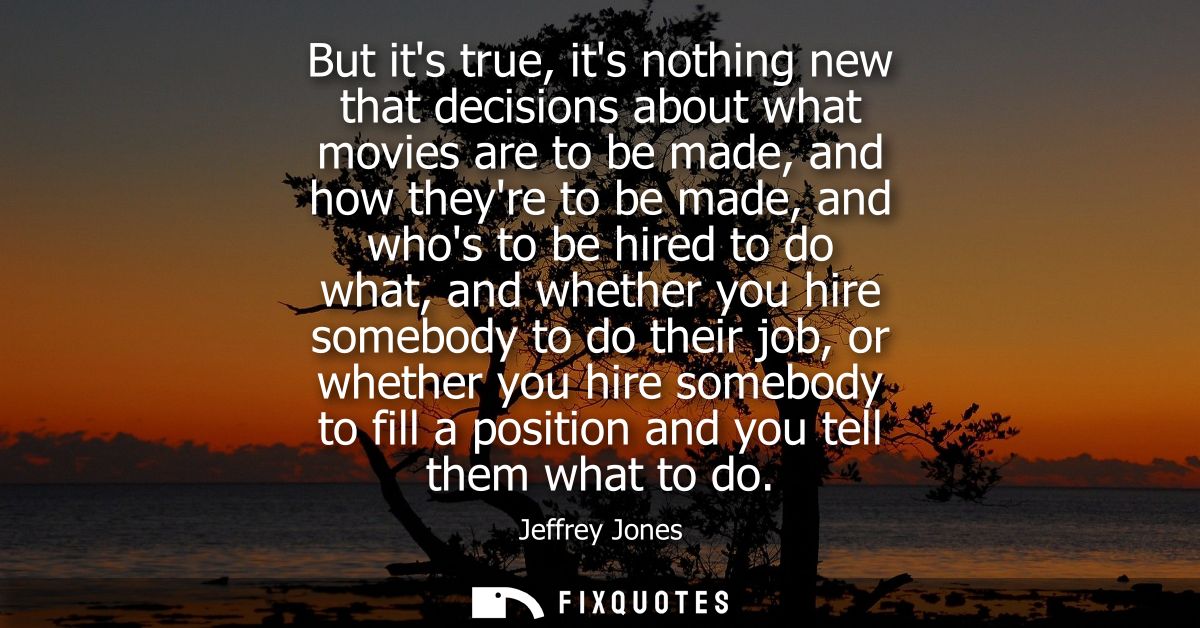
"But it's true, it's nothing new that decisions about what movies are to be made, and how they're to be made, and who's to be hired to do what, and whether you hire somebody to do their job, or whether you hire somebody to fill a position and you tell them what to do"
About this Quote
You can hear the weary backstage exhale in Jeffrey Jones's run-on: the sentence is structured like a production meeting that won’t end. Clauses stack, double back, and keep adding “and” the way Hollywood adds notes, committees, and gatekeepers. The form is the point. He’s not delivering a neat thesis; he’s recreating the feeling of creative decisions being sanded down into logistics.
Jones’s intent is almost disarmingly modest: “it’s nothing new.” That shrug is a defense mechanism and an indictment. He’s acknowledging an open secret in the film business: the most consequential “creative” choices are often managerial ones. What gets greenlit, who gets hired, whether a person is valued for craft or merely slotted into a role and managed like interchangeable labor. That last pivot - hiring someone “to do their job” versus hiring them “to fill a position and you tell them what to do” - is the real sting. It’s a distinction between authorship and obedience, between collaboration and compliance.
The subtext is about power, not taste. Hollywood loves the mythology of inspired artists shepherding visions, but Jones is describing a factory that occasionally produces art. His language flattens the romance: movies are “made,” people are “hired,” tasks are “filled.” In that framing, actors aren’t muses; they’re variables in a system designed to minimize risk. The cynicism lands because it’s banal. He’s not exposing a scandal; he’s naming the everyday mechanism that quietly decides what stories we’re allowed to see and who gets to tell them.
Jones’s intent is almost disarmingly modest: “it’s nothing new.” That shrug is a defense mechanism and an indictment. He’s acknowledging an open secret in the film business: the most consequential “creative” choices are often managerial ones. What gets greenlit, who gets hired, whether a person is valued for craft or merely slotted into a role and managed like interchangeable labor. That last pivot - hiring someone “to do their job” versus hiring them “to fill a position and you tell them what to do” - is the real sting. It’s a distinction between authorship and obedience, between collaboration and compliance.
The subtext is about power, not taste. Hollywood loves the mythology of inspired artists shepherding visions, but Jones is describing a factory that occasionally produces art. His language flattens the romance: movies are “made,” people are “hired,” tasks are “filled.” In that framing, actors aren’t muses; they’re variables in a system designed to minimize risk. The cynicism lands because it’s banal. He’s not exposing a scandal; he’s naming the everyday mechanism that quietly decides what stories we’re allowed to see and who gets to tell them.
Quote Details
| Topic | Decision-Making |
|---|
More Quotes by Jeffrey
Add to List