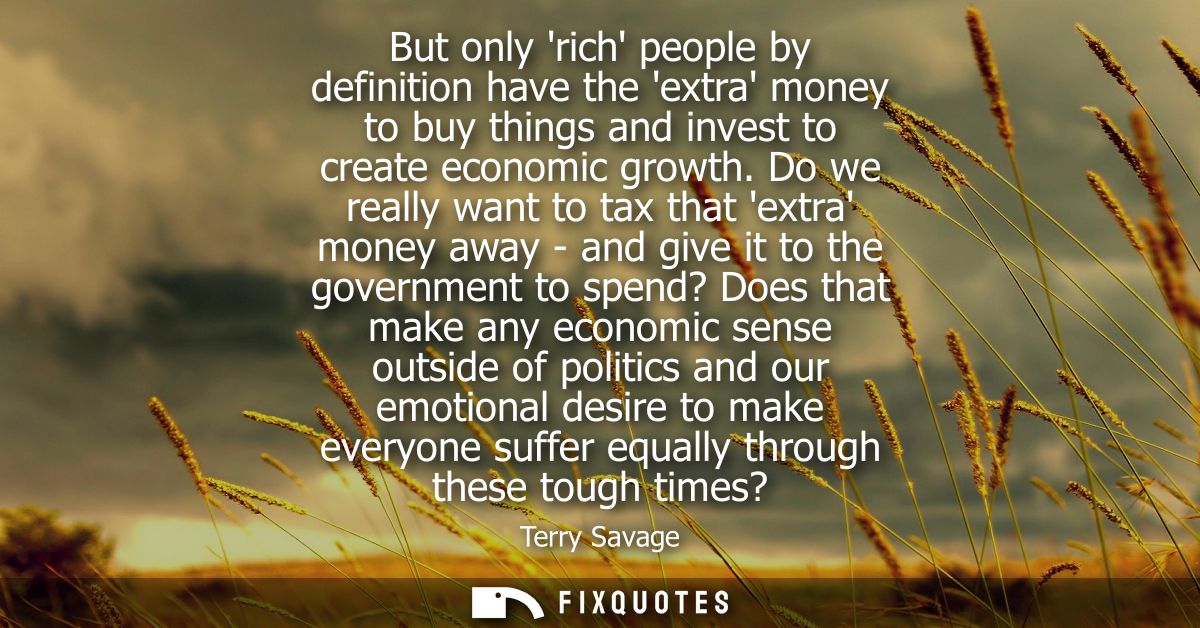
"But only 'rich' people by definition have the 'extra' money to buy things and invest to create economic growth. Do we really want to tax that 'extra' money away - and give it to the government to spend? Does that make any economic sense outside of politics and our emotional desire to make everyone suffer equally through these tough times?"
About this Quote
The rhetorical questions are calibrated to close the argument rather than open it. "Do we really want..". presumes a shared, sensible "we" that already knows the answer. Government is cast as a spendthrift middleman, not a buyer of public goods, and that omission is the point: if you never mention infrastructure, research, health, education, or demand-stabilizing programs, "give it to the government to spend" sounds like pure waste.
Then comes the emotional trap: opposition is reduced to "politics" and a mean-spirited urge to "make everyone suffer equally". That’s not just a critique of redistribution; it’s a preemptive character judgment. The subtext is a recession-era anxiety (or any "tough times") where calls to "share the burden" can feel like punishment. Savage’s intent is to reframe tax policy as envy dressed up as compassion, and to make defending wealth retention sound like defending recovery itself.
Quote Details
| Topic | Wealth |
|---|---|
| Source | Help us find the source |
| Cite |
Citation Formats
APA Style (7th ed.)
Savage, Terry. (2026, January 16). But only 'rich' people by definition have the 'extra' money to buy things and invest to create economic growth. Do we really want to tax that 'extra' money away - and give it to the government to spend? Does that make any economic sense outside of politics and our emotional desire to make everyone suffer equally through these tough times? FixQuotes. https://fixquotes.com/quotes/but-only-rich-people-by-definition-have-the-extra-116161/
Chicago Style
Savage, Terry. "But only 'rich' people by definition have the 'extra' money to buy things and invest to create economic growth. Do we really want to tax that 'extra' money away - and give it to the government to spend? Does that make any economic sense outside of politics and our emotional desire to make everyone suffer equally through these tough times?" FixQuotes. January 16, 2026. https://fixquotes.com/quotes/but-only-rich-people-by-definition-have-the-extra-116161/.
MLA Style (9th ed.)
"But only 'rich' people by definition have the 'extra' money to buy things and invest to create economic growth. Do we really want to tax that 'extra' money away - and give it to the government to spend? Does that make any economic sense outside of politics and our emotional desire to make everyone suffer equally through these tough times?" FixQuotes, 16 Jan. 2026, https://fixquotes.com/quotes/but-only-rich-people-by-definition-have-the-extra-116161/. Accessed 4 Apr. 2026.