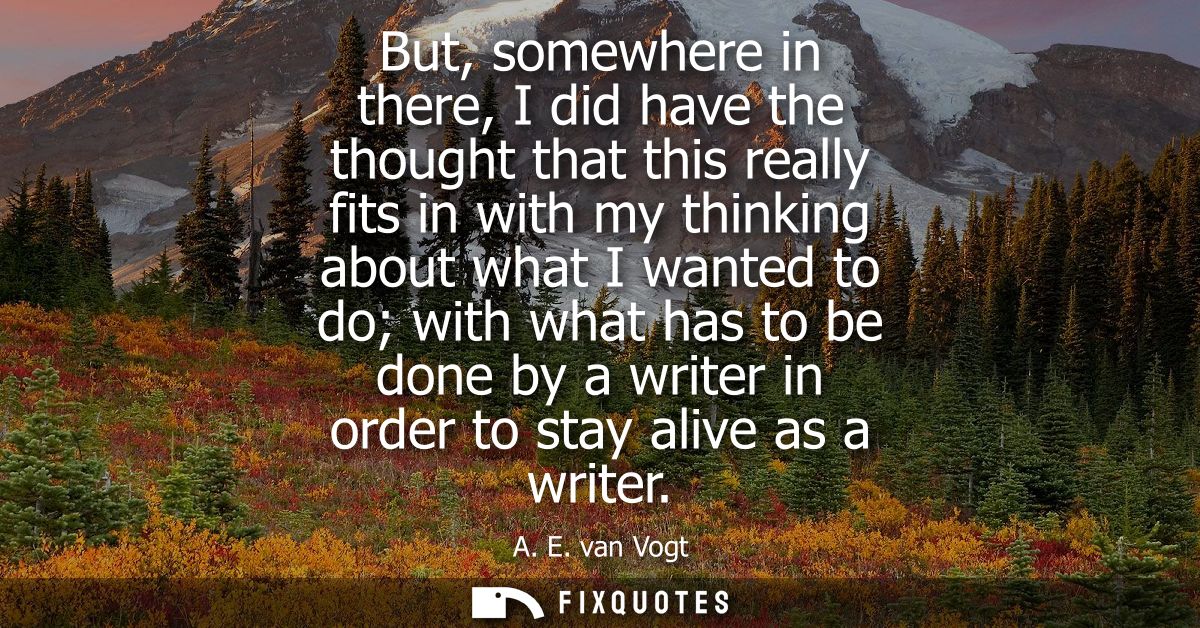
"But, somewhere in there, I did have the thought that this really fits in with my thinking about what I wanted to do; with what has to be done by a writer in order to stay alive as a writer"
About this Quote
The line pivots on a quiet but brutal premise: staying "alive as a writer" isn’t about inspiration, it’s about continuity. Van Vogt isn’t talking about literal life; he’s naming the more common death in creative careers - the slow disappearance that happens when you lose the inner logic of your work, or when the industry trains you to write away from your own obsessions. "What I wanted to do" sits beside "what has to be done" like two competing authorities: desire versus discipline, personal vision versus the craft-and-commerce demands that keep you publishable.
Subtextually, he’s defending a kind of adaptive pragmatism. The writer survives by aligning ambition with necessity, turning external constraints into a framework that still feels internally true. It’s less romantic than the myth of the solitary genius, more useful: a portrait of artistry as maintenance, not fireworks.
Quote Details
| Topic | Writing |
|---|---|
| Source | Help us find the source |
| Cite |
Citation Formats
APA Style (7th ed.)
Vogt, A. E. van. (2026, January 17). But, somewhere in there, I did have the thought that this really fits in with my thinking about what I wanted to do; with what has to be done by a writer in order to stay alive as a writer. FixQuotes. https://fixquotes.com/quotes/but-somewhere-in-there-i-did-have-the-thought-43314/
Chicago Style
Vogt, A. E. van. "But, somewhere in there, I did have the thought that this really fits in with my thinking about what I wanted to do; with what has to be done by a writer in order to stay alive as a writer." FixQuotes. January 17, 2026. https://fixquotes.com/quotes/but-somewhere-in-there-i-did-have-the-thought-43314/.
MLA Style (9th ed.)
"But, somewhere in there, I did have the thought that this really fits in with my thinking about what I wanted to do; with what has to be done by a writer in order to stay alive as a writer." FixQuotes, 17 Jan. 2026, https://fixquotes.com/quotes/but-somewhere-in-there-i-did-have-the-thought-43314/. Accessed 29 Mar. 2026.