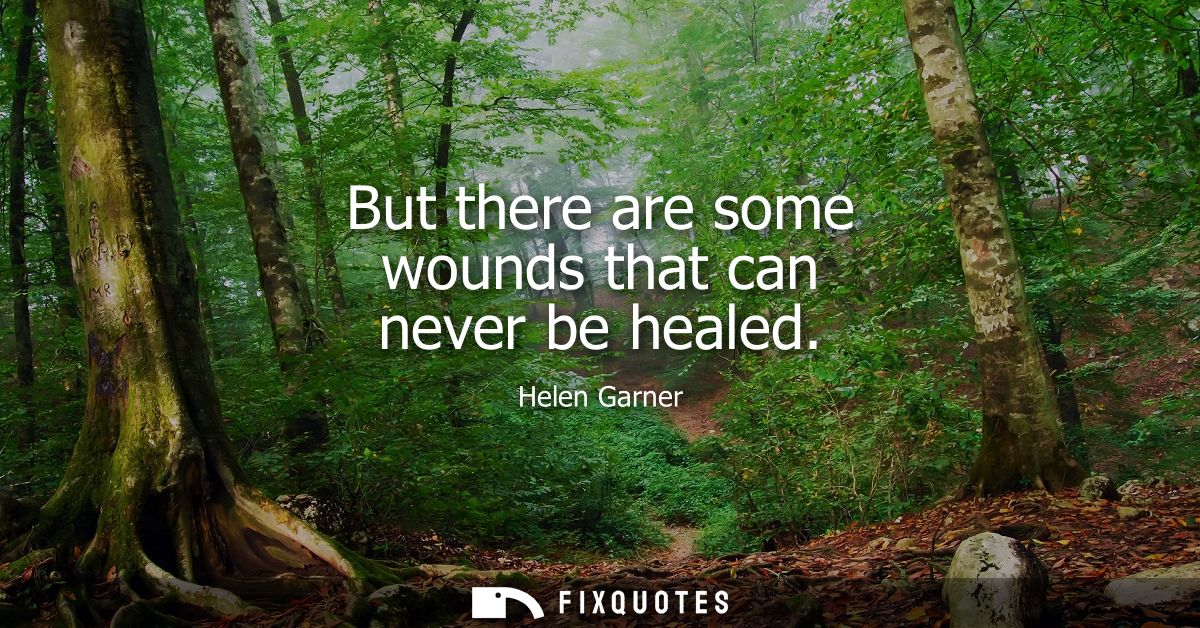
"But there are some wounds that can never be healed"
About this Quote
Some lines land like a diagnosis, not a metaphor. Garner's "But there are some wounds that can never be healed" refuses the modern compulsion to wrap pain in a redemption arc. The sentence is plain, almost domestic in its diction, yet the absolutism of "never" and the bodily bluntness of "wounds" slam the door on the comforting vocabulary of "closure". Garner isn't interested in trauma as a plot device. She's interested in what damage does to the architecture of a life: how people keep functioning while something inside them stays un-fixed.
The word "But" matters. It's a pivot away from whatever hopeful, rational, or therapeutic story precedes it. Garner often writes at the edge where empathy meets moral messiness, and that conjunction signals her signature move: letting sentiment run until it hits the hard fact it can't dissolve. The line carries a quiet rebuke to institutional language - courts, counseling, media narratives - that implies every injury has a corresponding remedy if you just find the right process. "Some" is the knife twist: not all wounds are incurable, which makes the incurable ones more eerie, more unjust. It introduces an uneven moral universe where recovery is partly luck.
Contextually, it sits comfortably in Garner's broader project: exposing the costs of violence, betrayal, and public scandal without turning sufferers into symbols. The subtext is not despair so much as realism with ethical teeth. If certain harms don't heal, then society's obligations don't expire when the news cycle does.
The word "But" matters. It's a pivot away from whatever hopeful, rational, or therapeutic story precedes it. Garner often writes at the edge where empathy meets moral messiness, and that conjunction signals her signature move: letting sentiment run until it hits the hard fact it can't dissolve. The line carries a quiet rebuke to institutional language - courts, counseling, media narratives - that implies every injury has a corresponding remedy if you just find the right process. "Some" is the knife twist: not all wounds are incurable, which makes the incurable ones more eerie, more unjust. It introduces an uneven moral universe where recovery is partly luck.
Contextually, it sits comfortably in Garner's broader project: exposing the costs of violence, betrayal, and public scandal without turning sufferers into symbols. The subtext is not despair so much as realism with ethical teeth. If certain harms don't heal, then society's obligations don't expire when the news cycle does.
Quote Details
| Topic | Sadness |
|---|---|
| Source | Help us find the source |
| Cite |
Citation Formats
APA Style (7th ed.)
Garner, Helen. (2026, January 17). But there are some wounds that can never be healed. FixQuotes. https://fixquotes.com/quotes/but-there-are-some-wounds-that-can-never-be-healed-48045/
Chicago Style
Garner, Helen. "But there are some wounds that can never be healed." FixQuotes. January 17, 2026. https://fixquotes.com/quotes/but-there-are-some-wounds-that-can-never-be-healed-48045/.
MLA Style (9th ed.)
"But there are some wounds that can never be healed." FixQuotes, 17 Jan. 2026, https://fixquotes.com/quotes/but-there-are-some-wounds-that-can-never-be-healed-48045/. Accessed 6 Mar. 2026.
More Quotes by Helen
Add to List