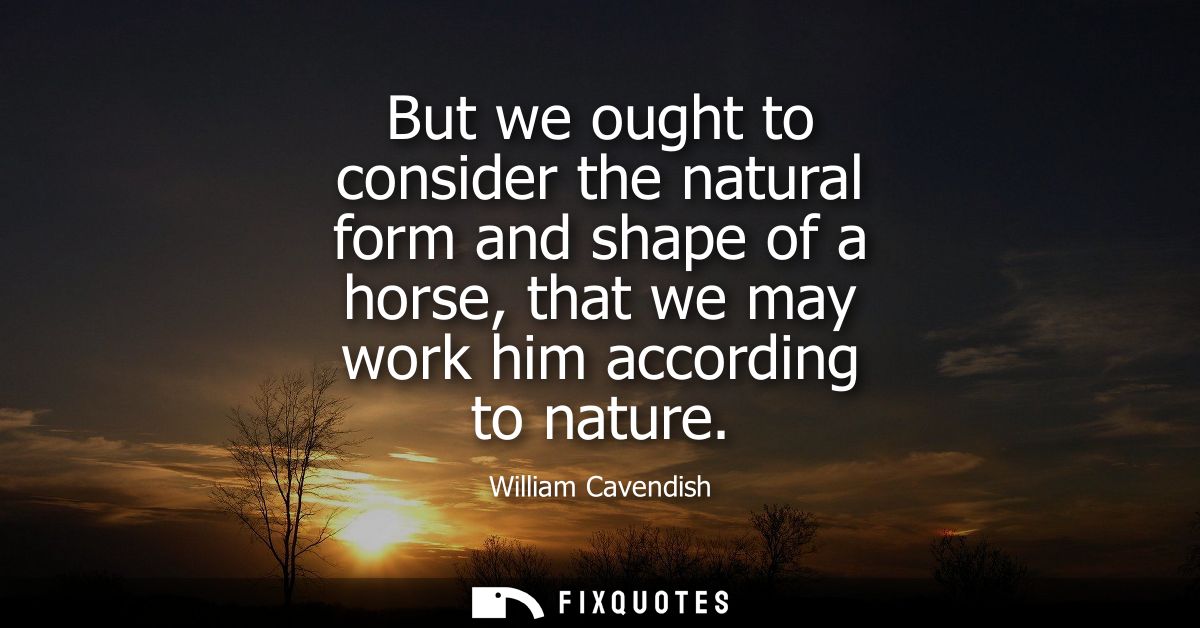
"But we ought to consider the natural form and shape of a horse, that we may work him according to nature"
About this Quote
Cavendish’s line reads like stable advice, but it’s really a manifesto for a certain kind of power: control that flatters itself as wisdom. “Natural form and shape” sounds humane, even modern - work with the animal, not against it. Yet the kicker is the purpose clause: “that we may work him.” Nature isn’t being honored for its own sake; it’s being studied so it can be exploited more efficiently, with fewer visible ruptures. The rhetoric is soft-handed dominion.
Context matters. William Cavendish, a courtly public servant and aristocrat writing in an era when horsemanship was military technology and status theater, isn’t talking about a hobby. The horse is a living engine of war, transport, and prestige. To “work him according to nature” is to produce obedience that looks effortless, the hallmark of elite competence. It’s the same aesthetic that governed good governance: rule should feel like order, not force.
The subtext is a broader early modern confidence that systems - bodies, animals, households, states - have discoverable “forms” and “shapes.” Learn the template, then you can shape outcomes while claiming you merely followed the grain of reality. Cavendish smuggles coercion under a veneer of stewardship: the best master is the one whose mastery is least detectable. That’s why the sentence still lands. It captures a timeless managerial impulse: respect the organism, map its limits, then turn that knowledge into leverage.
Context matters. William Cavendish, a courtly public servant and aristocrat writing in an era when horsemanship was military technology and status theater, isn’t talking about a hobby. The horse is a living engine of war, transport, and prestige. To “work him according to nature” is to produce obedience that looks effortless, the hallmark of elite competence. It’s the same aesthetic that governed good governance: rule should feel like order, not force.
The subtext is a broader early modern confidence that systems - bodies, animals, households, states - have discoverable “forms” and “shapes.” Learn the template, then you can shape outcomes while claiming you merely followed the grain of reality. Cavendish smuggles coercion under a veneer of stewardship: the best master is the one whose mastery is least detectable. That’s why the sentence still lands. It captures a timeless managerial impulse: respect the organism, map its limits, then turn that knowledge into leverage.
Quote Details
| Topic | Horse |
|---|
More Quotes by William
Add to List