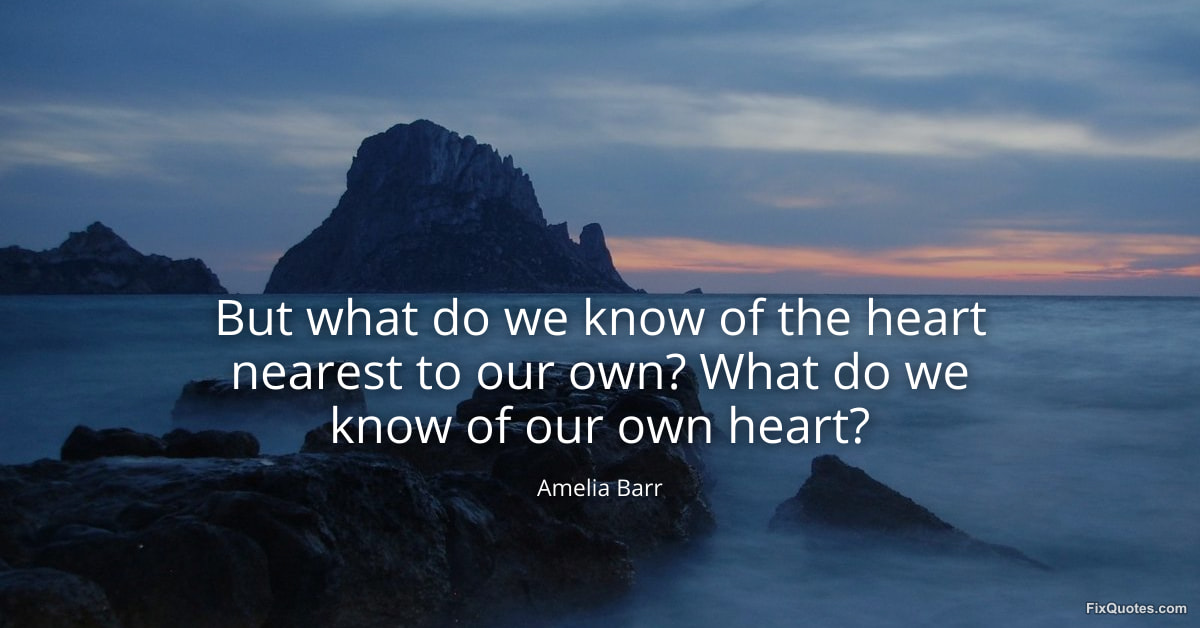
"But what do we know of the heart nearest to our own? What do we know of our own heart?"
About this Quote
The second question is the real trapdoor. It shrinks the target from the unknowable other to the supposedly knowable self, and in doing so it exposes how much of everyday morality is built on a flattering premise: that we can reliably read our motives, predict our reactions, and claim clean intentions. Barr’s phrasing makes that premise wobble. The repetition of “What do we know…” isn’t rhetorical fluff; it mimics the mind circling an uncomfortable fact, returning to it because it can’t be resolved.
In context, Barr wrote in a 19th-century literary culture that prized the interior life but also policed it, especially for women. Her novels often track the gap between public virtue and private feeling, between duty and desire. These two sentences condense that whole project. They argue, quietly but insistently, that the self is not a stable narrator and the household is not a courtroom where truth is easily established. The intent isn’t despair; it’s a demand for humility: before we judge, before we claim to understand, remember how dim the lighting is inside any human being.
Quote Details
| Topic | Deep |
|---|---|
| Source | Help us find the source |
| Cite |
Citation Formats
APA Style (7th ed.)
Barr, Amelia. (2026, January 17). But what do we know of the heart nearest to our own? What do we know of our own heart? FixQuotes. https://fixquotes.com/quotes/but-what-do-we-know-of-the-heart-nearest-to-our-75395/
Chicago Style
Barr, Amelia. "But what do we know of the heart nearest to our own? What do we know of our own heart?" FixQuotes. January 17, 2026. https://fixquotes.com/quotes/but-what-do-we-know-of-the-heart-nearest-to-our-75395/.
MLA Style (9th ed.)
"But what do we know of the heart nearest to our own? What do we know of our own heart?" FixQuotes, 17 Jan. 2026, https://fixquotes.com/quotes/but-what-do-we-know-of-the-heart-nearest-to-our-75395/. Accessed 12 Feb. 2026.