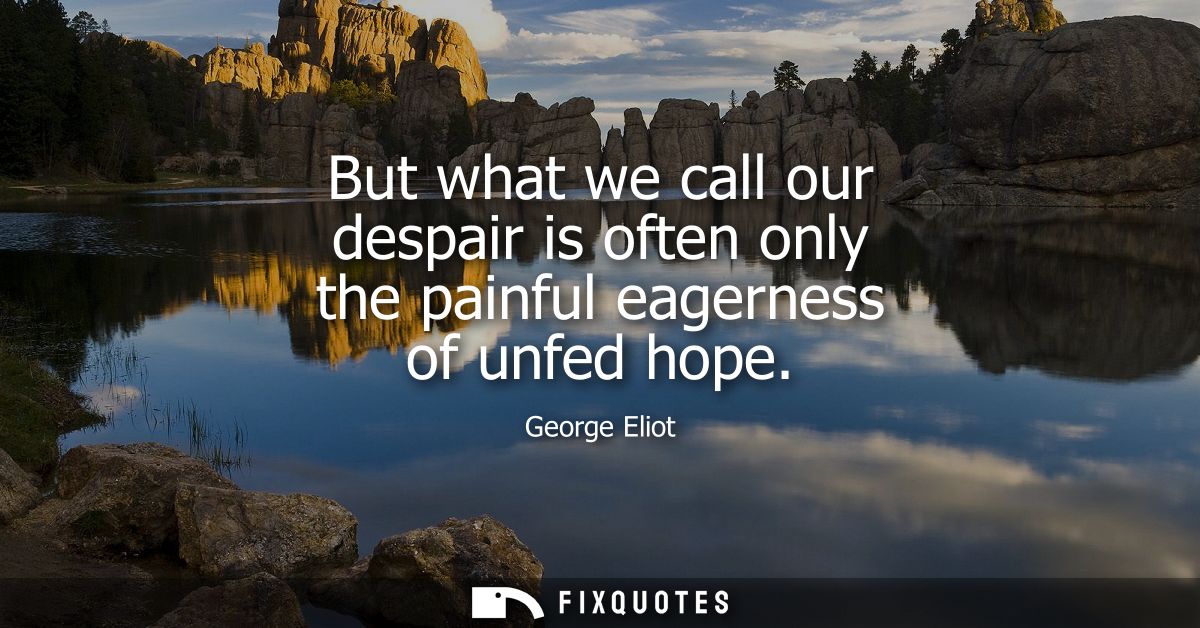
"But what we call our despair is often only the painful eagerness of unfed hope"
About this Quote
Eliot is writing as a realist with a moral imagination, suspicious of melodrama and equally wary of cheap consolation. The sentence performs that double move. It refuses despair the dignity of finality (a subtle rebuke to romantic self-pity), while also refusing to shame the sufferer. "Unfed" matters: hope is not an abstract virtue, it is a need that requires conditions - love returned, work recognized, justice enacted, a future that behaves. When those conditions fail, the psyche doesn’t simply "give up"; it keeps leaning forward, and that forward-leaning becomes agony.
The subtext is quietly political as well as personal. Victorian society was full of prescriptions about stoicism, duty, and knowing one's place; Eliot suggests that what looks like weakness may be the body registering deprivation. Despair becomes diagnostic: it points to the shape of the hope you were promised, the hope you are still trying to live on, and the structures - social, relational, economic - that aren’t feeding it. Eliot’s consolation, if it is one, is bracing: your pain may not mean you’re broken. It may mean you’re still in motion.
Quote Details
| Topic | Hope |
|---|---|
| Source | Help us find the source |
| Cite |
Citation Formats
APA Style (7th ed.)
Eliot, George. (2026, January 17). But what we call our despair is often only the painful eagerness of unfed hope. FixQuotes. https://fixquotes.com/quotes/but-what-we-call-our-despair-is-often-only-the-25808/
Chicago Style
Eliot, George. "But what we call our despair is often only the painful eagerness of unfed hope." FixQuotes. January 17, 2026. https://fixquotes.com/quotes/but-what-we-call-our-despair-is-often-only-the-25808/.
MLA Style (9th ed.)
"But what we call our despair is often only the painful eagerness of unfed hope." FixQuotes, 17 Jan. 2026, https://fixquotes.com/quotes/but-what-we-call-our-despair-is-often-only-the-25808/. Accessed 14 Mar. 2026.