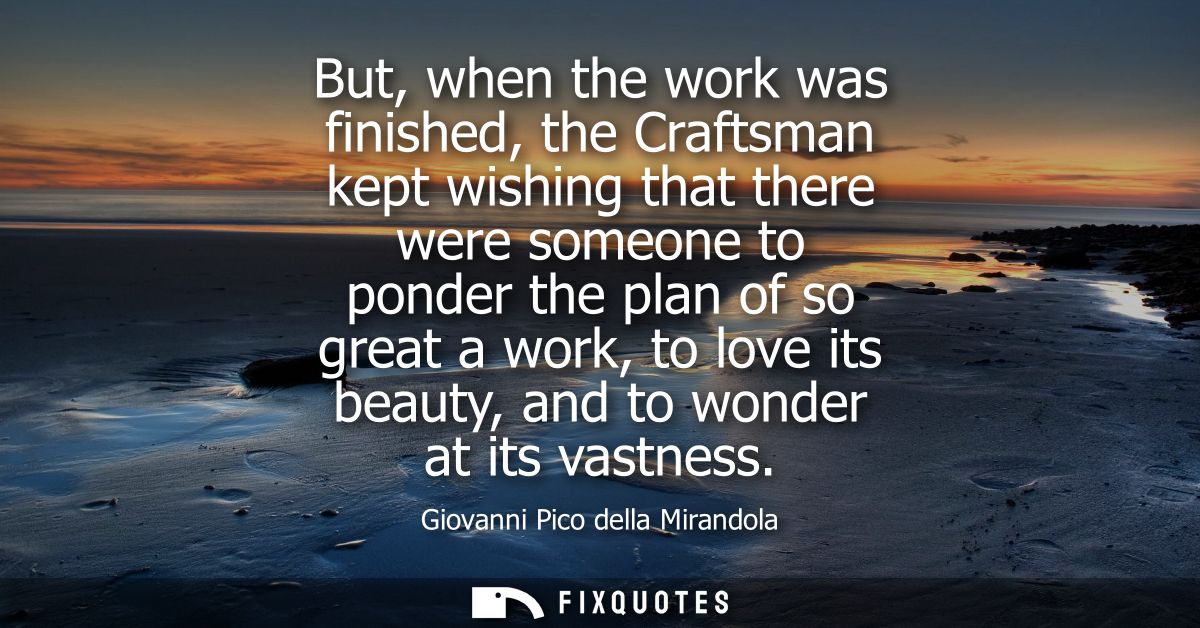
"But, when the work was finished, the Craftsman kept wishing that there were someone to ponder the plan of so great a work, to love its beauty, and to wonder at its vastness"
About this Quote
Loneliness is smuggled into this line under the guise of triumph. Pico gives us a Craftsman who has done everything right: the plan is grand, the work is complete, the scale is “vast.” And yet completion produces not satisfaction but an ache for an audience. The verb “kept wishing” is the tell; this isn’t a passing vanity, it’s a structural need. Creation, in Pico’s telling, isn’t finished when the last stone is set. It’s finished when someone can contemplate it, love it, and be stunned by it.
That triad matters. “Ponder the plan” flatters the intellect, “love its beauty” flatters the senses, “wonder at its vastness” flatters the human capacity for awe. Pico is writing at the dawn of the Renaissance humanist project, where the dignity of the human mind becomes the mirror in which the universe recognizes itself. Subtext: the cosmos is not just a machine; it is a stage built for interpretation. The “Craftsman” reads as God by another name, but God here is less a stern lawgiver than an artist with a terrifying problem: a masterpiece without viewers is a kind of mute excess.
Context sharpens the intent. Pico’s world is saturated with theological debates about why humanity exists at all. This sentence answers with a humanist twist: humans are not accidental tenants of creation but the necessary readers of it, the consciousness that turns “work” into “meaning.” It’s a cosmic argument for spectatorship as vocation: to look closely, to feel deeply, to be appropriately overwhelmed.
That triad matters. “Ponder the plan” flatters the intellect, “love its beauty” flatters the senses, “wonder at its vastness” flatters the human capacity for awe. Pico is writing at the dawn of the Renaissance humanist project, where the dignity of the human mind becomes the mirror in which the universe recognizes itself. Subtext: the cosmos is not just a machine; it is a stage built for interpretation. The “Craftsman” reads as God by another name, but God here is less a stern lawgiver than an artist with a terrifying problem: a masterpiece without viewers is a kind of mute excess.
Context sharpens the intent. Pico’s world is saturated with theological debates about why humanity exists at all. This sentence answers with a humanist twist: humans are not accidental tenants of creation but the necessary readers of it, the consciousness that turns “work” into “meaning.” It’s a cosmic argument for spectatorship as vocation: to look closely, to feel deeply, to be appropriately overwhelmed.
Quote Details
| Topic | Art |
|---|
More Quotes by Giovanni
Add to List