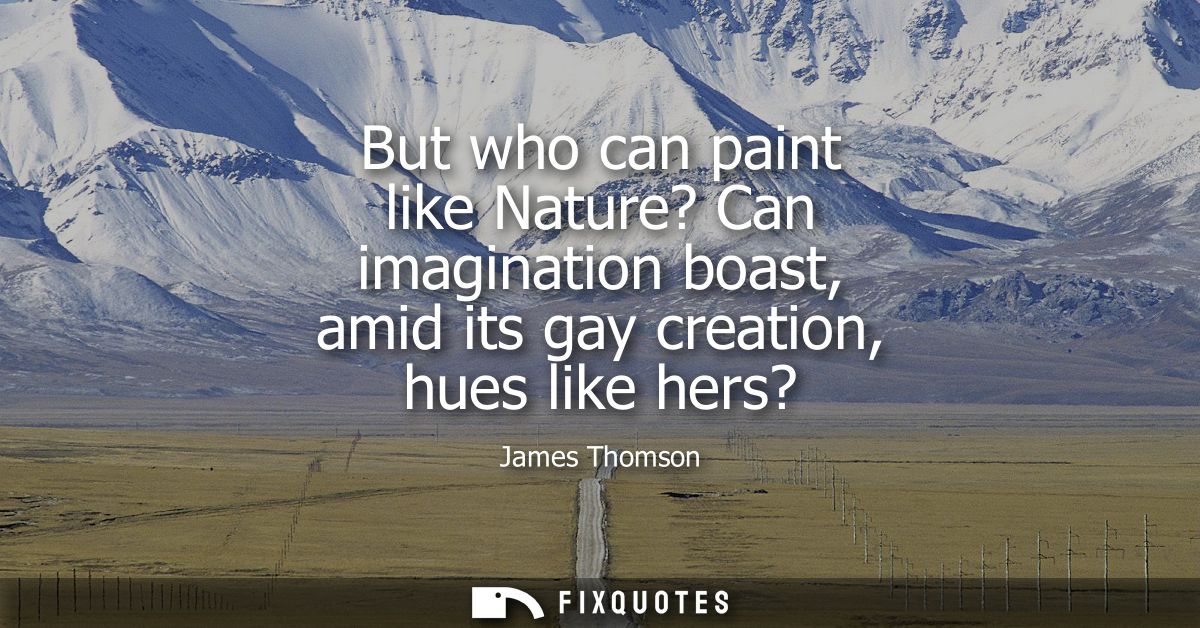
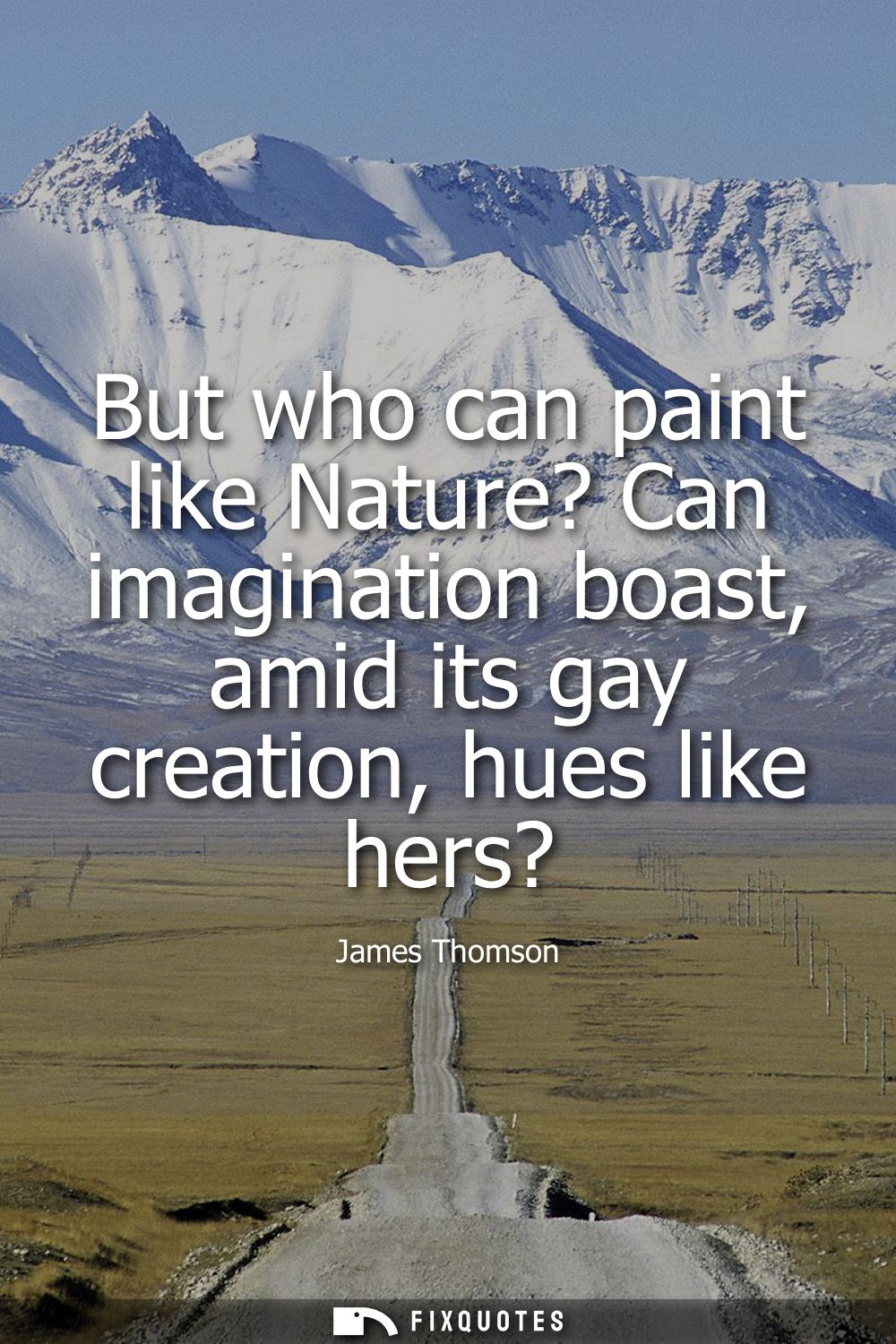
"But who can paint like Nature? Can imagination boast, amid its gay creation, hues like hers?"
About this Quote
The phrasing turns Nature into an artist with proprietary “hues,” a palette that can’t be counterfeit. That’s not just praise; it’s a subtle demotion of human-making. Imagination is allowed its inventions, but they’re painted as loud rather than deep, decorative rather than true. In the 18th-century context, this sits neatly inside the era’s growing worship of the natural world and the early drift toward Romantic sensibility: the belief that authenticity and moral force live outside salons and studios, in the field, the storm, the seasons.
There’s also a quiet insecurity in the compliment. When you insist Nature can’t be matched, you’re admitting that art is always at risk of feeling like an imitation of the real thing. Thomson doesn’t solve that tension; he stylizes it. The irony is that he uses crafted language - the very “imagination” he pretends to humble - to make Nature’s supremacy vivid enough to feel like a lived experience, not a lecture.
Quote Details
| Topic | Nature |
|---|---|
| Source | Help us find the source |
| Cite |
Citation Formats
APA Style (7th ed.)
Thomson, James. (2026, January 17). But who can paint like Nature? Can imagination boast, amid its gay creation, hues like hers? FixQuotes. https://fixquotes.com/quotes/but-who-can-paint-like-nature-can-imagination-46797/
Chicago Style
Thomson, James. "But who can paint like Nature? Can imagination boast, amid its gay creation, hues like hers?" FixQuotes. January 17, 2026. https://fixquotes.com/quotes/but-who-can-paint-like-nature-can-imagination-46797/.
MLA Style (9th ed.)
"But who can paint like Nature? Can imagination boast, amid its gay creation, hues like hers?" FixQuotes, 17 Jan. 2026, https://fixquotes.com/quotes/but-who-can-paint-like-nature-can-imagination-46797/. Accessed 5 Apr. 2026.