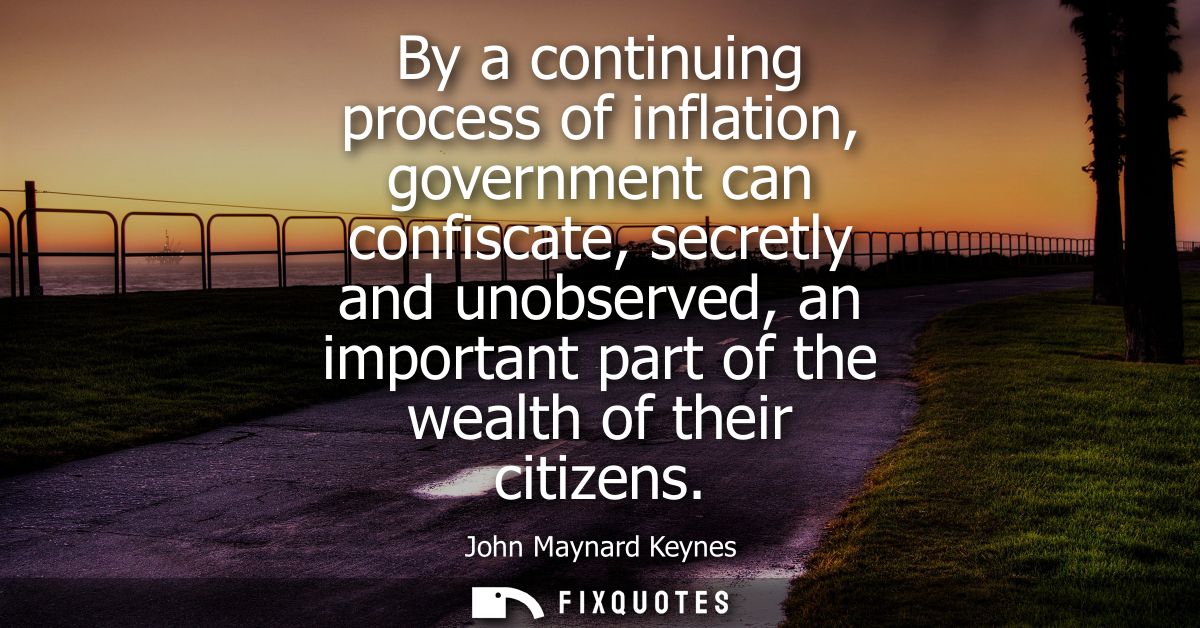
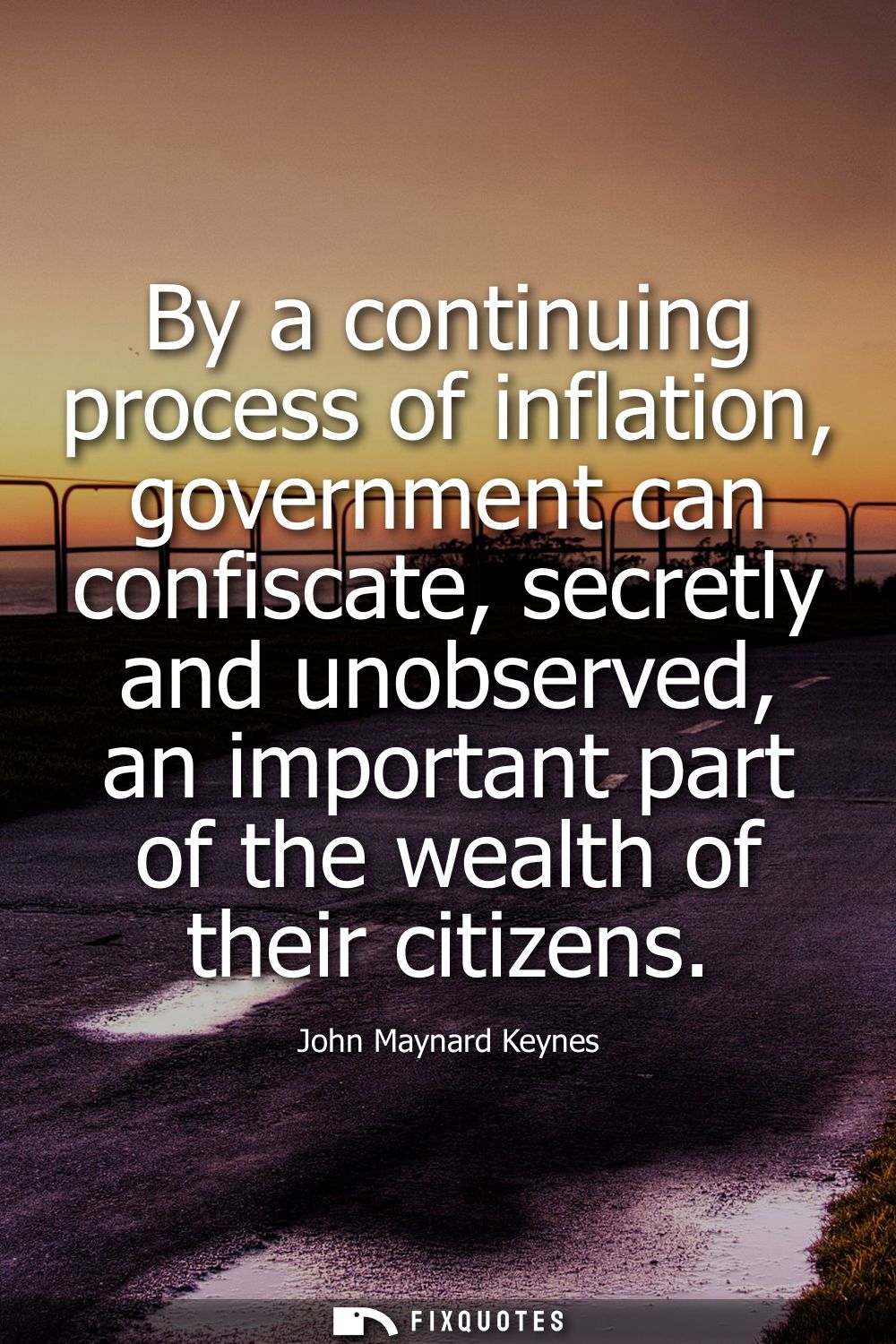
"By a continuing process of inflation, government can confiscate, secretly and unobserved, an important part of the wealth of their citizens"
About this Quote
“Continuing process” matters. He’s not talking about a one-off price spike caused by war or supply shocks; he’s describing a policy environment where currency loses value steadily enough that people normalize it. That’s where the confiscation becomes “secretly and unobserved.” Tax bills arrive with a signature and a due date. Inflation arrives as smaller portions, higher rents, wages that look bigger but buy less. The state doesn’t have to pass an unpopular levy; it can let the unit of account deteriorate and watch the public argue with their employers, their landlords, and each other.
Keynes is also pointing at distribution. Inflation rarely hits evenly. Debtors win, creditors lose. Asset owners often outrun the erosion; wage earners and savers eat it first. “An important part of the wealth” isn’t melodrama: in a world of fixed incomes and cash savings, modest annual inflation compounds into a quiet transfer from the cautious to the leveraged.
The context is early 20th-century Europe, where wartime finance and postwar instability made currency credibility a live issue. Keynes understood mass politics well enough to know that governments prefer policies that diffuse blame. He’s not romanticizing austerity; he’s diagnosing how modern states can fund themselves without asking permission - and how easily citizens can miss the bill until it’s already been paid.
Quote Details
| Topic | Wealth |
|---|---|
| Source | Verified source: The Economic Consequences of the Peace (John Maynard Keynes, 1919)
Evidence: Lenin is said to have declared that the best way to destroy the Capitalist System was to debauch the currency. By a continuing process of inflation, governments can confiscate, secretly and unobserved, an important part of the wealth of their citizens. (Chapter VI, "Europe after the Treaty" (exact page varies by edition; often cited as pp. 235–236 in some printings)). This line appears in Keynes’s own text (primary source) in Chapter VI (“Europe after the Treaty”). The wording commonly circulated as a standalone quote is an excerpt from a longer paragraph about inflation and currency debasement. Project Gutenberg reproduces a 1920 New York printing (Harcourt, Brace and Howe) but the book’s original publication date is 1919 (preface dated November 1919). Other candidates (1) The Inflation Myth and the Wonderful World of Deflation (Mark Mobius, 2021) compilation97.1% ... John Maynard Keynes , economist : “ By a continuing process of inflation , government can confiscate , secretly a... |
| Cite |
Citation Formats
APA Style (7th ed.)
Keynes, John Maynard. (2026, February 9). By a continuing process of inflation, government can confiscate, secretly and unobserved, an important part of the wealth of their citizens. FixQuotes. https://fixquotes.com/quotes/by-a-continuing-process-of-inflation-government-32142/
Chicago Style
Keynes, John Maynard. "By a continuing process of inflation, government can confiscate, secretly and unobserved, an important part of the wealth of their citizens." FixQuotes. February 9, 2026. https://fixquotes.com/quotes/by-a-continuing-process-of-inflation-government-32142/.
MLA Style (9th ed.)
"By a continuing process of inflation, government can confiscate, secretly and unobserved, an important part of the wealth of their citizens." FixQuotes, 9 Feb. 2026, https://fixquotes.com/quotes/by-a-continuing-process-of-inflation-government-32142/. Accessed 3 Apr. 2026.