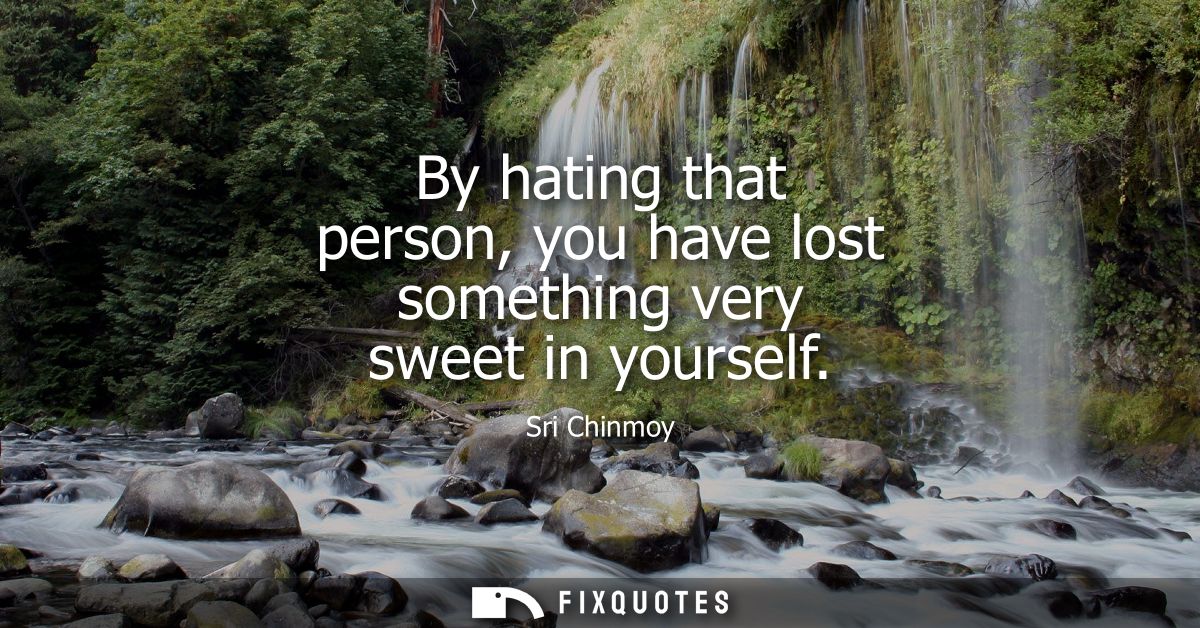
"By hating that person, you have lost something very sweet in yourself"
About this Quote
Hate, in Sri Chinmoy's framing, isn’t a weapon you aim outward; it’s a self-inflicted amputation. The line works because it refuses the usual moral arithmetic where hatred is “earned” by someone else’s behavior. Instead, it shifts the ledger inward: the cost isn’t that you’ve become unjust, it’s that you’ve become less capable of sweetness. That word choice matters. “Sweet” is disarming, almost childlike, a deliberately non-heroic virtue. He’s not talking about spiritual enlightenment in lofty terms; he’s talking about a quality most people recognize as real and fragile: the unforced tenderness that makes you feel like yourself on a good day.
The intent is corrective, almost therapeutic. Chinmoy isn’t scolding the hater for being bad; he’s warning them they’re being robbed, and the thief is their own fixation. The subtext is that hatred binds you to the person you claim to reject. You keep them alive inside you, rent-free, as a recurring story you rehearse. In that rehearsal, you harden. You start treating your inner life like a courtroom, not a garden.
Contextually, Chinmoy’s philosophy sits in a late-20th-century spiritual ecosystem that favored inner transformation over ideological combat: meditation as culture’s counter-program to grievance, speed, and ego. Read that way, the quote is less about excusing harm than about reclaiming agency. You may not control what someone did to you; you do control whether you let it curdle your capacity for softness. The quiet provocation is that sweetness isn’t naïveté. It’s a resource - and hatred spends it fast.
The intent is corrective, almost therapeutic. Chinmoy isn’t scolding the hater for being bad; he’s warning them they’re being robbed, and the thief is their own fixation. The subtext is that hatred binds you to the person you claim to reject. You keep them alive inside you, rent-free, as a recurring story you rehearse. In that rehearsal, you harden. You start treating your inner life like a courtroom, not a garden.
Contextually, Chinmoy’s philosophy sits in a late-20th-century spiritual ecosystem that favored inner transformation over ideological combat: meditation as culture’s counter-program to grievance, speed, and ego. Read that way, the quote is less about excusing harm than about reclaiming agency. You may not control what someone did to you; you do control whether you let it curdle your capacity for softness. The quiet provocation is that sweetness isn’t naïveté. It’s a resource - and hatred spends it fast.
Quote Details
| Topic | Forgiveness |
|---|---|
| Source | Help us find the source |
| Cite |
Citation Formats
APA Style (7th ed.)
Chinmoy, Sri. (2026, January 18). By hating that person, you have lost something very sweet in yourself. FixQuotes. https://fixquotes.com/quotes/by-hating-that-person-you-have-lost-something-7725/
Chicago Style
Chinmoy, Sri. "By hating that person, you have lost something very sweet in yourself." FixQuotes. January 18, 2026. https://fixquotes.com/quotes/by-hating-that-person-you-have-lost-something-7725/.
MLA Style (9th ed.)
"By hating that person, you have lost something very sweet in yourself." FixQuotes, 18 Jan. 2026, https://fixquotes.com/quotes/by-hating-that-person-you-have-lost-something-7725/. Accessed 21 Mar. 2026.
More Quotes by Sri
Add to List