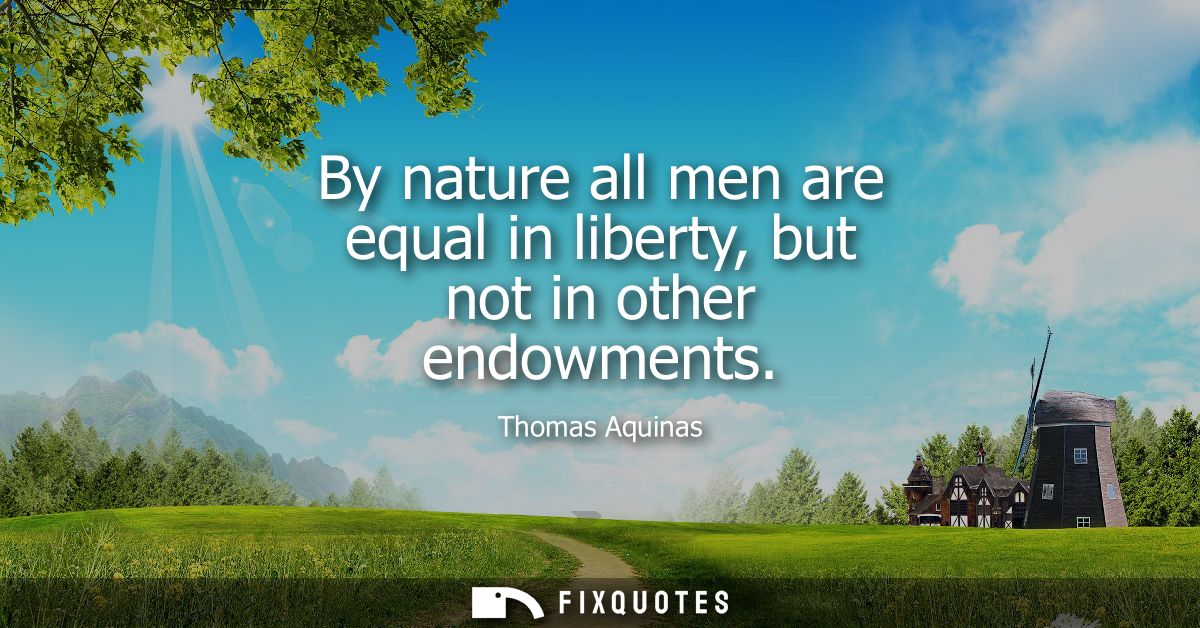
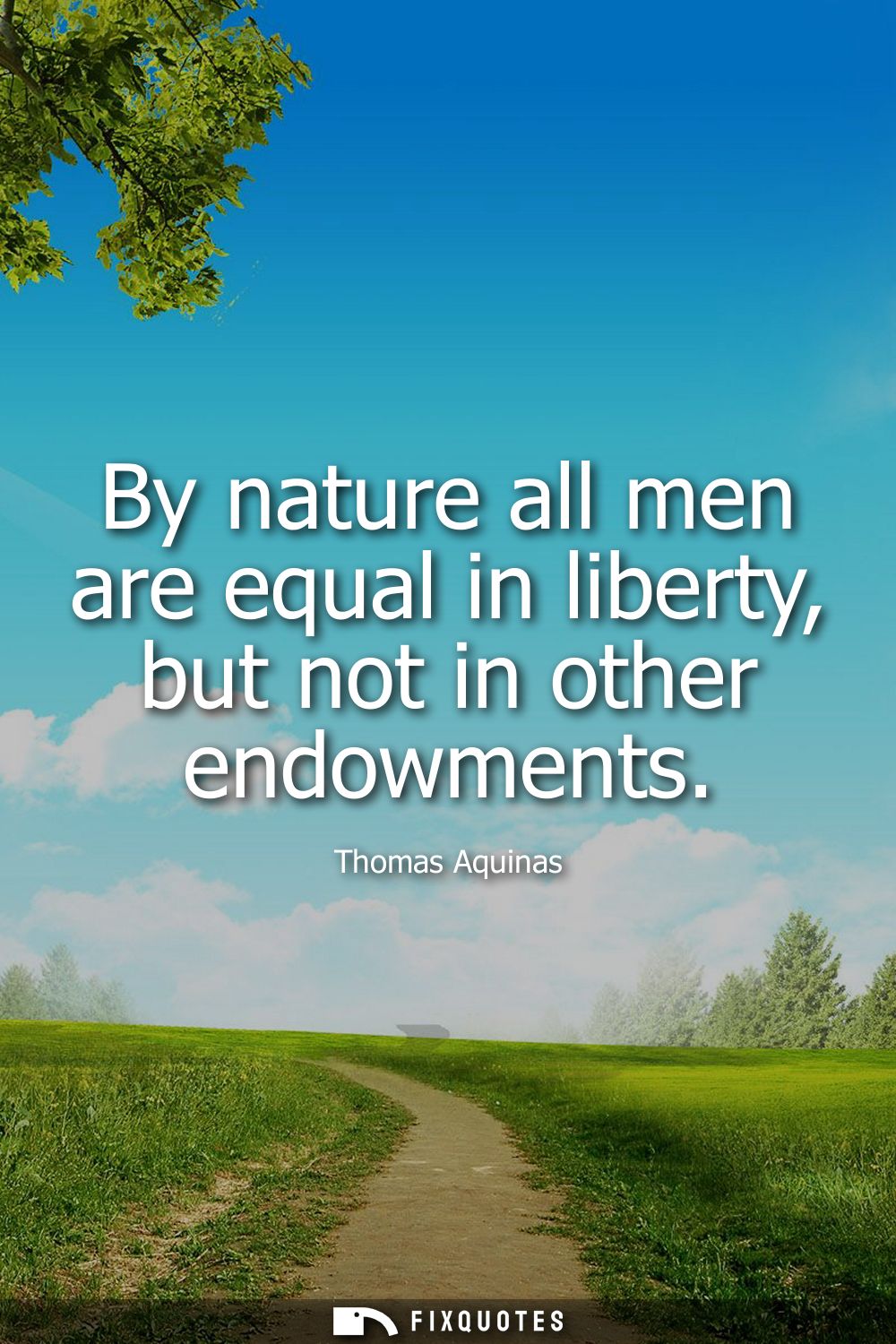
"By nature all men are equal in liberty, but not in other endowments"
About this Quote
Aquinas manages a tightrope act that still haunts political arguments: he affirms a baseline moral equality while leaving ample room for hierarchy. “By nature” is the key move. He’s not talking about the social order people are born into; he’s grounding equality in a shared human essence - rational creatures ordered toward God. That gives him a way to say every person possesses liberty in a fundamental sense: the capacity for choice, moral responsibility, and participation in the good. No one is naturally a slave in the way Aristotle sometimes implied.
Then comes the second clause, and the medieval world snaps back into focus. “But not in other endowments” is Aquinas making peace with obvious differences in strength, intellect, wealth, and vocation - differences his society treated as politically and spiritually meaningful. The subtext is a defense of differentiated roles: some are better suited to rule, teach, fight, or labor. Equality is real, but it’s not the flattening kind.
Context matters: Aquinas is synthesizing Christian doctrine with Greek philosophy under feudal conditions. He’s trying to reconcile the Gospel’s radical moral claims with an inherited social hierarchy without burning the whole structure down. The rhetorical power is in the limited grant. By conceding “liberty” to all, he inoculates the hierarchy against charges of outright injustice; by denying equal “endowments,” he justifies unequal authority as natural, not merely customary.
It’s a sentence built to discipline both extremes: the strong are reminded they don’t own other souls; the weak are warned that moral equality doesn’t automatically translate into equal station.
Then comes the second clause, and the medieval world snaps back into focus. “But not in other endowments” is Aquinas making peace with obvious differences in strength, intellect, wealth, and vocation - differences his society treated as politically and spiritually meaningful. The subtext is a defense of differentiated roles: some are better suited to rule, teach, fight, or labor. Equality is real, but it’s not the flattening kind.
Context matters: Aquinas is synthesizing Christian doctrine with Greek philosophy under feudal conditions. He’s trying to reconcile the Gospel’s radical moral claims with an inherited social hierarchy without burning the whole structure down. The rhetorical power is in the limited grant. By conceding “liberty” to all, he inoculates the hierarchy against charges of outright injustice; by denying equal “endowments,” he justifies unequal authority as natural, not merely customary.
It’s a sentence built to discipline both extremes: the strong are reminded they don’t own other souls; the weak are warned that moral equality doesn’t automatically translate into equal station.
Quote Details
| Topic | Equality |
|---|---|
| Source | Help us find the source |
| Cite |
Citation Formats
APA Style (7th ed.)
Aquinas, Thomas. (2026, January 18). By nature all men are equal in liberty, but not in other endowments. FixQuotes. https://fixquotes.com/quotes/by-nature-all-men-are-equal-in-liberty-but-not-in-2021/
Chicago Style
Aquinas, Thomas. "By nature all men are equal in liberty, but not in other endowments." FixQuotes. January 18, 2026. https://fixquotes.com/quotes/by-nature-all-men-are-equal-in-liberty-but-not-in-2021/.
MLA Style (9th ed.)
"By nature all men are equal in liberty, but not in other endowments." FixQuotes, 18 Jan. 2026, https://fixquotes.com/quotes/by-nature-all-men-are-equal-in-liberty-but-not-in-2021/. Accessed 18 Feb. 2026.
More Quotes by Thomas
Add to List