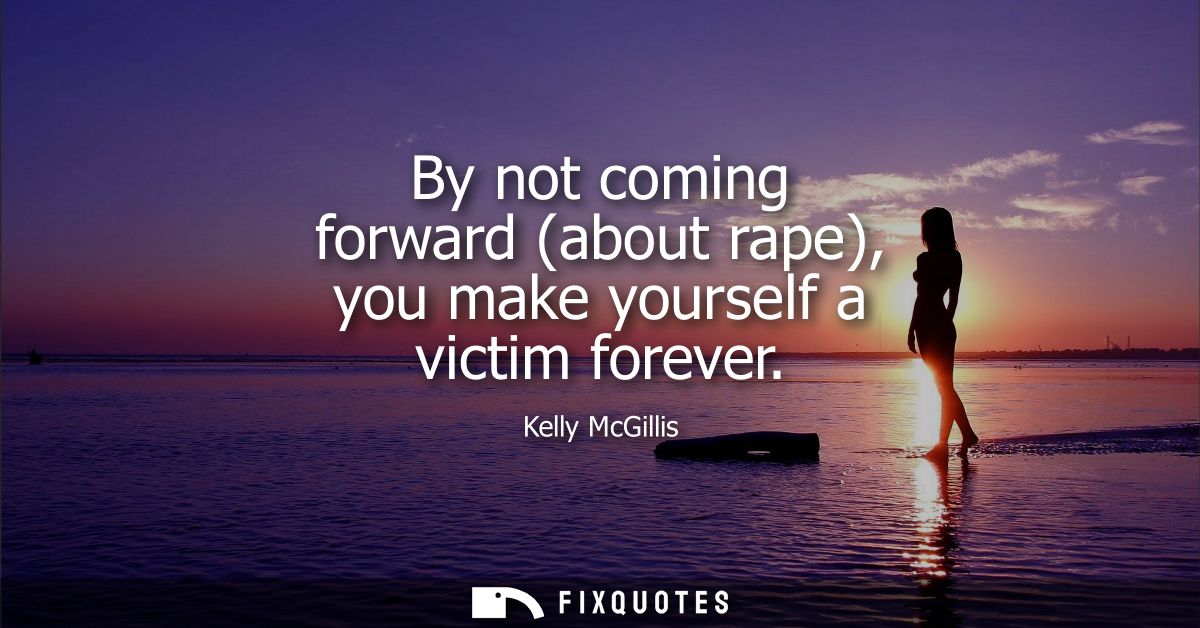
"By not coming forward (about rape), you make yourself a victim forever"
About this Quote
McGillis’s line lands like a shove because it turns “silence” into something active: not just the absence of speech, but a choice that allegedly locks the survivor into a permanent identity. Coming from an actress who has spoken about her own assault, it reads less like a tidy self-help maxim than a battle-scarred provocation aimed at the culture of hush money, disbelief, and career retaliation that has long surrounded rape accusations in Hollywood and beyond.
The intent is bluntly motivational: reclaim agency by telling the story. “Coming forward” is framed as the hinge between being acted upon and acting. The subtext, though, is complicated. The quote implies a kind of moral calculus in which disclosure equals liberation, and nondisclosure equals self-imposed captivity. That’s emotionally understandable from someone who experienced the cost of silence, but it also risks collapsing a wide spectrum of survival strategies into a single script of “healing.” Survivors stay quiet for reasons that aren’t psychological weakness: legal exposure, public shaming, family pressure, immigration status, racial bias in credibility, or simply wanting privacy.
Culturally, the line sits in the long wake of #MeToo, when “speak out” became both rallying cry and litmus test. Its power is in the dare: it rejects the passive, socially palatable image of the “perfect victim” and argues that identity can be renegotiated. Its danger is in how easily that dare can be weaponized, shifting responsibility from perpetrators and institutions onto the person already harmed.
The intent is bluntly motivational: reclaim agency by telling the story. “Coming forward” is framed as the hinge between being acted upon and acting. The subtext, though, is complicated. The quote implies a kind of moral calculus in which disclosure equals liberation, and nondisclosure equals self-imposed captivity. That’s emotionally understandable from someone who experienced the cost of silence, but it also risks collapsing a wide spectrum of survival strategies into a single script of “healing.” Survivors stay quiet for reasons that aren’t psychological weakness: legal exposure, public shaming, family pressure, immigration status, racial bias in credibility, or simply wanting privacy.
Culturally, the line sits in the long wake of #MeToo, when “speak out” became both rallying cry and litmus test. Its power is in the dare: it rejects the passive, socially palatable image of the “perfect victim” and argues that identity can be renegotiated. Its danger is in how easily that dare can be weaponized, shifting responsibility from perpetrators and institutions onto the person already harmed.
Quote Details
| Topic | Justice |
|---|---|
| Source | Help us find the source |
| Cite |
Citation Formats
APA Style (7th ed.)
McGillis, Kelly. (2026, January 16). By not coming forward (about rape), you make yourself a victim forever. FixQuotes. https://fixquotes.com/quotes/by-not-coming-forward-about-rape-you-make-127429/
Chicago Style
McGillis, Kelly. "By not coming forward (about rape), you make yourself a victim forever." FixQuotes. January 16, 2026. https://fixquotes.com/quotes/by-not-coming-forward-about-rape-you-make-127429/.
MLA Style (9th ed.)
"By not coming forward (about rape), you make yourself a victim forever." FixQuotes, 16 Jan. 2026, https://fixquotes.com/quotes/by-not-coming-forward-about-rape-you-make-127429/. Accessed 28 Mar. 2026.
More Quotes by Kelly
Add to List