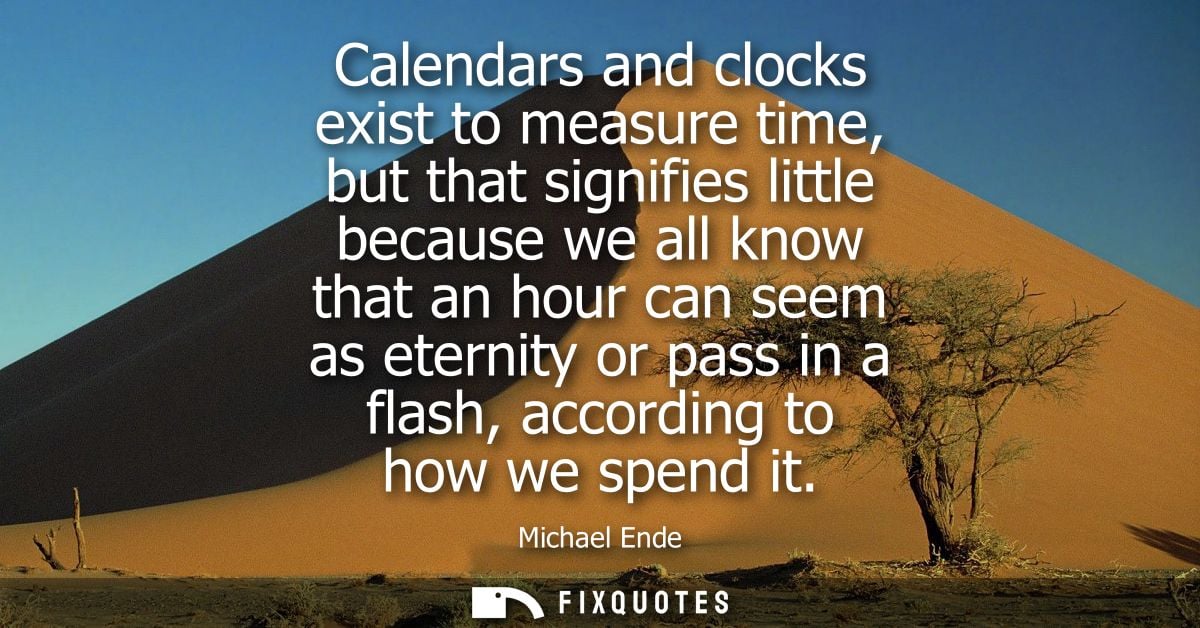
"Calendars and clocks exist to measure time, but that signifies little because we all know that an hour can seem as eternity or pass in a flash, according to how we spend it"
About this Quote
The intent is less metaphysical than moral. Ende is arguing that lived time is made, not found. An hour is not an hour in the way a meter is a meter; it expands and collapses based on attention, fear, boredom, desire, and meaning. The subtext is a critique of industrial time: the regimented, external time of factories, schools, and offices that treats human experience as a unit to be optimized. By contrast, he smuggles in a different standard of value: what the hour feels like, and what it holds.
Context matters: Ende, best known for Momo and The Neverending Story, repeatedly writes against the theft of imagination by systems that monetize or ration it. "How we spend it" is doing double duty. It suggests agency, but also an accusation: if your days feel thin, the problem might not be the clock but the life arranged around it. The line works because it turns a banal observation - time flies - into an ethical provocation: measurement is easy; meaning is the hard work.
Quote Details
| Topic | Time |
|---|---|
| Source | Help us find the source |
| Cite |
Citation Formats
APA Style (7th ed.)
Ende, Michael. (2026, January 15). Calendars and clocks exist to measure time, but that signifies little because we all know that an hour can seem as eternity or pass in a flash, according to how we spend it. FixQuotes. https://fixquotes.com/quotes/calendars-and-clocks-exist-to-measure-time-but-3914/
Chicago Style
Ende, Michael. "Calendars and clocks exist to measure time, but that signifies little because we all know that an hour can seem as eternity or pass in a flash, according to how we spend it." FixQuotes. January 15, 2026. https://fixquotes.com/quotes/calendars-and-clocks-exist-to-measure-time-but-3914/.
MLA Style (9th ed.)
"Calendars and clocks exist to measure time, but that signifies little because we all know that an hour can seem as eternity or pass in a flash, according to how we spend it." FixQuotes, 15 Jan. 2026, https://fixquotes.com/quotes/calendars-and-clocks-exist-to-measure-time-but-3914/. Accessed 31 Mar. 2026.