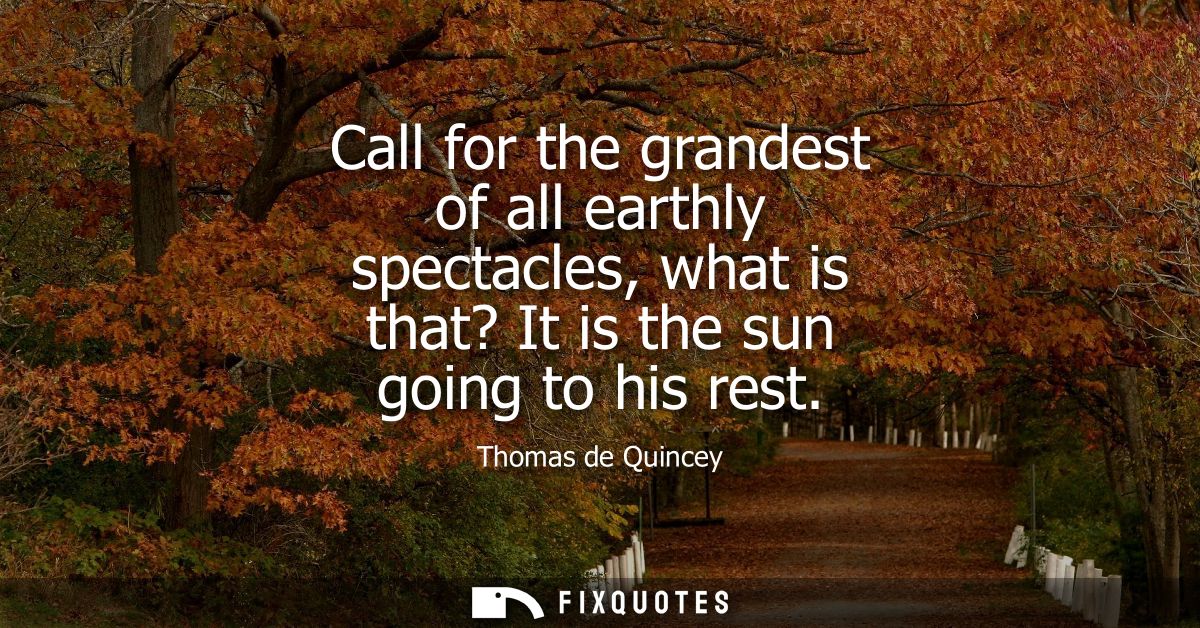
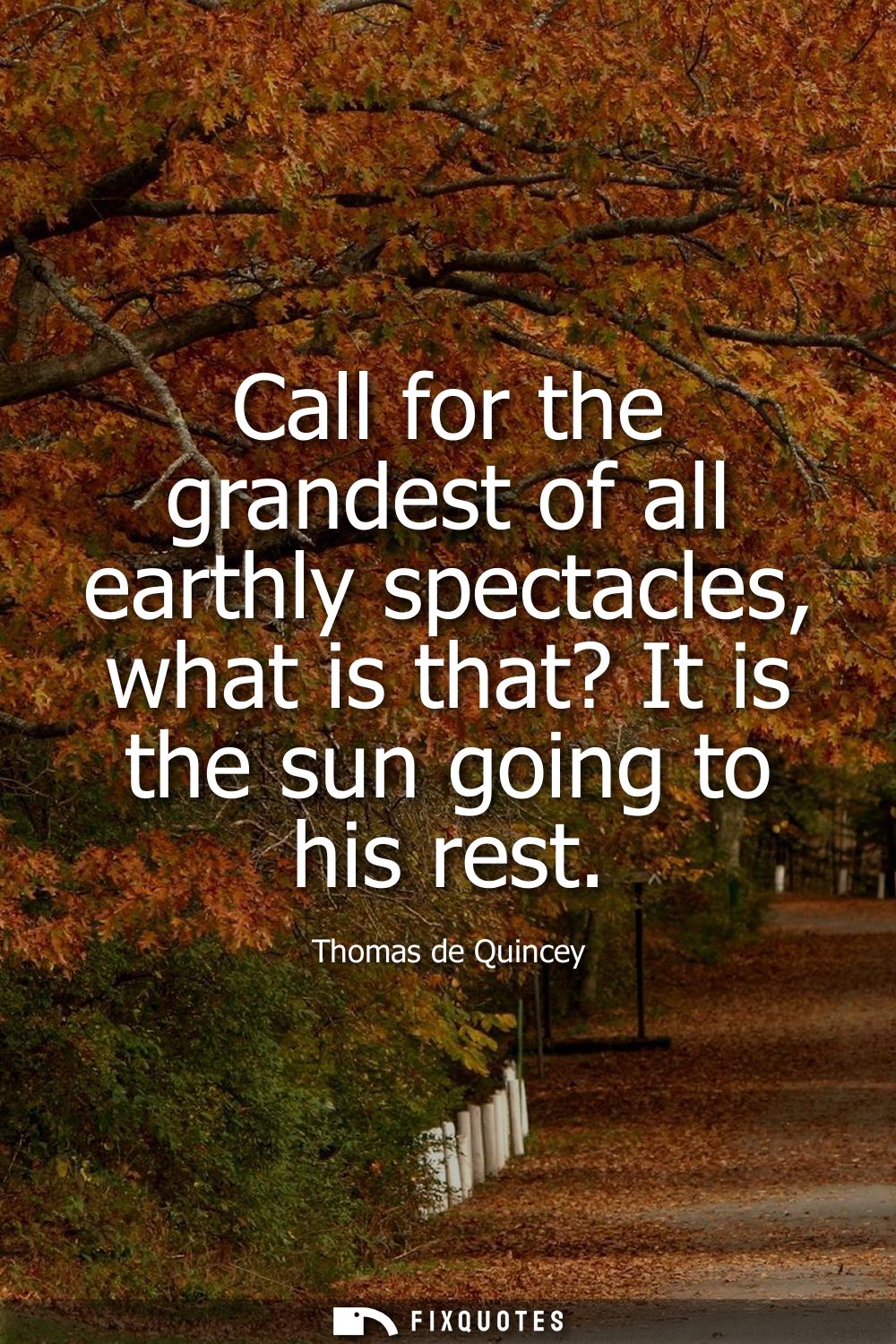
"Call for the grandest of all earthly spectacles, what is that? It is the sun going to his rest"
About this Quote
The phrase "the sun going to his rest" does extra cultural work. It personifies the sun with a masculine pronoun and a human routine, turning astronomy into narrative. Sunset becomes not an ending but a dignified withdrawal, a sovereign retiring from court. That choice is steeped in Romantic-era instincts: nature as theater, the cosmos as moral imagery, and ordinary perception as a kind of spiritual literacy. De Quincey, a writer famous for heightened sensation and a taste for the sublime, is also quietly defending attention itself as an ethical act.
There is subtextual pushback here against modernity's emerging obsession with spectacle as product. The sunset is spectacle without ownership, grandeur without gatekeeping. By calling it "earthly", he keeps the claim ambitious but grounded: you do not need transcendence or empire to be overwhelmed. You need to look up at the right hour and let scale do its quiet persuasion.
Quote Details
| Topic | Nature |
|---|---|
| Source | Help us find the source |
| Cite |
Citation Formats
APA Style (7th ed.)
Quincey, Thomas de. (2026, January 16). Call for the grandest of all earthly spectacles, what is that? It is the sun going to his rest. FixQuotes. https://fixquotes.com/quotes/call-for-the-grandest-of-all-earthly-spectacles-105410/
Chicago Style
Quincey, Thomas de. "Call for the grandest of all earthly spectacles, what is that? It is the sun going to his rest." FixQuotes. January 16, 2026. https://fixquotes.com/quotes/call-for-the-grandest-of-all-earthly-spectacles-105410/.
MLA Style (9th ed.)
"Call for the grandest of all earthly spectacles, what is that? It is the sun going to his rest." FixQuotes, 16 Jan. 2026, https://fixquotes.com/quotes/call-for-the-grandest-of-all-earthly-spectacles-105410/. Accessed 12 Feb. 2026.