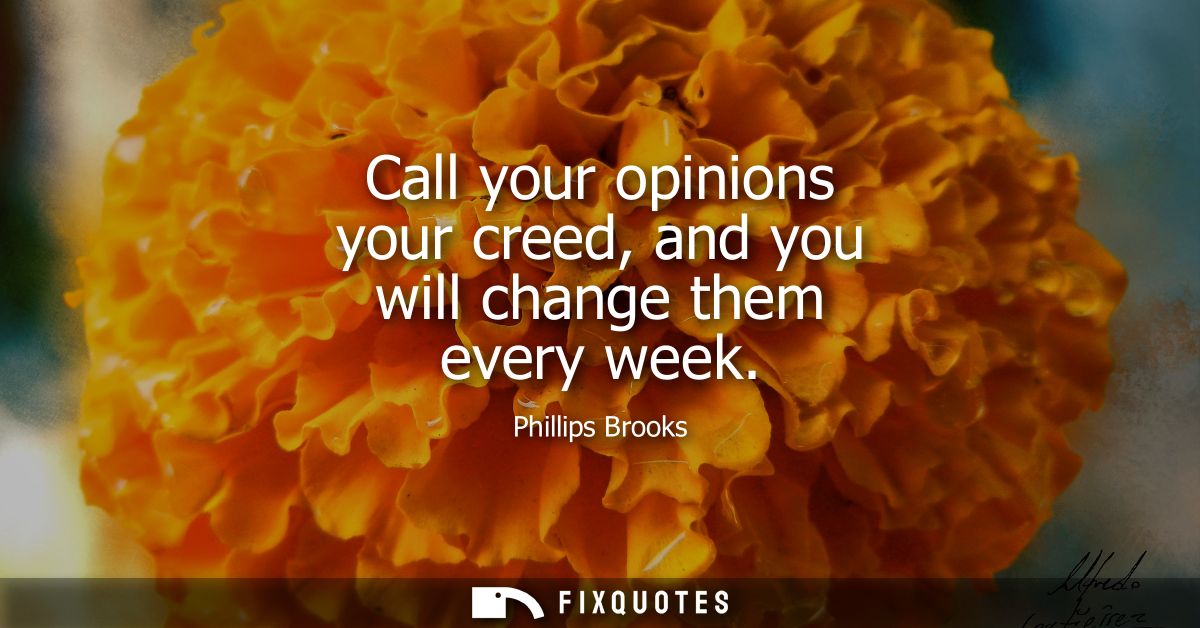
"Call your opinions your creed, and you will change them every week"
About this Quote
Brand your opinions as sacred doctrine and you guarantee a weekly heresy hunt - starring you. Phillips Brooks, a 19th-century clergyman known for broad-church generosity and moral seriousness, lands the line with a pastor's economy: it sounds like advice, but it’s really an indictment of how easily the ego hijacks belief. The trick is in the word "creed". A creed is meant to be slow-cooked, communal, and costly; an opinion is quick, private, and often mood-shaped. Confuse the two and your inner life becomes a revolving door of certainties.
Brooks is not attacking intellectual flexibility. He’s warning about the brittle performance of certainty, the kind that treats every passing take as a badge of identity. When opinions are elevated to creeds, changing your mind stops being learning and starts being disloyalty. So people either cling harder (the moral panic route) or churn faster (the trend-chasing route). Brooks skewers the second: the zealot of the new, converting again and again, mistaking novelty for conviction.
The context matters: this is Victorian Protestant America, an era of revivals, doctrinal boundary-policing, and emerging modern skepticism. Brooks pushes back against both dogmatism and fashionable doubt by insisting on a hierarchy of commitments. Let opinions be provisional and argumentative; reserve "creed" for the deep commitments that should withstand the week’s outrage cycle. It’s a spiritual discipline dressed up as a one-liner - and it still reads like a critique of timeline-driven identity politics.
Brooks is not attacking intellectual flexibility. He’s warning about the brittle performance of certainty, the kind that treats every passing take as a badge of identity. When opinions are elevated to creeds, changing your mind stops being learning and starts being disloyalty. So people either cling harder (the moral panic route) or churn faster (the trend-chasing route). Brooks skewers the second: the zealot of the new, converting again and again, mistaking novelty for conviction.
The context matters: this is Victorian Protestant America, an era of revivals, doctrinal boundary-policing, and emerging modern skepticism. Brooks pushes back against both dogmatism and fashionable doubt by insisting on a hierarchy of commitments. Let opinions be provisional and argumentative; reserve "creed" for the deep commitments that should withstand the week’s outrage cycle. It’s a spiritual discipline dressed up as a one-liner - and it still reads like a critique of timeline-driven identity politics.
Quote Details
| Topic | Wisdom |
|---|---|
| Source | Help us find the source |
| Cite | Cite this Quote |
Citation Formats
APA Style (7th ed.)
Brooks, Phillips. (n.d.). Call your opinions your creed, and you will change them every week. FixQuotes. https://fixquotes.com/quotes/call-your-opinions-your-creed-and-you-will-change-163709/
Chicago Style
Brooks, Phillips. "Call your opinions your creed, and you will change them every week." FixQuotes. Accessed February 2, 2026. https://fixquotes.com/quotes/call-your-opinions-your-creed-and-you-will-change-163709/.
MLA Style (9th ed.)
"Call your opinions your creed, and you will change them every week." FixQuotes, https://fixquotes.com/quotes/call-your-opinions-your-creed-and-you-will-change-163709/. Accessed 2 Feb. 2026.
More Quotes by Phillips
Add to List