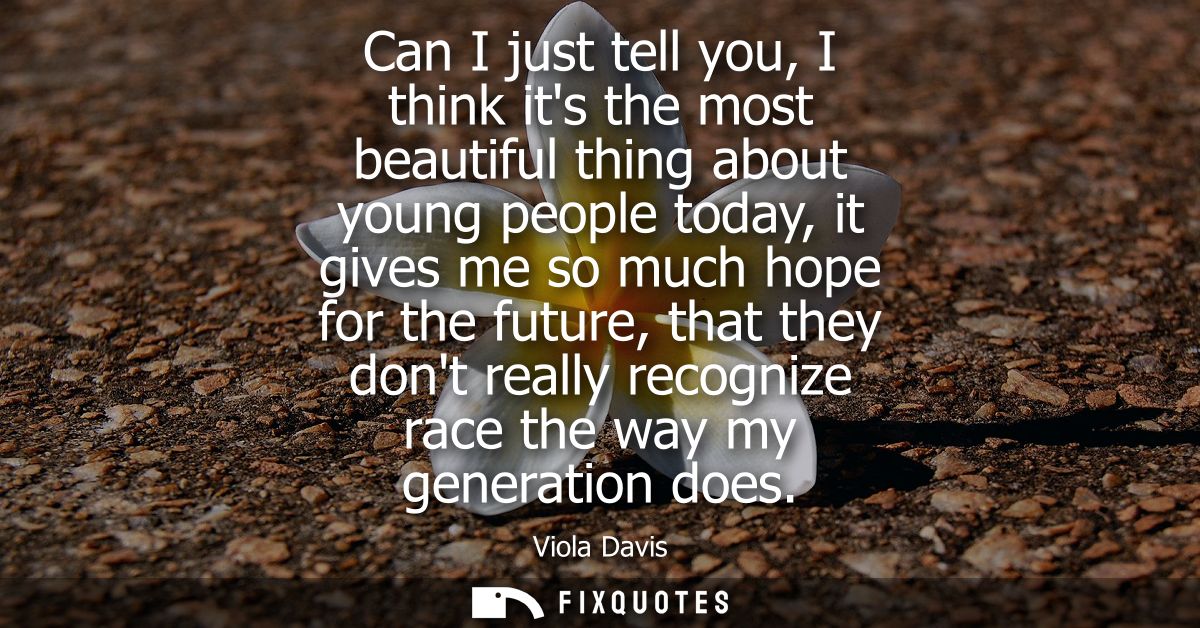
"Can I just tell you, I think it's the most beautiful thing about young people today, it gives me so much hope for the future, that they don't really recognize race the way my generation does"
About this Quote
Viola Davis is doing two things at once here: offering a benediction to the young, and issuing a gentle indictment of the old. The line opens with intimacy - "Can I just tell you" - a conversational knock before entering a morally charged room. That soft phrasing matters. It frames what could sound like a lecture as an emotional confession, the kind of hope you share because you need it, not because you want credit for having it.
The praise itself is strategically optimistic: young people "don't really recognize race" the way her generation does. Davis isn’t claiming a post-racial miracle; the hedge words ("really", "the way") are doing quiet work, acknowledging that race still exists while pointing to a shift in reflexes - who gets defaulted to as the protagonist, who gets read as "other", which differences get treated as destiny. It’s a statement less about ideology than about social muscle memory.
The subtext is complicated because Davis, a Black actress who has spoken candidly about exclusion in Hollywood, knows how seductive this sentiment can be. In American public talk, "I don’t see race" has often been a dodge. Her version threads a needle: she casts a vision of progress without erasing the fact that her generation had to recognize race constantly just to survive institutions built around it.
Contextually, it lands in a culture where youth activism and multiracial communities are visible, and where older generations are being asked to unlearn assumptions. Davis’s hope isn’t naive; it’s aspirational pressure, a way of saying: if kids can practice a different kind of seeing, the rest of us have no excuse not to try.
The praise itself is strategically optimistic: young people "don't really recognize race" the way her generation does. Davis isn’t claiming a post-racial miracle; the hedge words ("really", "the way") are doing quiet work, acknowledging that race still exists while pointing to a shift in reflexes - who gets defaulted to as the protagonist, who gets read as "other", which differences get treated as destiny. It’s a statement less about ideology than about social muscle memory.
The subtext is complicated because Davis, a Black actress who has spoken candidly about exclusion in Hollywood, knows how seductive this sentiment can be. In American public talk, "I don’t see race" has often been a dodge. Her version threads a needle: she casts a vision of progress without erasing the fact that her generation had to recognize race constantly just to survive institutions built around it.
Contextually, it lands in a culture where youth activism and multiracial communities are visible, and where older generations are being asked to unlearn assumptions. Davis’s hope isn’t naive; it’s aspirational pressure, a way of saying: if kids can practice a different kind of seeing, the rest of us have no excuse not to try.
Quote Details
| Topic | Equality |
|---|---|
| Source | Help us find the source |
More Quotes by Viola
Add to List