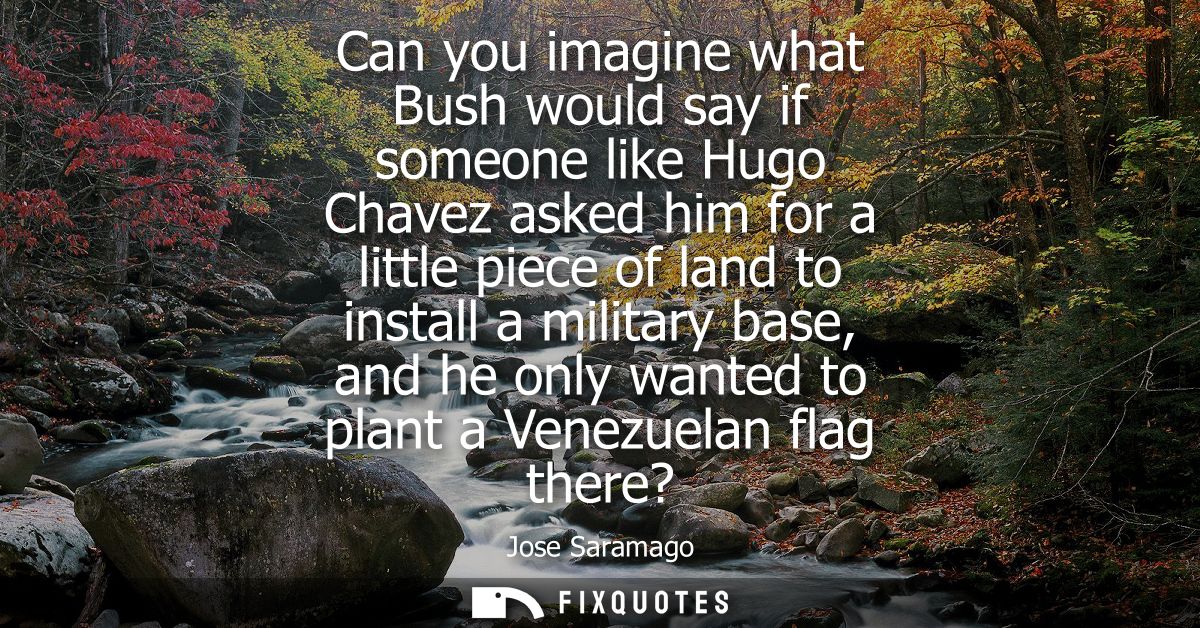
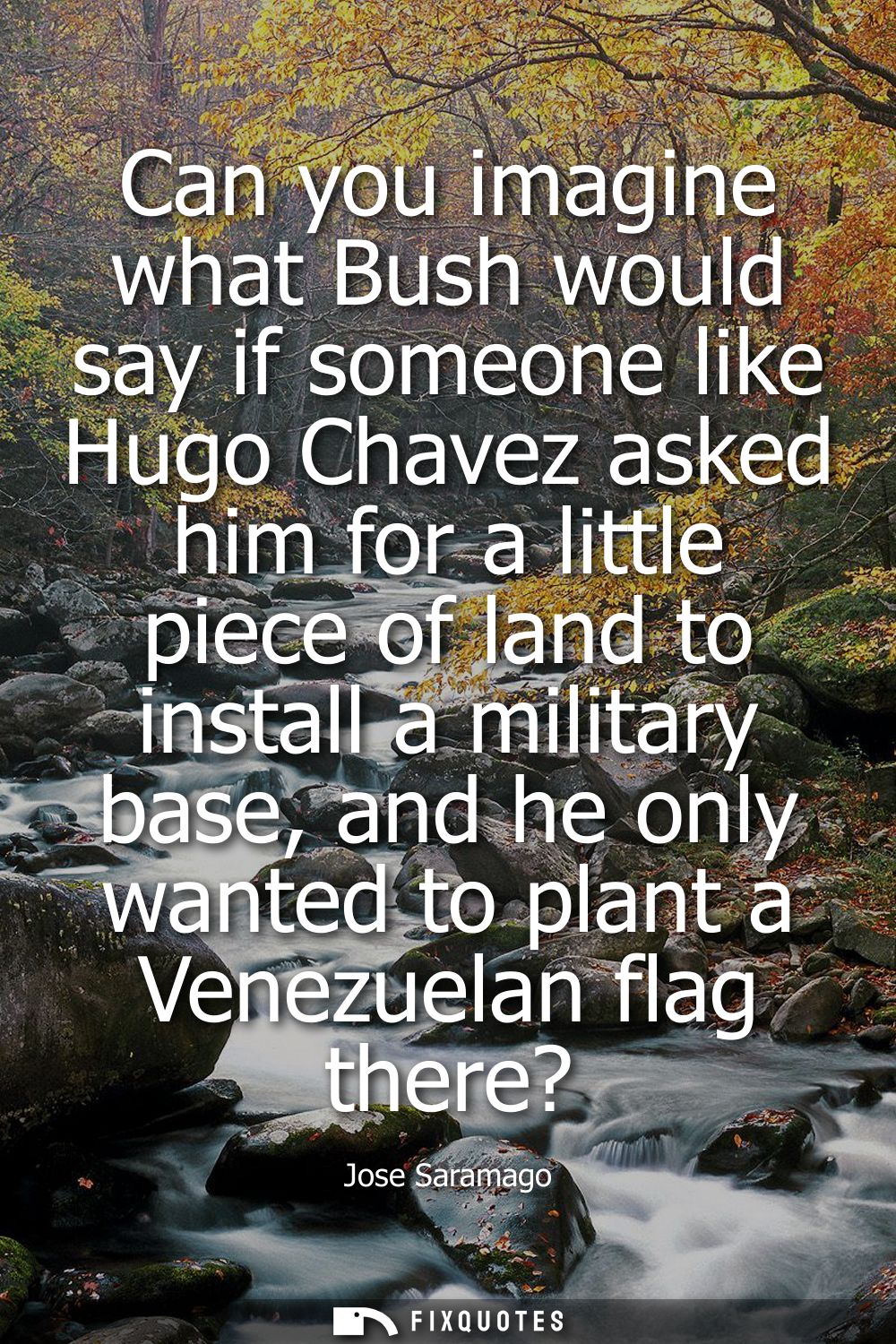
"Can you imagine what Bush would say if someone like Hugo Chavez asked him for a little piece of land to install a military base, and he only wanted to plant a Venezuelan flag there?"
About this Quote
He picks his props carefully: “a little piece of land” shrinks the demand into something almost neighborly, while “install a military base” snaps the euphemism back into focus. That oscillation exposes how empire sells itself - soft language masking hard infrastructure. The final flourish, “only wanted to plant a Venezuelan flag,” lands with theatrical irony. Flags are never “only” flags; they’re shorthand for sovereignty, permanence, and who gets to define the rules on someone else’s soil. By framing the act as symbolic, he highlights how symbols are deployed to launder coercion.
The context is early-2000s geopolitics: Bush-era militarism, the War on Terror’s expansion of overseas footprints, and Latin America’s resurgent left, with Chavez as the convenient villain in U.S. rhetoric. Saramago, a lifelong critic of authoritarianism and Western double standards, isn’t defending Chavez so much as spotlighting the reflexive hypocrisy that decides whose bases are “stability” and whose flags are “provocation.”
Quote Details
| Topic | War |
|---|---|
| Source | Help us find the source |
| Cite |
Citation Formats
APA Style (7th ed.)
Saramago, Jose. (2026, January 17). Can you imagine what Bush would say if someone like Hugo Chavez asked him for a little piece of land to install a military base, and he only wanted to plant a Venezuelan flag there? FixQuotes. https://fixquotes.com/quotes/can-you-imagine-what-bush-would-say-if-someone-73330/
Chicago Style
Saramago, Jose. "Can you imagine what Bush would say if someone like Hugo Chavez asked him for a little piece of land to install a military base, and he only wanted to plant a Venezuelan flag there?" FixQuotes. January 17, 2026. https://fixquotes.com/quotes/can-you-imagine-what-bush-would-say-if-someone-73330/.
MLA Style (9th ed.)
"Can you imagine what Bush would say if someone like Hugo Chavez asked him for a little piece of land to install a military base, and he only wanted to plant a Venezuelan flag there?" FixQuotes, 17 Jan. 2026, https://fixquotes.com/quotes/can-you-imagine-what-bush-would-say-if-someone-73330/. Accessed 1 Apr. 2026.