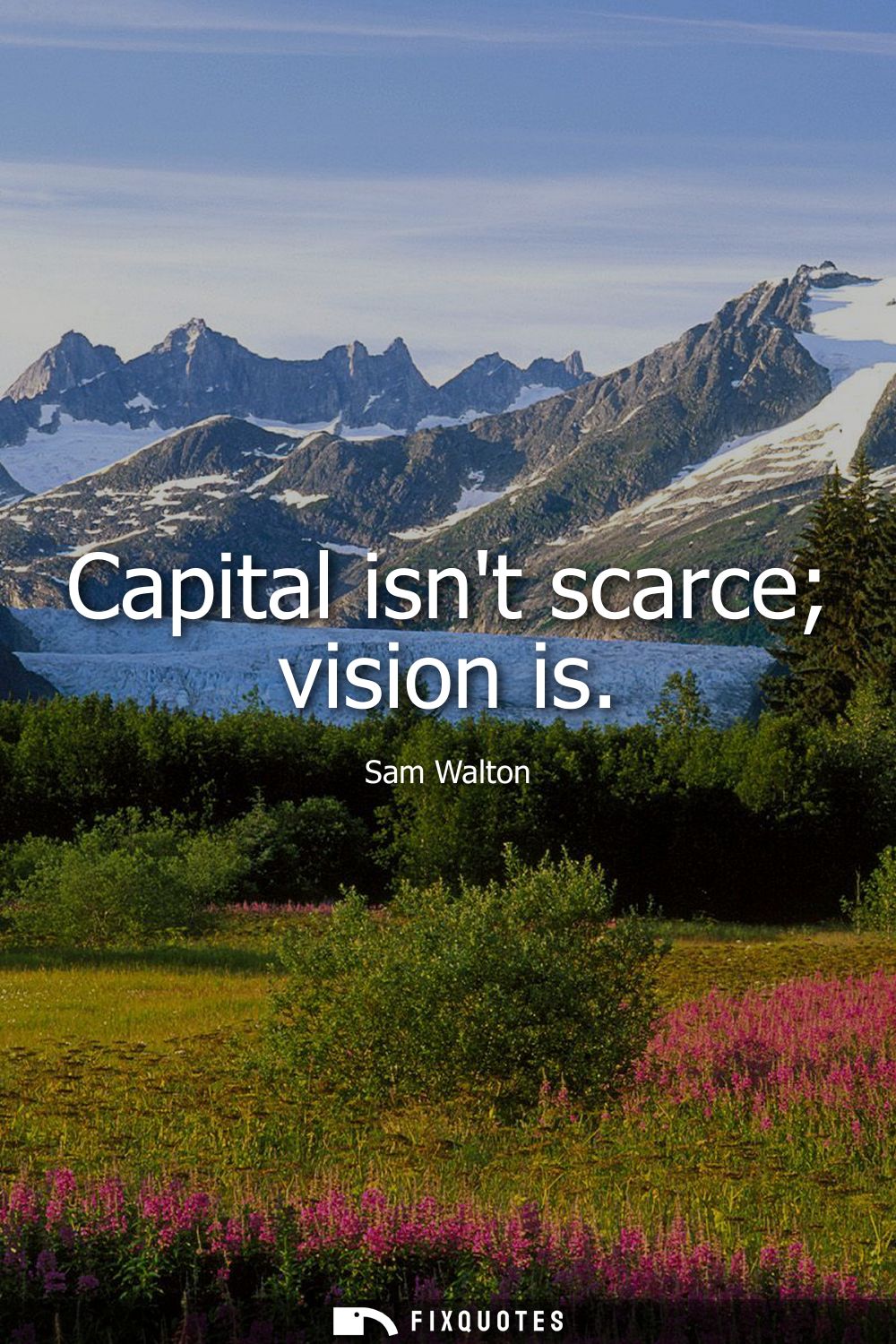
"Capital isn't scarce; vision is"
About this Quote
Walton’s line is a neat reversal of what entrepreneurs are trained to complain about. “Capital” is the respectable excuse, the one that makes failure sound structural instead of personal. By declaring it not scarce, he strips away that alibi and points the spotlight at the harder, lonelier variable: “vision,” the ability to see demand before it’s obvious and to build an organization that can chase it at scale.
The subtext is classic Walton-era retail Darwinism. In postwar America, money was increasingly available to the right-looking ventures: banks expanding, suburbs booming, supply chains modernizing. Walton came up in a landscape where plenty of businesses could get financing for another store, another truck, another inventory order. What they couldn’t easily finance was the mental model: the discipline of low margins, high volume, relentless logistics, and a culture that treats efficiency like a moral project. Vision, for Walton, isn’t inspiration; it’s operational prophecy.
It also functions as a quiet critique of corporate complacency. If capital is abundant, then big incumbents have no excuse for missing the future. They weren’t underfunded; they were unimaginative. That’s a pointed message from a man who built Walmart by betting that rural customers were underserved and that technology and distribution could turn “cheap” into a system, not a stigma.
There’s a managerial edge, too: stop fetishizing fundraising and start sweating the blueprint. Money follows a story that sounds inevitable. Vision is what makes it sound that way.
The subtext is classic Walton-era retail Darwinism. In postwar America, money was increasingly available to the right-looking ventures: banks expanding, suburbs booming, supply chains modernizing. Walton came up in a landscape where plenty of businesses could get financing for another store, another truck, another inventory order. What they couldn’t easily finance was the mental model: the discipline of low margins, high volume, relentless logistics, and a culture that treats efficiency like a moral project. Vision, for Walton, isn’t inspiration; it’s operational prophecy.
It also functions as a quiet critique of corporate complacency. If capital is abundant, then big incumbents have no excuse for missing the future. They weren’t underfunded; they were unimaginative. That’s a pointed message from a man who built Walmart by betting that rural customers were underserved and that technology and distribution could turn “cheap” into a system, not a stigma.
There’s a managerial edge, too: stop fetishizing fundraising and start sweating the blueprint. Money follows a story that sounds inevitable. Vision is what makes it sound that way.
Quote Details
| Topic | Vision & Strategy |
|---|---|
| Source | Sam Walton, Made in America: My Story (Doubleday, 1992) — quote attributed to Walton in his memoir. |
| Cite |
Citation Formats
APA Style (7th ed.)
Walton, Sam. (2026, January 16). Capital isn't scarce; vision is. FixQuotes. https://fixquotes.com/quotes/capital-isnt-scarce-vision-is-95168/
Chicago Style
Walton, Sam. "Capital isn't scarce; vision is." FixQuotes. January 16, 2026. https://fixquotes.com/quotes/capital-isnt-scarce-vision-is-95168/.
MLA Style (9th ed.)
"Capital isn't scarce; vision is." FixQuotes, 16 Jan. 2026, https://fixquotes.com/quotes/capital-isnt-scarce-vision-is-95168/. Accessed 12 Feb. 2026.
More Quotes by Sam
Add to List