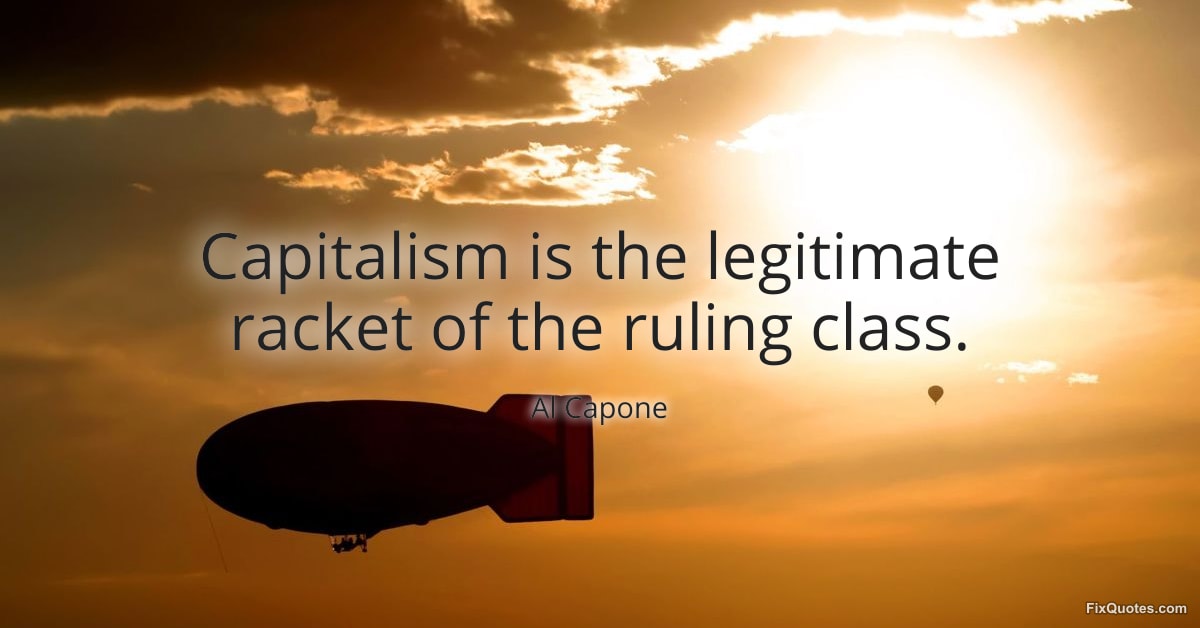
"Capitalism is the legitimate racket of the ruling class"
About this Quote
Al Capone calling capitalism a "legitimate racket" lands like a confession flipped into an accusation. From a man whose brand was extortion with good PR, the line isn’t a Marxist seminar; it’s a streetwise taxonomy. A racket is a system that extracts money through intimidation, protection, and controlled scarcity. Add "legitimate" and you get the punch: the same mechanics, upgraded with paperwork, courts, and respectability.
The specific intent is twofold. First, it’s self-exoneration by comparison: if elites can run extraction schemes with legal cover, why is his version uniquely damned? Second, it’s a threat disguised as insight. Capone is reminding you that legality is not morality; it’s power wearing a suit. The phrase "ruling class" sharpens the target, framing capitalism less as a neutral marketplace than as an arrangement administered by winners who wrote the rules after they won.
Context matters: Prohibition-era America was a masterclass in selective enforcement. The state criminalized a mass appetite, then watched a parallel economy bloom, complete with bribed officials and respectable businessmen laundering proceeds through real institutions. Capone didn’t invent corruption; he industrialized what the era quietly rewarded.
The subtext is the most corrosive part: capitalism’s violence is usually abstracted - rent, debt, wages, monopolies - while criminal violence is literal and camera-ready. Capone collapses that distinction. His cynicism works because it’s not theoretical; it’s observational. He’s arguing that the only real difference between a gangster and a tycoon is who gets invited to testify before Congress versus who gets chased by it.
The specific intent is twofold. First, it’s self-exoneration by comparison: if elites can run extraction schemes with legal cover, why is his version uniquely damned? Second, it’s a threat disguised as insight. Capone is reminding you that legality is not morality; it’s power wearing a suit. The phrase "ruling class" sharpens the target, framing capitalism less as a neutral marketplace than as an arrangement administered by winners who wrote the rules after they won.
Context matters: Prohibition-era America was a masterclass in selective enforcement. The state criminalized a mass appetite, then watched a parallel economy bloom, complete with bribed officials and respectable businessmen laundering proceeds through real institutions. Capone didn’t invent corruption; he industrialized what the era quietly rewarded.
The subtext is the most corrosive part: capitalism’s violence is usually abstracted - rent, debt, wages, monopolies - while criminal violence is literal and camera-ready. Capone collapses that distinction. His cynicism works because it’s not theoretical; it’s observational. He’s arguing that the only real difference between a gangster and a tycoon is who gets invited to testify before Congress versus who gets chased by it.
Quote Details
| Topic | Justice |
|---|---|
| Source | Later attribution: Capitalism and COVID-19: Time to Make a Democratic New Wo... (Noel Chellan, 2023) modern compilationISBN: 9789004539808 · ID: hOz7EAAAQBAJ
Evidence:
... Capitalism is the legitimate racket of the ruling class " ( Al Capone ) ; “ Capitalism is the extraordinary belief that the nastiest of men , for the nastiest of reasons , will somehow work for the benefit of us all " ( John Maynard ... |
| Cite |
Citation Formats
APA Style (7th ed.)
Capone, Al. (2026, February 25). Capitalism is the legitimate racket of the ruling class. FixQuotes. https://fixquotes.com/quotes/capitalism-is-the-legitimate-racket-of-the-ruling-43880/
Chicago Style
Capone, Al. "Capitalism is the legitimate racket of the ruling class." FixQuotes. February 25, 2026. https://fixquotes.com/quotes/capitalism-is-the-legitimate-racket-of-the-ruling-43880/.
MLA Style (9th ed.)
"Capitalism is the legitimate racket of the ruling class." FixQuotes, 25 Feb. 2026, https://fixquotes.com/quotes/capitalism-is-the-legitimate-racket-of-the-ruling-43880/. Accessed 4 Apr. 2026.
More Quotes by Al
Add to List