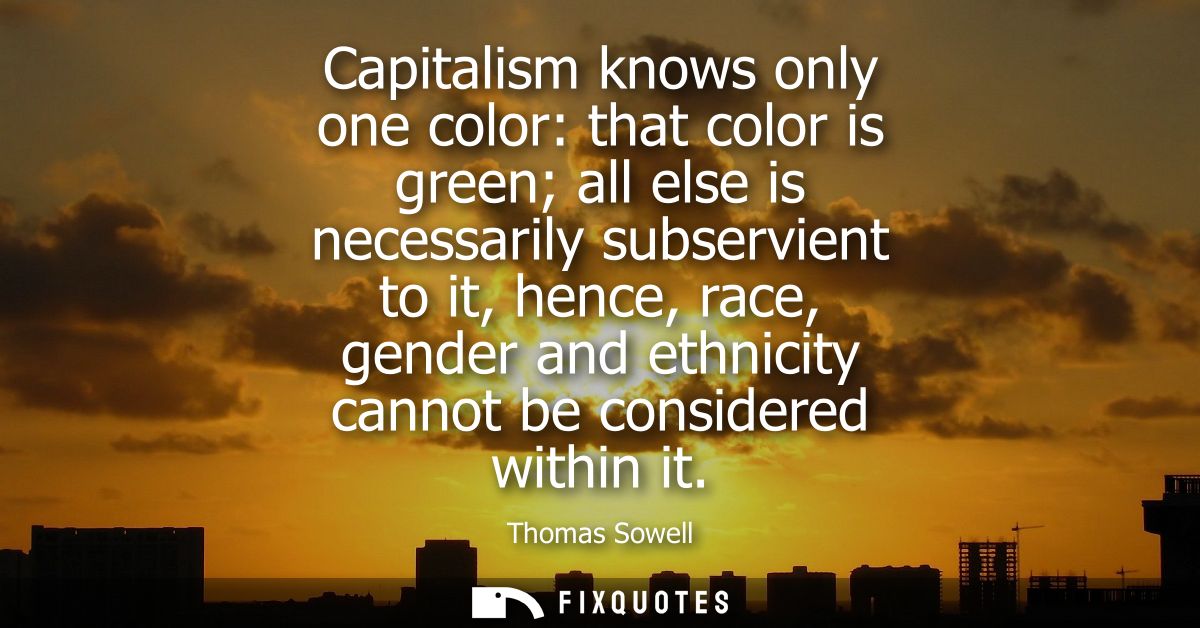
"Capitalism knows only one color: that color is green; all else is necessarily subservient to it, hence, race, gender and ethnicity cannot be considered within it"
About this Quote
The subtext is defensive and polemical. By claiming race, gender, and ethnicity “cannot be considered within” capitalism, he’s not merely describing a system; he’s trying to pre-empt certain critiques of it. If capitalism inherently reduces everything to profit, then discrimination becomes, at best, an inefficient habit and, at worst, a category error: the market punishes bias because it leaves money on the table. That frames civil-rights-era and post-civil-rights debates as over-reading identity into a mechanism that, ideally, doesn’t “care.”
Context matters because the sentence isn’t a neutral observation; it’s a counterargument to structural accounts of inequality that treat capitalism and hierarchy as intertwined. Sowell’s broader project has been to redirect attention from historic injustice to cultural patterns and institutional incentives. The strength of the quote is its clarity: it gives readers a single lever to pull. The weakness is in the absolutism. Real markets are social arenas with gatekeepers, networks, information asymmetries, and inherited advantage; “green” may be the scoreboard, but who gets on the field is never purely economic.
Quote Details
| Topic | Equality |
|---|---|
| Source | Help us find the source |
| Cite |
Citation Formats
APA Style (7th ed.)
Sowell, Thomas. (2026, January 15). Capitalism knows only one color: that color is green; all else is necessarily subservient to it, hence, race, gender and ethnicity cannot be considered within it. FixQuotes. https://fixquotes.com/quotes/capitalism-knows-only-one-color-that-color-is-2115/
Chicago Style
Sowell, Thomas. "Capitalism knows only one color: that color is green; all else is necessarily subservient to it, hence, race, gender and ethnicity cannot be considered within it." FixQuotes. January 15, 2026. https://fixquotes.com/quotes/capitalism-knows-only-one-color-that-color-is-2115/.
MLA Style (9th ed.)
"Capitalism knows only one color: that color is green; all else is necessarily subservient to it, hence, race, gender and ethnicity cannot be considered within it." FixQuotes, 15 Jan. 2026, https://fixquotes.com/quotes/capitalism-knows-only-one-color-that-color-is-2115/. Accessed 14 Mar. 2026.