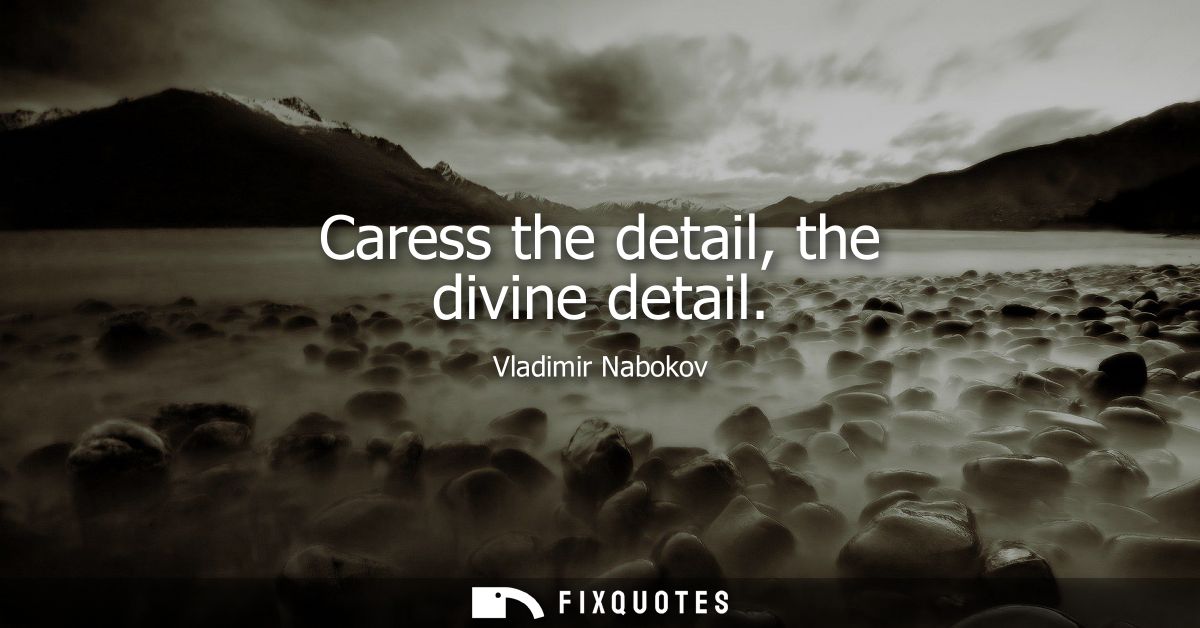
"Caress the detail, the divine detail"
About this Quote
“Caress the detail, the divine detail” is Nabokov at his most seductive and most authoritarian: a whisper that doubles as a commandment. The verb matters. To “caress” suggests intimacy, patience, even erotic attention, turning craft into a bodily practice rather than an abstract ideal. Nabokov isn’t just praising observation; he’s prescribing a way of reading and writing that refuses the lazy shortcut of “message” or “moral.” Detail isn’t decoration. It’s where reality (and art) hides its signature.
Calling detail “divine” is the sly pivot. Nabokov, famously allergic to didacticism and ideological “big ideas,” elevates the small to the sacred, as if the closest thing to transcendence available to modern consciousness is exact perception. It’s also a rebuke to any culture that treats art as a delivery system for virtue. If you want meaning, he implies, earn it by attending to texture, pattern, and particularity.
Context sharpens the edge. Nabokov the lepidopterist, the chess-problem maker, the stylist who builds traps in syntax and rhythm, is defending a worldview in which precision is ethics. The subtext is elitist in the best and worst ways: only the attentive deserve the full experience. Read carelessly and you get plot; read with a trained sensibility and you glimpse the “divine” circuitry behind the apparent surface. In an era that rewards hot takes and summaries, the line remains a dare: slow down, look closer, stop pretending the large is automatically profound.
Calling detail “divine” is the sly pivot. Nabokov, famously allergic to didacticism and ideological “big ideas,” elevates the small to the sacred, as if the closest thing to transcendence available to modern consciousness is exact perception. It’s also a rebuke to any culture that treats art as a delivery system for virtue. If you want meaning, he implies, earn it by attending to texture, pattern, and particularity.
Context sharpens the edge. Nabokov the lepidopterist, the chess-problem maker, the stylist who builds traps in syntax and rhythm, is defending a worldview in which precision is ethics. The subtext is elitist in the best and worst ways: only the attentive deserve the full experience. Read carelessly and you get plot; read with a trained sensibility and you glimpse the “divine” circuitry behind the apparent surface. In an era that rewards hot takes and summaries, the line remains a dare: slow down, look closer, stop pretending the large is automatically profound.
Quote Details
| Topic | Art |
|---|---|
| Source | Help us find the source |
| Cite |
Citation Formats
APA Style (7th ed.)
Nabokov, Vladimir. (2026, January 15). Caress the detail, the divine detail. FixQuotes. https://fixquotes.com/quotes/caress-the-detail-the-divine-detail-16295/
Chicago Style
Nabokov, Vladimir. "Caress the detail, the divine detail." FixQuotes. January 15, 2026. https://fixquotes.com/quotes/caress-the-detail-the-divine-detail-16295/.
MLA Style (9th ed.)
"Caress the detail, the divine detail." FixQuotes, 15 Jan. 2026, https://fixquotes.com/quotes/caress-the-detail-the-divine-detail-16295/. Accessed 20 Mar. 2026.
More Quotes by Vladimir
Add to List