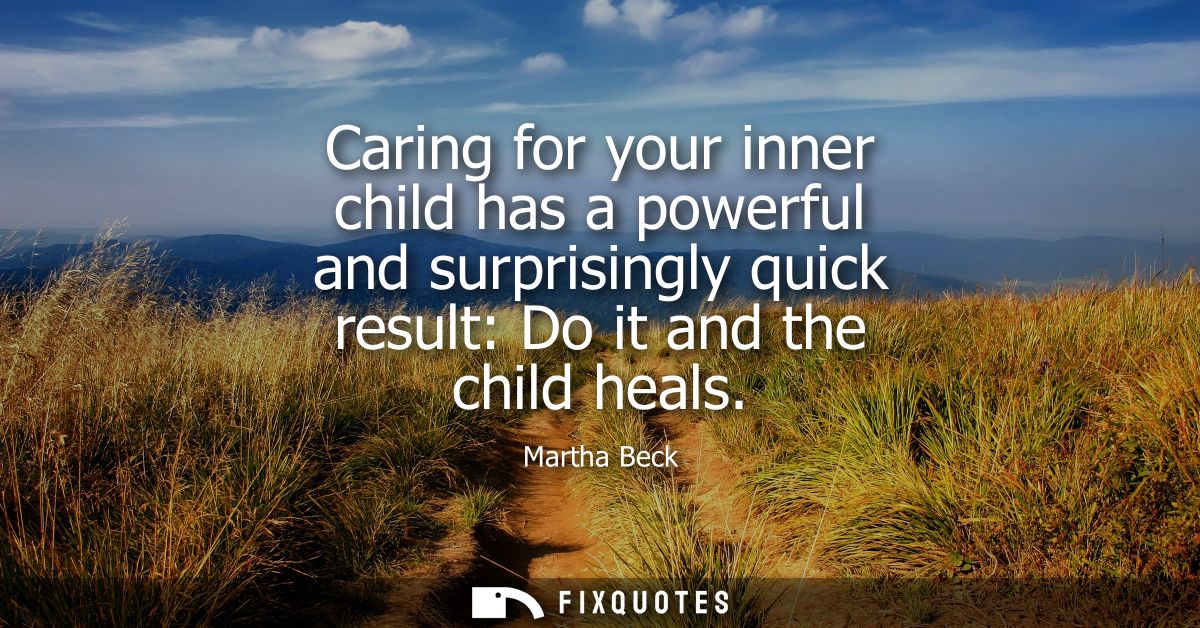
"Caring for your inner child has a powerful and surprisingly quick result: Do it and the child heals"
About this Quote
The subtext is a quiet rebuke to adult competence as a cover story. “Caring” implies that the hurt part of you hasn’t been defeated by logic or outgrown by achievement; it’s been neglected. By framing healing as the result of care rather than insight, Beck shifts authority away from the analyst-self toward the nurturer-self. The sentence structure mirrors that move: “Do it and” reads like a simple experiment, almost a dare, replacing psychological mystique with action.
Context matters because “inner child” is loaded: a term popularized through late-20th-century therapy culture that’s been meme-ified, mocked, and yet stubbornly useful. Beck reclaims it by stripping away ceremony and emphasizing speed - a pitch suited to modern burnout, where people want relief without making their suffering a second job. The line also courts critique: “the child heals” can sound too clean, too linear. That’s part of its rhetorical power. It offers hope in a culture trained to expect damage to be permanent, and it does so with the kind of certainty that gets you to try.
Quote Details
| Topic | Self-Care |
|---|---|
| Source | Help us find the source |
| Cite |
Citation Formats
APA Style (7th ed.)
Beck, Martha. (2026, January 17). Caring for your inner child has a powerful and surprisingly quick result: Do it and the child heals. FixQuotes. https://fixquotes.com/quotes/caring-for-your-inner-child-has-a-powerful-and-57827/
Chicago Style
Beck, Martha. "Caring for your inner child has a powerful and surprisingly quick result: Do it and the child heals." FixQuotes. January 17, 2026. https://fixquotes.com/quotes/caring-for-your-inner-child-has-a-powerful-and-57827/.
MLA Style (9th ed.)
"Caring for your inner child has a powerful and surprisingly quick result: Do it and the child heals." FixQuotes, 17 Jan. 2026, https://fixquotes.com/quotes/caring-for-your-inner-child-has-a-powerful-and-57827/. Accessed 31 Mar. 2026.