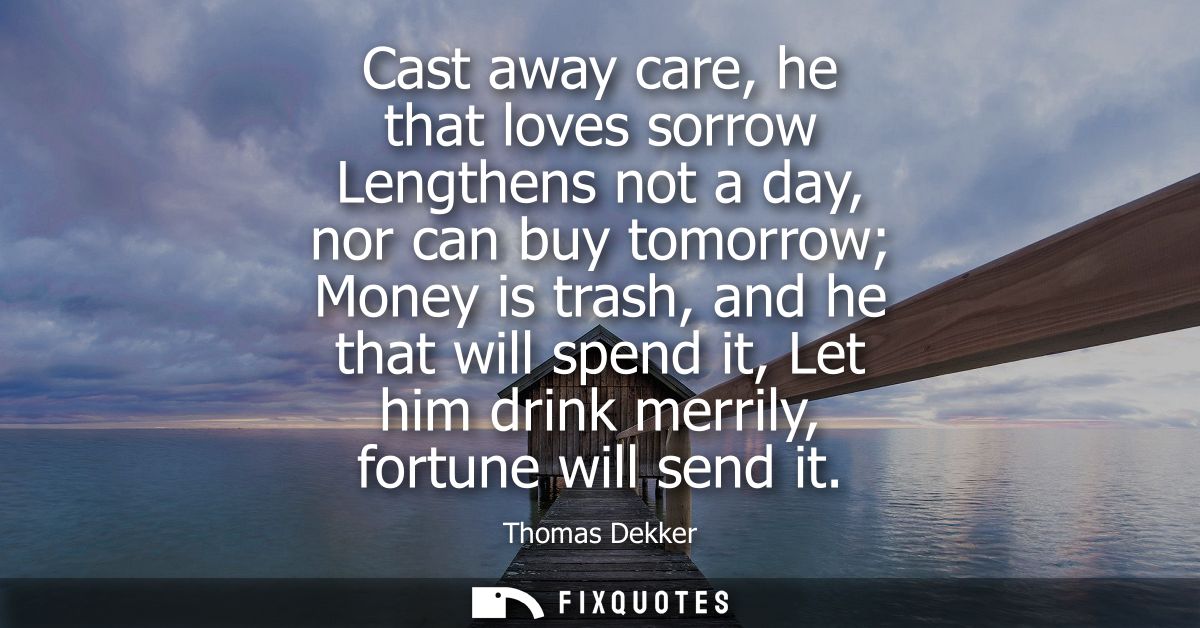
"Cast away care, he that loves sorrow lengthens not a day, nor can buy tomorrow; Money is trash, and he that will spend it, let him drink merrily, fortune will send it"
About this Quote
The couplets move with the brisk certainty of a drinking song, and that’s the trick. Rhyme and rhythm do the persuading that logic can’t. “He that loves sorrow / Lengthens not a day” lands like a blunt medical fact, turning melancholy from moral depth into useless labor. Then Dekker flips the Calvinist script on thrift: “nor can buy tomorrow.” In a city where luck, patronage, and catastrophe decide outcomes more than virtue does, the fantasy that prudence purchases security is exposed as sentimental economics.
“Money is trash” sounds reckless until you hear the irony: money isn’t literally worthless; it’s just a poor substitute for time, health, and fellowship. “Fortune will send it” is not confidence in justice but a shrug at volatility. Spend, drink, laugh - not because the world is kind, but because it isn’t. The subtext is a refusal to let anxiety be the only rational response to precarity. Dekker’s merriment is a pressure valve, yes, but also a quiet indictment of a system where tomorrow is always for sale and never actually delivered.
Quote Details
| Topic | Live in the Moment |
|---|---|
| Source | Help us find the source |
| Cite |
Citation Formats
APA Style (7th ed.)
Dekker, Thomas. (2026, February 19). Cast away care, he that loves sorrow lengthens not a day, nor can buy tomorrow; Money is trash, and he that will spend it, let him drink merrily, fortune will send it. FixQuotes. https://fixquotes.com/quotes/cast-away-care-he-that-loves-sorrow-lengthens-not-27747/
Chicago Style
Dekker, Thomas. "Cast away care, he that loves sorrow lengthens not a day, nor can buy tomorrow; Money is trash, and he that will spend it, let him drink merrily, fortune will send it." FixQuotes. February 19, 2026. https://fixquotes.com/quotes/cast-away-care-he-that-loves-sorrow-lengthens-not-27747/.
MLA Style (9th ed.)
"Cast away care, he that loves sorrow lengthens not a day, nor can buy tomorrow; Money is trash, and he that will spend it, let him drink merrily, fortune will send it." FixQuotes, 19 Feb. 2026, https://fixquotes.com/quotes/cast-away-care-he-that-loves-sorrow-lengthens-not-27747/. Accessed 31 Mar. 2026.