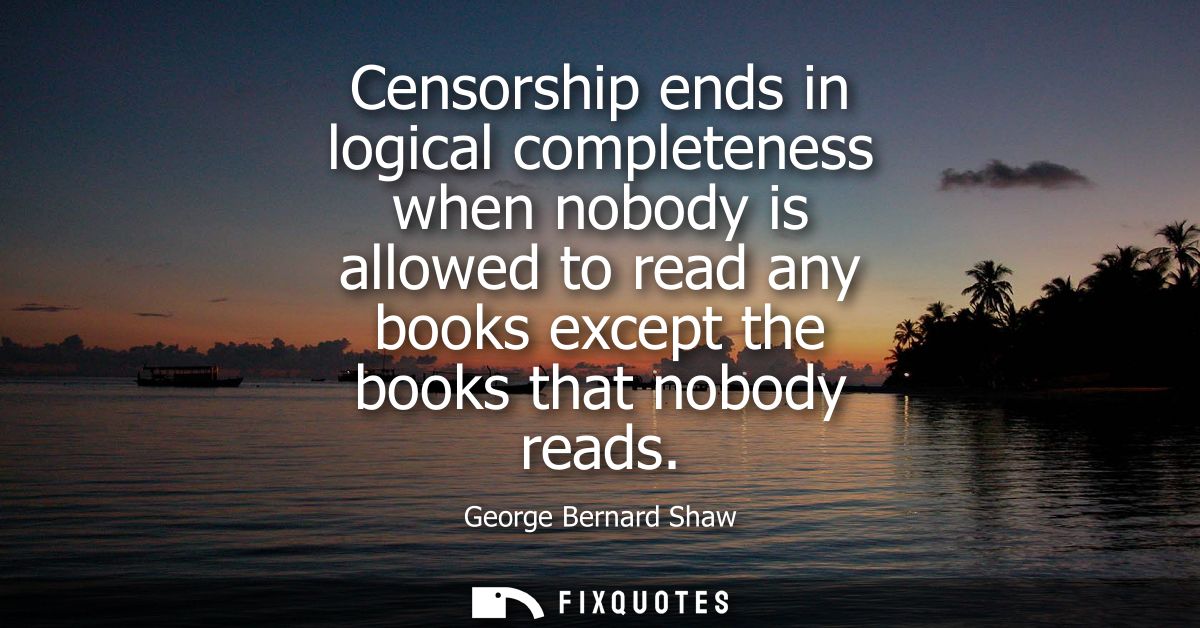
"Censorship ends in logical completeness when nobody is allowed to read any books except the books that nobody reads"
About this Quote
The subtext is less about banning than about chilling. Shaw understands that censorship rarely needs to burn every book; it only needs to make the cost of attention feel high. Once fear, stigma, or bureaucratic hassle do their work, the shelf can remain technically stocked while the public self-censors into apathy. The final twist - “except the books that nobody reads” - skewers the performative morality of gatekeepers who want the optics of protection without the vulnerability of engagement. A “permitted” culture that no one actually consumes is political theater.
Context matters: Shaw, a dramatist and public provocateur, wrote amid Britain’s anxieties over obscenity laws, wartime restrictions, and the policing of radical politics. His target isn’t just the state; it’s the respectable crowd that cheers on suppression, then wonders why art turns anemic. Censorship’s “completion” is cultural starvation disguised as order.
Quote Details
| Topic | Freedom |
|---|---|
| Source | Verified source: Fanny's First Play (George Bernard Shaw, 1911)
Evidence: Censorship ends in logical completeness when nobody is allowed to read any books except the books that nobody can read.. I was able to verify the wording (with 'can read', not 'reads') as a line in Shaw’s own published text of the play 'Fanny’s First Play' (1911) on Project Gutenberg. This appears to be a primary source in Shaw’s own work, and is earlier than the frequently-cited secondary citation to 'Literary Censorship in England' in Current Opinion (Nov 1913). However, I have NOT yet been able (in this search pass) to locate and verify the quote inside an original scan of the 1911 printed edition with a stable page number, nor to locate the alleged 1913 Current Opinion page image to check whether that magazine was quoting Shaw from an earlier source or reprinting his words. If your goal is “first published,” you should treat 1911 (published play text) as the earliest verified primary source from the evidence retrieved here, but with some remaining uncertainty until the 1911 first edition and/or an earlier pre-publication appearance (e.g., article/letter) is checked. Other candidates (1) Inside the Mind of George Bernard Shaw (David Graham, 2014) compilation96.1% ... moral when he is only uncomfortable . " * " Censorship ends in logical completeness when nobody is allowed to rea... |
| Cite |
Citation Formats
APA Style (7th ed.)
Shaw, George Bernard. (2026, February 21). Censorship ends in logical completeness when nobody is allowed to read any books except the books that nobody reads. FixQuotes. https://fixquotes.com/quotes/censorship-ends-in-logical-completeness-when-137476/
Chicago Style
Shaw, George Bernard. "Censorship ends in logical completeness when nobody is allowed to read any books except the books that nobody reads." FixQuotes. February 21, 2026. https://fixquotes.com/quotes/censorship-ends-in-logical-completeness-when-137476/.
MLA Style (9th ed.)
"Censorship ends in logical completeness when nobody is allowed to read any books except the books that nobody reads." FixQuotes, 21 Feb. 2026, https://fixquotes.com/quotes/censorship-ends-in-logical-completeness-when-137476/. Accessed 28 Mar. 2026.