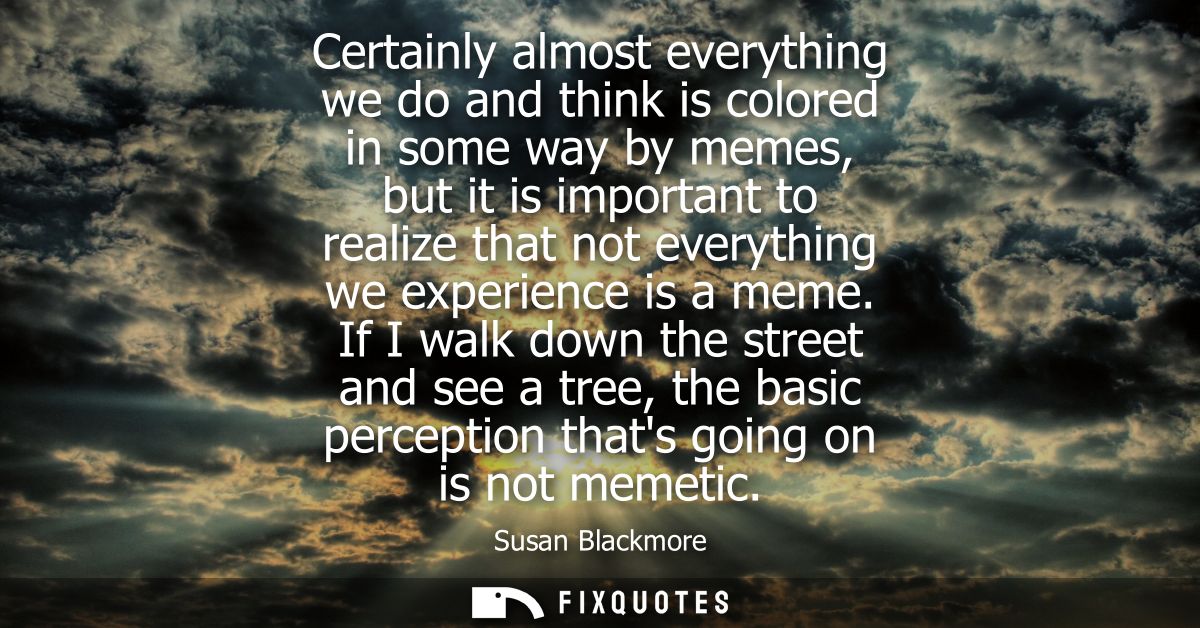
"Certainly almost everything we do and think is colored in some way by memes, but it is important to realize that not everything we experience is a meme. If I walk down the street and see a tree, the basic perception that's going on is not memetic"
About this Quote
The intent is partly defensive. Memetics has always faced the critique that it’s an overextended metaphor - Darwinism with vibes - that explains so much it ends up explaining nothing. By conceding limits, Blackmore makes the broader claim more credible: memes may shape interpretation, attention, and what we say about the tree (“nature,” “property value,” “climate grief”), but they don’t generate the baseline perceptual machinery that lets “tree” appear at all.
The subtext is a warning about category error. Modern discourse loves collapsing experience into discourse about experience, mistaking the social layer for the whole stack. Blackmore is insisting on levels: sensation, cognition, culture. In doing so, she also protects a sliver of non-memetic reality - not mystical truth, just pre-cultural processing - that keeps memetics from becoming a closed system. It’s a rhetorical hedge, but also an ethical one: if everything is a meme, nothing is accountable, and nothing is real.
Quote Details
| Topic | Deep |
|---|---|
| Source | Help us find the source |
| Cite |
Citation Formats
APA Style (7th ed.)
Blackmore, Susan. (2026, January 15). Certainly almost everything we do and think is colored in some way by memes, but it is important to realize that not everything we experience is a meme. If I walk down the street and see a tree, the basic perception that's going on is not memetic. FixQuotes. https://fixquotes.com/quotes/certainly-almost-everything-we-do-and-think-is-160886/
Chicago Style
Blackmore, Susan. "Certainly almost everything we do and think is colored in some way by memes, but it is important to realize that not everything we experience is a meme. If I walk down the street and see a tree, the basic perception that's going on is not memetic." FixQuotes. January 15, 2026. https://fixquotes.com/quotes/certainly-almost-everything-we-do-and-think-is-160886/.
MLA Style (9th ed.)
"Certainly almost everything we do and think is colored in some way by memes, but it is important to realize that not everything we experience is a meme. If I walk down the street and see a tree, the basic perception that's going on is not memetic." FixQuotes, 15 Jan. 2026, https://fixquotes.com/quotes/certainly-almost-everything-we-do-and-think-is-160886/. Accessed 28 Mar. 2026.