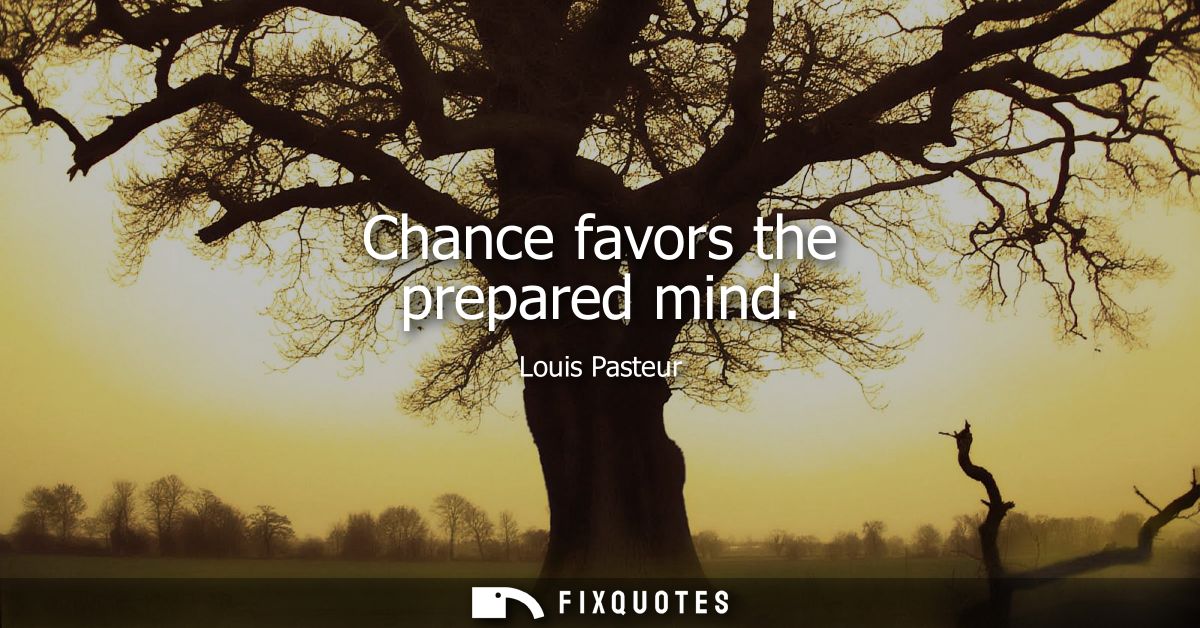
"Chance favors the prepared mind"
About this Quote
“Chance favors the prepared mind” is a neat demolition of the fairy tale version of discovery. Pasteur, a scientist who spent his life turning messy, invisible realities (microbes, fermentation, infection) into controllable knowledge, is arguing that “luck” isn’t a lightning bolt from the gods. It’s a pattern you’re trained to notice, a mistake you’re skilled enough to interpret, a weird result you don’t throw away because you know what a non-weird result would look like.
The intent is partly motivational, but it’s also territorial. In the 19th century, science was professionalizing: laboratories, methods, reputations. Pasteur is staking a claim that breakthroughs belong to disciplined inquiry, not to romantic genius or idle speculation. “Chance” still matters, he admits; experiments surprise you. The subtext is that surprise is useless unless you have the intellectual tools - and the humility - to treat anomaly as signal rather than noise.
The line works because it reframes agency without denying uncertainty. It flatters effort while keeping the world unpredictable. “Prepared” isn’t just knowledge; it’s habits: careful observation, documentation, skepticism, the willingness to rerun and refine. Even the aphorism’s balance does rhetorical work: chance is personified as a fickle patron, but the prepared mind is the one allowed into the room.
In cultural terms, it’s an early slogan for modern meritocracy with a scientist’s caveat: opportunity exists, but it’s legible only to those who’ve trained their perception.
The intent is partly motivational, but it’s also territorial. In the 19th century, science was professionalizing: laboratories, methods, reputations. Pasteur is staking a claim that breakthroughs belong to disciplined inquiry, not to romantic genius or idle speculation. “Chance” still matters, he admits; experiments surprise you. The subtext is that surprise is useless unless you have the intellectual tools - and the humility - to treat anomaly as signal rather than noise.
The line works because it reframes agency without denying uncertainty. It flatters effort while keeping the world unpredictable. “Prepared” isn’t just knowledge; it’s habits: careful observation, documentation, skepticism, the willingness to rerun and refine. Even the aphorism’s balance does rhetorical work: chance is personified as a fickle patron, but the prepared mind is the one allowed into the room.
In cultural terms, it’s an early slogan for modern meritocracy with a scientist’s caveat: opportunity exists, but it’s legible only to those who’ve trained their perception.
Quote Details
| Topic | Motivational |
|---|
More Quotes by Louis
Add to List