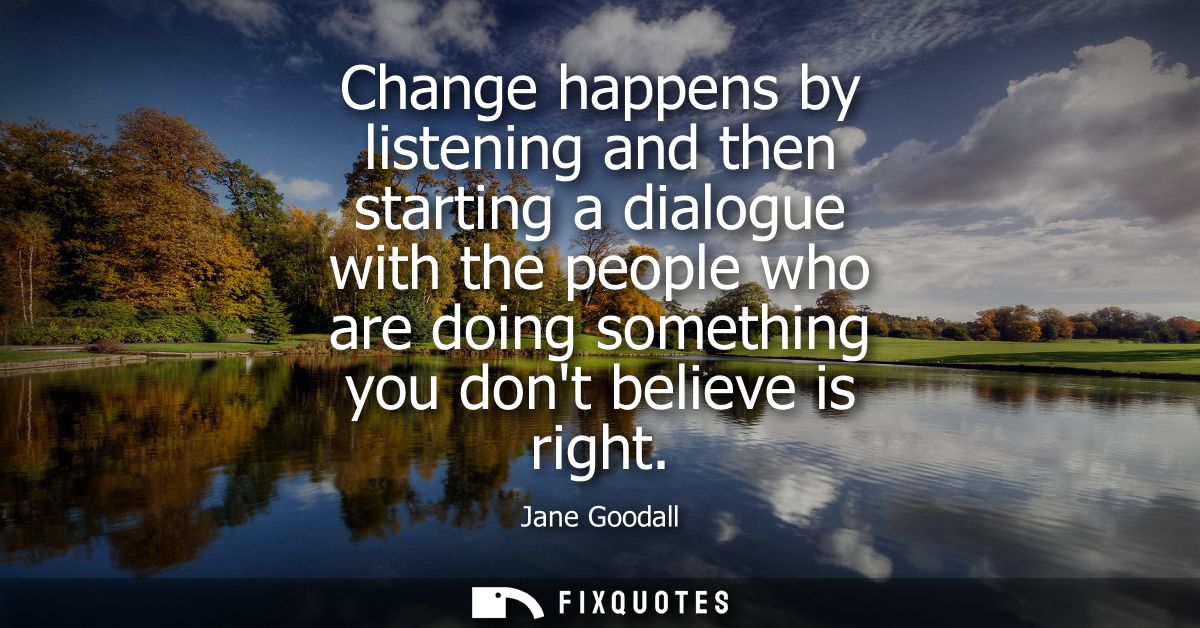
"Change happens by listening and then starting a dialogue with the people who are doing something you don't believe is right"
About this Quote
The subtext is a critique of purity politics. “People who are doing something you don’t believe is right” are not caricatures; they’re stakeholders, often embedded in economic systems, traditions, or survival strategies. Goodall doesn’t ask you to abandon your moral judgment, but she demotes it from a weapon to a compass. Dialogue isn’t kumbaya; it’s tactic. It’s how you uncover what someone is protecting (status, livelihood, identity) and where a face-saving off-ramp might exist.
There’s also a quiet power move here: by starting with listening, you seize epistemic control. You get better information, better leverage, and a better chance of building durable change instead of performative victory. In an era of viral condemnation and instant alignment tests, Goodall is arguing for a slower, more strategic kind of courage: engaging the “wrong” people long enough to make them movable.
Quote Details
| Topic | Change |
|---|---|
| Source | Help us find the source |
| Cite |
Citation Formats
APA Style (7th ed.)
Goodall, Jane. (2026, January 15). Change happens by listening and then starting a dialogue with the people who are doing something you don't believe is right. FixQuotes. https://fixquotes.com/quotes/change-happens-by-listening-and-then-starting-a-62140/
Chicago Style
Goodall, Jane. "Change happens by listening and then starting a dialogue with the people who are doing something you don't believe is right." FixQuotes. January 15, 2026. https://fixquotes.com/quotes/change-happens-by-listening-and-then-starting-a-62140/.
MLA Style (9th ed.)
"Change happens by listening and then starting a dialogue with the people who are doing something you don't believe is right." FixQuotes, 15 Jan. 2026, https://fixquotes.com/quotes/change-happens-by-listening-and-then-starting-a-62140/. Accessed 26 Mar. 2026.