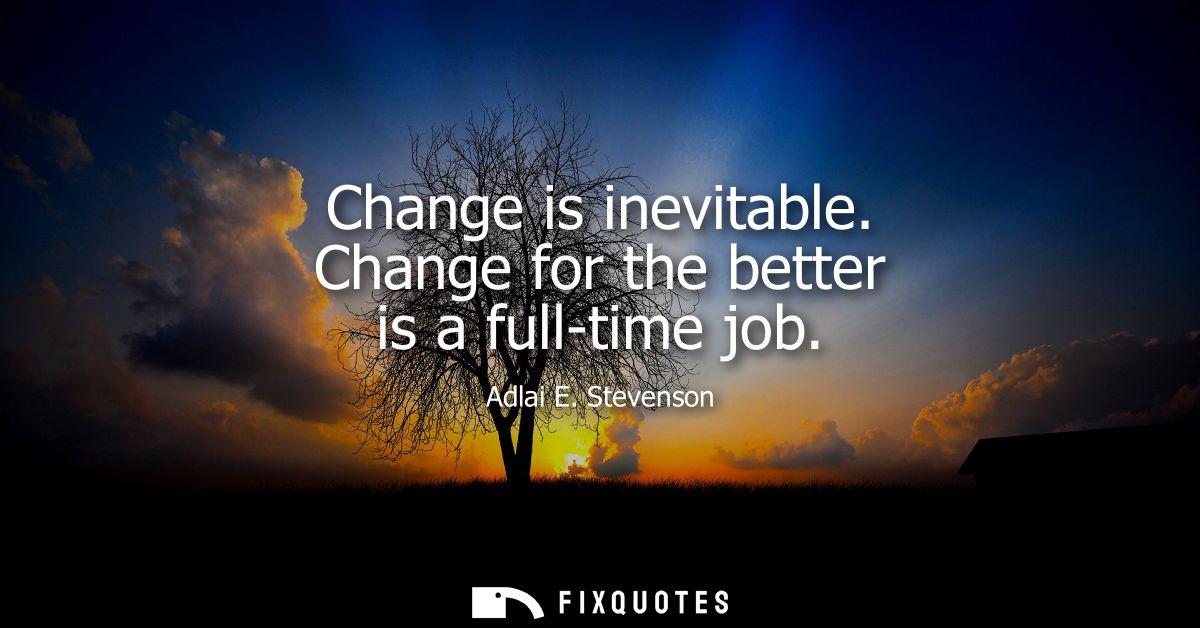
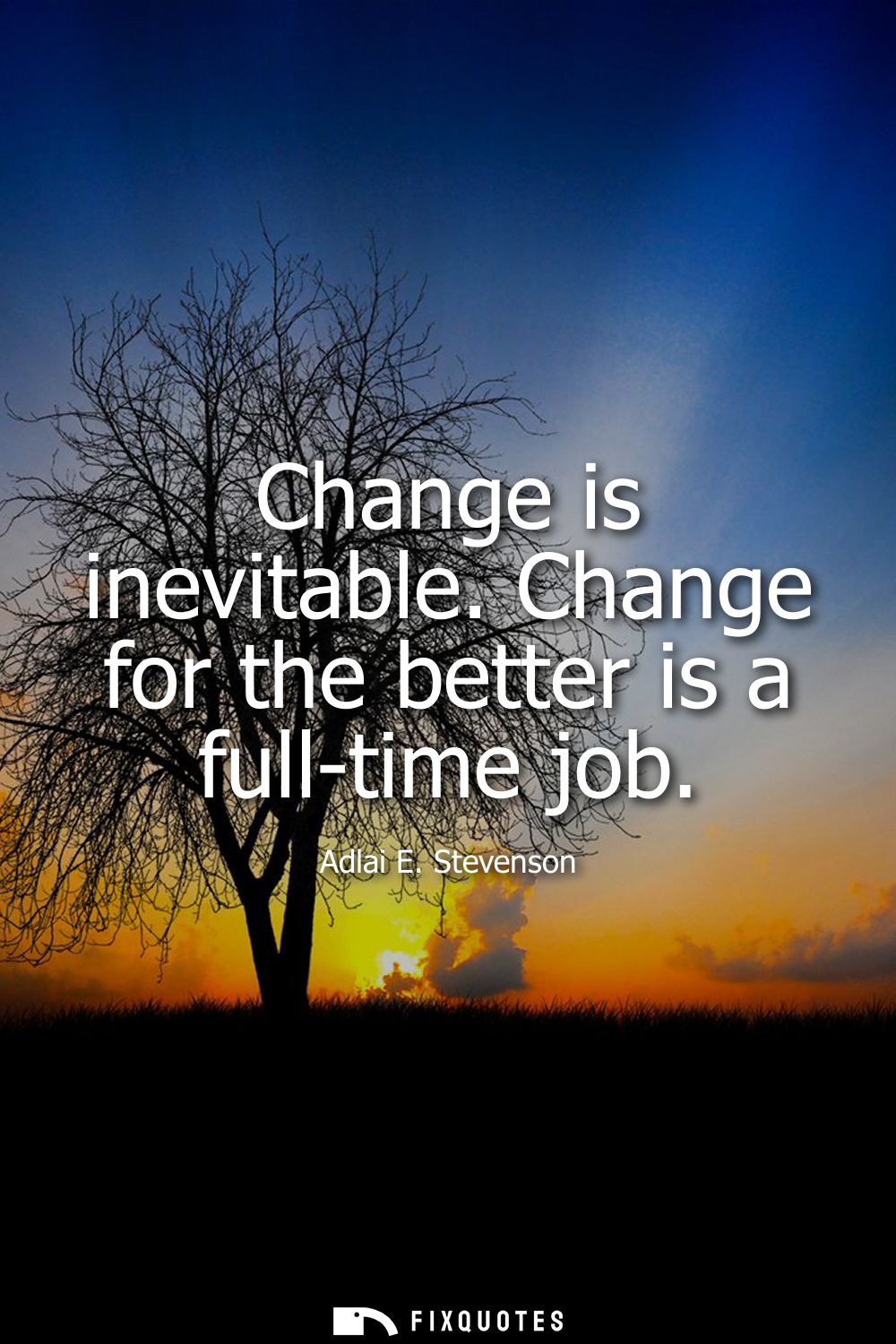
"Change is inevitable. Change for the better is a full-time job"
About this Quote
Stevenson’s line is a polite Midwestern slap to the face of complacency. The first sentence nods to a civic truism: history moves whether you vote, organize, or hide under the covers. But the second sentence yanks that comfort away. If change is inevitable, improvement is not. “For the better” is the battleground, and Stevenson frames it as labor, not destiny.
The phrase “a full-time job” does double duty. It domesticates politics, dragging lofty talk about progress down to the workbench: budgets, negotiations, coalition-building, tedious persuasion. It also carries a quiet rebuke to armchair idealists and periodic patriots who show up for election season and treat the rest of governance like someone else’s problem. Stevenson isn’t romanticizing hustle; he’s insisting that progress is maintenance. Like democracy, it degrades without attention.
Context matters. Stevenson was a leading liberal voice in the early Cold War, a moment when “change” arrived as threat as often as promise: nuclear anxiety, civil rights pressure, decolonization, televised politics, the expansion of the federal state. In that environment, the line reads as a defense of responsible, continuous reform against both reactionary nostalgia and utopian shortcuts. It suggests that the moral arc doesn’t bend by itself; it’s bent by people willing to do the unglamorous, daily work of making institutions behave.
The phrase “a full-time job” does double duty. It domesticates politics, dragging lofty talk about progress down to the workbench: budgets, negotiations, coalition-building, tedious persuasion. It also carries a quiet rebuke to armchair idealists and periodic patriots who show up for election season and treat the rest of governance like someone else’s problem. Stevenson isn’t romanticizing hustle; he’s insisting that progress is maintenance. Like democracy, it degrades without attention.
Context matters. Stevenson was a leading liberal voice in the early Cold War, a moment when “change” arrived as threat as often as promise: nuclear anxiety, civil rights pressure, decolonization, televised politics, the expansion of the federal state. In that environment, the line reads as a defense of responsible, continuous reform against both reactionary nostalgia and utopian shortcuts. It suggests that the moral arc doesn’t bend by itself; it’s bent by people willing to do the unglamorous, daily work of making institutions behave.
Quote Details
| Topic | Embrace Change |
|---|---|
| Source | Help us find the source |
More Quotes by Adlai
Add to List