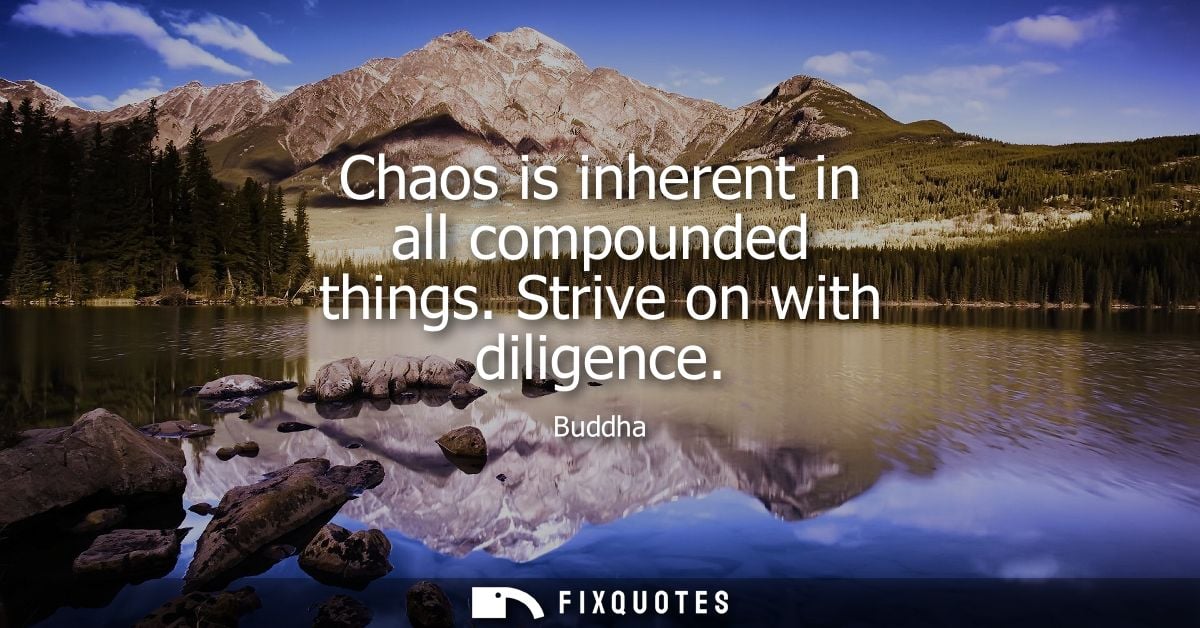
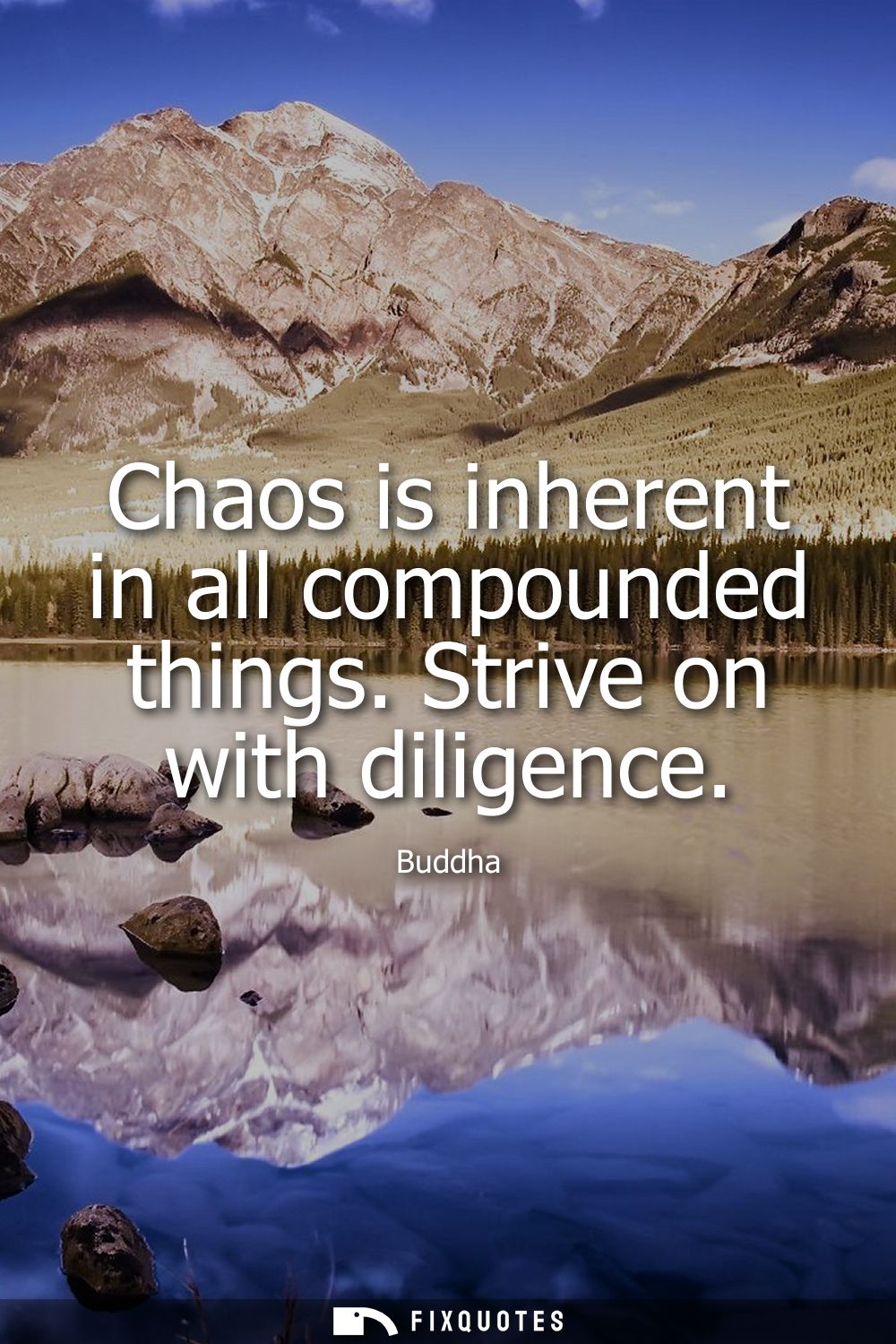
"Chaos is inherent in all compounded things. Strive on with diligence"
About this Quote
Impermanence arrives here not as a comforting mantra but as a tactical warning. “Chaos is inherent in all compounded things” strips the world of its false promise of stability: anything made of parts - bodies, relationships, institutions, even your carefully curated identity - is already mid-collapse. “Chaos” isn’t moral failure or cosmic punishment; it’s the built-in property of composition. By choosing the blunt, almost mechanical language of “compounded,” the line refuses sentimentality. It frames suffering as structural, not personal, and that shift is the first act of liberation: stop negotiating with the idea that life should hold still.
Then comes the pivot that makes the saying endure: “Strive on with diligence.” It’s not a pep talk; it’s an ethic built for a world that won’t stop moving. Buddha’s authority isn’t performative charisma so much as the credibility of someone pointing to a law of experience and offering a method rather than a slogan. The subtext is ruthless: you don’t get to wait for conditions to improve before practicing. Chaos is not the interruption; it’s the terrain.
In Buddhist context, this echoes the last-instruction energy often attributed to the Buddha: the teacher exits, the student remains, the path continues. Diligence (appamada, often translated as heedfulness) becomes a political and psychological stance - attention as resistance against drift, craving, and the soothing stories we tell to avoid the work. The line’s power is its refusal to bargain: nothing lasts, so practice as if it matters now.
Then comes the pivot that makes the saying endure: “Strive on with diligence.” It’s not a pep talk; it’s an ethic built for a world that won’t stop moving. Buddha’s authority isn’t performative charisma so much as the credibility of someone pointing to a law of experience and offering a method rather than a slogan. The subtext is ruthless: you don’t get to wait for conditions to improve before practicing. Chaos is not the interruption; it’s the terrain.
In Buddhist context, this echoes the last-instruction energy often attributed to the Buddha: the teacher exits, the student remains, the path continues. Diligence (appamada, often translated as heedfulness) becomes a political and psychological stance - attention as resistance against drift, craving, and the soothing stories we tell to avoid the work. The line’s power is its refusal to bargain: nothing lasts, so practice as if it matters now.
Quote Details
| Topic | Wisdom |
|---|---|
| Source | Dhammapada, verse 277 (Khuddaka Nikaya, Pali Canon). Commonly rendered as a short verse attributed to the Buddha: ‘All compounded things are impermanent; strive on with diligence.’ |
| Cite |
Citation Formats
APA Style (7th ed.)
Buddha. (2026, January 18). Chaos is inherent in all compounded things. Strive on with diligence. FixQuotes. https://fixquotes.com/quotes/chaos-is-inherent-in-all-compounded-things-strive-22157/
Chicago Style
Buddha. "Chaos is inherent in all compounded things. Strive on with diligence." FixQuotes. January 18, 2026. https://fixquotes.com/quotes/chaos-is-inherent-in-all-compounded-things-strive-22157/.
MLA Style (9th ed.)
"Chaos is inherent in all compounded things. Strive on with diligence." FixQuotes, 18 Jan. 2026, https://fixquotes.com/quotes/chaos-is-inherent-in-all-compounded-things-strive-22157/. Accessed 12 Feb. 2026.
More Quotes by Buddha
Add to List