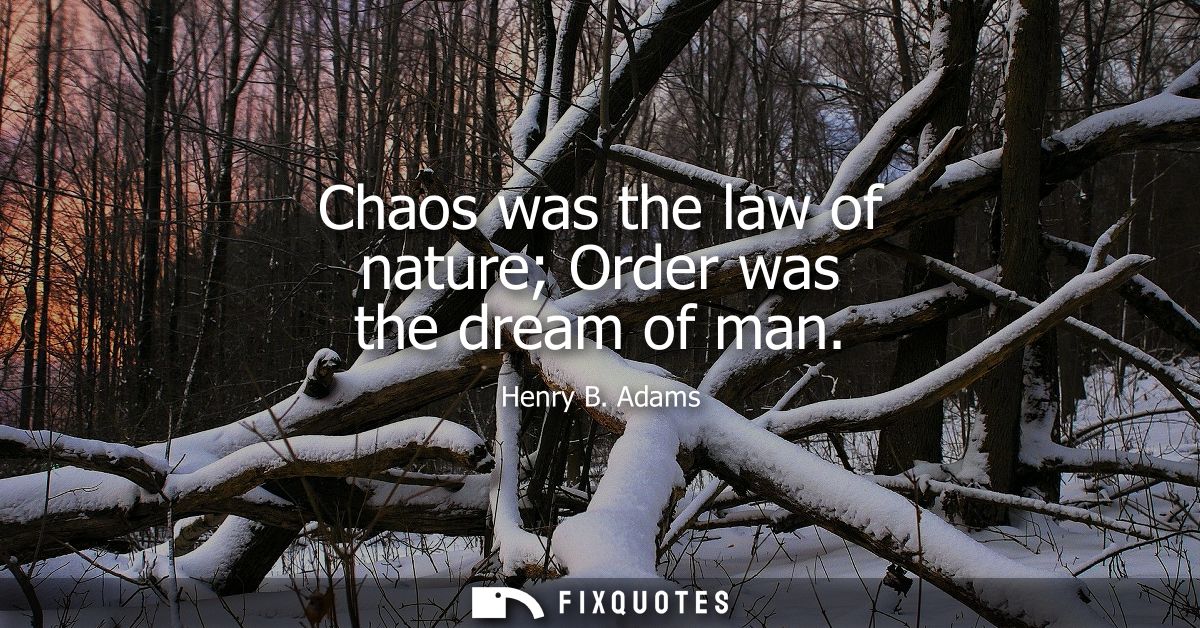
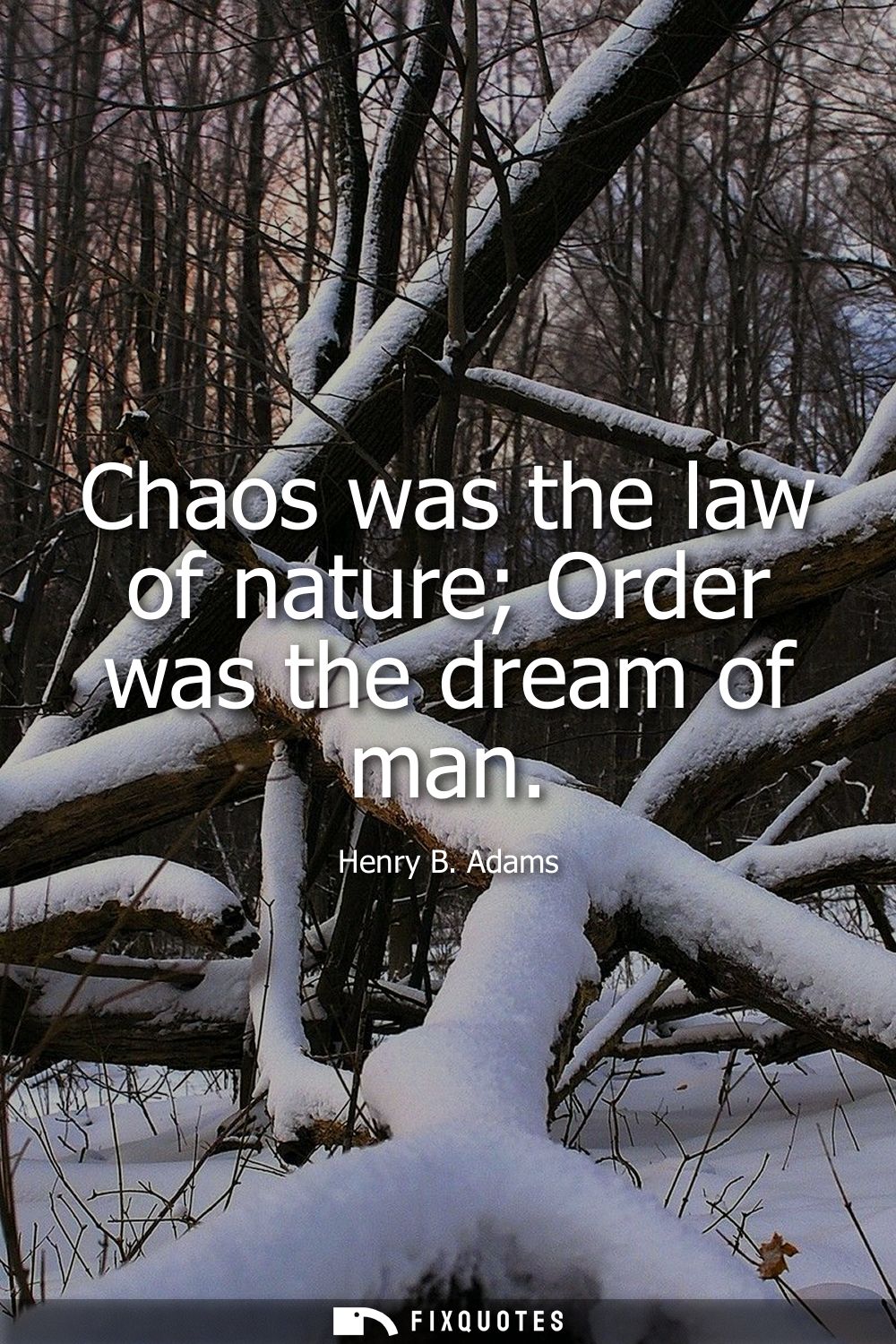
"Chaos was the law of nature; Order was the dream of man"
About this Quote
Adams frames modern life as a rigged contest: not good versus evil, but entropy versus our stubborn appetite for pattern. By calling chaos "the law of nature", he steals the language of authority. Law is impersonal, enforced without malice, and indifferent to protest. Then he flips registers with "Order was the dream of man" - not law, not fact, not even expectation, but dream: a private, tender, maybe delusional projection. The sentence works because it demotes human reason from ruler to wish-maker, leaving us with a bracingly unsentimental anthropology.
The subtext is less nihilism than diagnosis. Adams isn't saying order is worthless; he's saying it is manufactured, maintained, and always precarious. That matters coming from a historian watching the late 19th and early 20th centuries accelerate: industrial systems, imperial competition, new technologies, new bureaucracies - all claiming to rationalize the world while producing fresh instability. In Adams's mind, "progress" doesn't tame chaos; it just gives it larger, faster machinery.
There's also a sly critique of the American confidence project. A nation sold on managerial optimism and moral clarity gets reduced to a species dreaming of straight lines in a universe built on turbulence. The rhetoric is austere, almost scientific, but the emotional temperature is elegiac: a man of institutions admitting that institutions are sandcastles. Order remains essential, even noble - but it is art, not nature, and the artist is always working against the grain.
The subtext is less nihilism than diagnosis. Adams isn't saying order is worthless; he's saying it is manufactured, maintained, and always precarious. That matters coming from a historian watching the late 19th and early 20th centuries accelerate: industrial systems, imperial competition, new technologies, new bureaucracies - all claiming to rationalize the world while producing fresh instability. In Adams's mind, "progress" doesn't tame chaos; it just gives it larger, faster machinery.
There's also a sly critique of the American confidence project. A nation sold on managerial optimism and moral clarity gets reduced to a species dreaming of straight lines in a universe built on turbulence. The rhetoric is austere, almost scientific, but the emotional temperature is elegiac: a man of institutions admitting that institutions are sandcastles. Order remains essential, even noble - but it is art, not nature, and the artist is always working against the grain.
Quote Details
| Topic | Wisdom |
|---|---|
| Source | Attributed to Henry Adams in The Education of Henry Adams (1907). |
| Cite |
Citation Formats
APA Style (7th ed.)
Adams, Henry B. (2026, January 17). Chaos was the law of nature; Order was the dream of man. FixQuotes. https://fixquotes.com/quotes/chaos-was-the-law-of-nature-order-was-the-dream-48866/
Chicago Style
Adams, Henry B. "Chaos was the law of nature; Order was the dream of man." FixQuotes. January 17, 2026. https://fixquotes.com/quotes/chaos-was-the-law-of-nature-order-was-the-dream-48866/.
MLA Style (9th ed.)
"Chaos was the law of nature; Order was the dream of man." FixQuotes, 17 Jan. 2026, https://fixquotes.com/quotes/chaos-was-the-law-of-nature-order-was-the-dream-48866/. Accessed 12 Feb. 2026.
More Quotes by Henry
Add to List