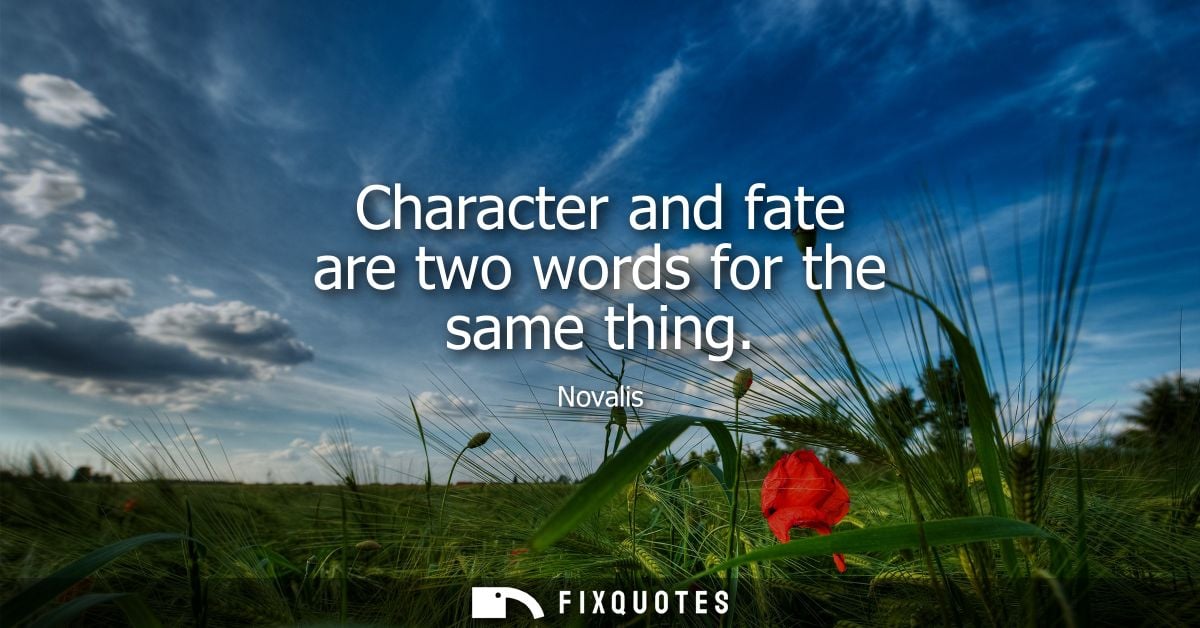
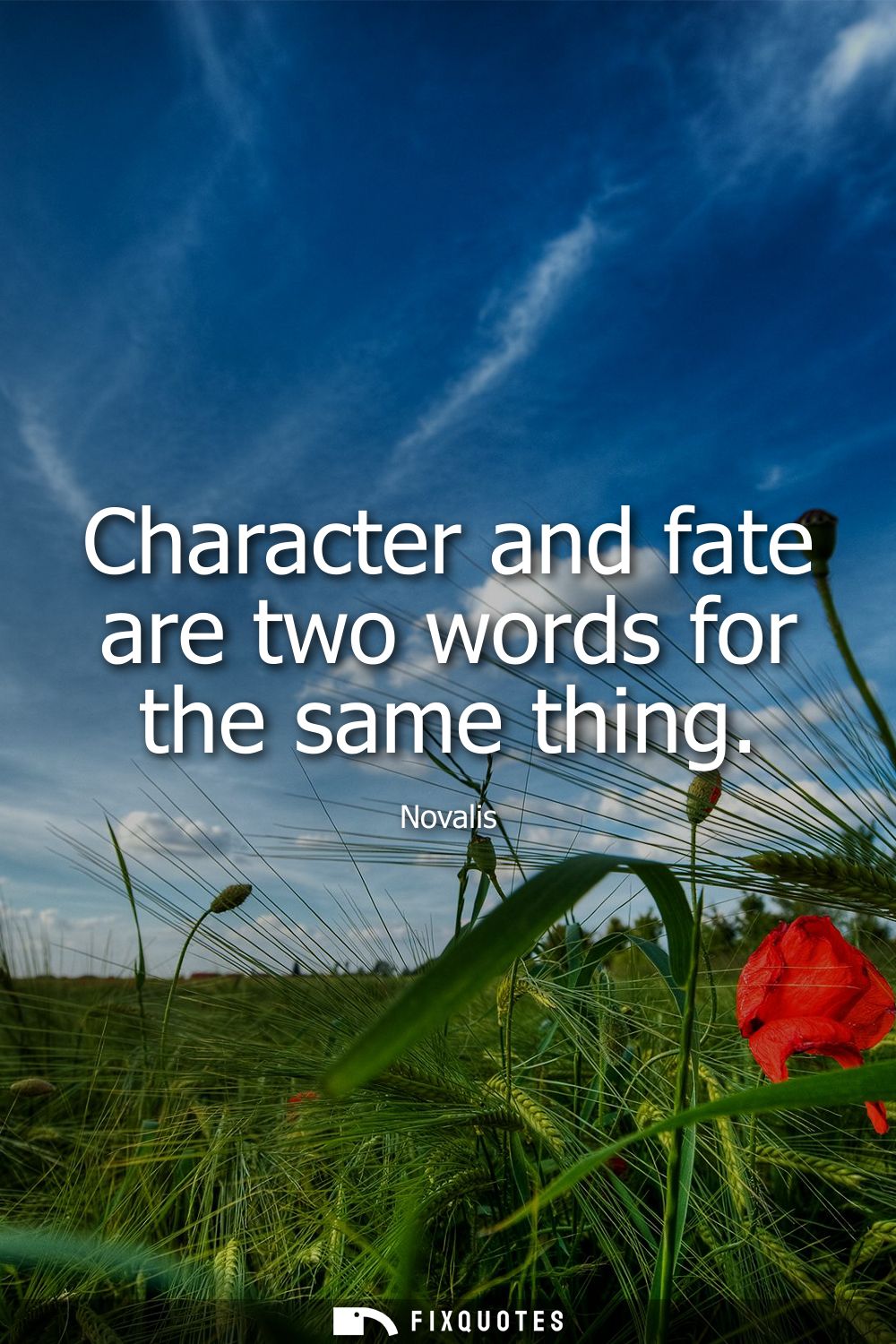
"Character and fate are two words for the same thing"
About this Quote
Novalis collapses the comforting gap between who you are and what happens to you. “Character and fate are two words for the same thing” reads like a Romantic mic drop: the universe isn’t a cold machine doling out random outcomes, and it isn’t a fairy-tale judge either. It’s your inner composition - your habits of attention, your desires, your moral reflexes - externalized over time until it looks like destiny.
The line works because it smuggles a hard claim inside a simple equivalence. “Fate” usually absolves; it’s what you blame when you want the story without the responsibility. “Character” indicts; it’s the slow accumulation of choices you can’t outsource. By declaring them synonyms, Novalis turns fate from an alibi into a mirror. That’s the subtext: the forces that seem to “happen to us” are often the predictable consequences of the selves we’ve rehearsed into being.
Context matters. Writing at the height of German Romanticism, Novalis was steeped in the era’s hunger to re-enchant modern life, to find spiritual meaning not in institutions but in interior experience. His twist is that the interior is not a private refuge; it has causal power. It shapes your relationships, your risks, your failures, even the kinds of coincidences you’re able to notice and seize.
There’s also a quiet provocation aimed at fatalism. If fate is character, then changing your fate isn’t a metaphysical petition - it’s self-work. That’s both liberating and brutal, which is why the sentence still lands.
The line works because it smuggles a hard claim inside a simple equivalence. “Fate” usually absolves; it’s what you blame when you want the story without the responsibility. “Character” indicts; it’s the slow accumulation of choices you can’t outsource. By declaring them synonyms, Novalis turns fate from an alibi into a mirror. That’s the subtext: the forces that seem to “happen to us” are often the predictable consequences of the selves we’ve rehearsed into being.
Context matters. Writing at the height of German Romanticism, Novalis was steeped in the era’s hunger to re-enchant modern life, to find spiritual meaning not in institutions but in interior experience. His twist is that the interior is not a private refuge; it has causal power. It shapes your relationships, your risks, your failures, even the kinds of coincidences you’re able to notice and seize.
There’s also a quiet provocation aimed at fatalism. If fate is character, then changing your fate isn’t a metaphysical petition - it’s self-work. That’s both liberating and brutal, which is why the sentence still lands.
Quote Details
| Topic | Free Will & Fate |
|---|---|
| Source | Later attribution: The Bestseller Code (Matthew Jockers, Jodie Archer, 2016) modern compilationISBN: 9780241243718 · ID: lPMnDAAAQBAJ
Evidence:
... Character and fate are two words for the same thing , " said the German philosopher Novalis . Heraclitus , the Greek philosopher , said : “ A man's character is his fate . " Consider , then , the likely fate of a character who grunts ... |
| Cite |
Citation Formats
APA Style (7th ed.)
Novalis. (2026, February 17). Character and fate are two words for the same thing. FixQuotes. https://fixquotes.com/quotes/character-and-fate-are-two-words-for-the-same-7996/
Chicago Style
Novalis. "Character and fate are two words for the same thing." FixQuotes. February 17, 2026. https://fixquotes.com/quotes/character-and-fate-are-two-words-for-the-same-7996/.
MLA Style (9th ed.)
"Character and fate are two words for the same thing." FixQuotes, 17 Feb. 2026, https://fixquotes.com/quotes/character-and-fate-are-two-words-for-the-same-7996/. Accessed 6 Mar. 2026.
More Quotes by Novalis
Add to List