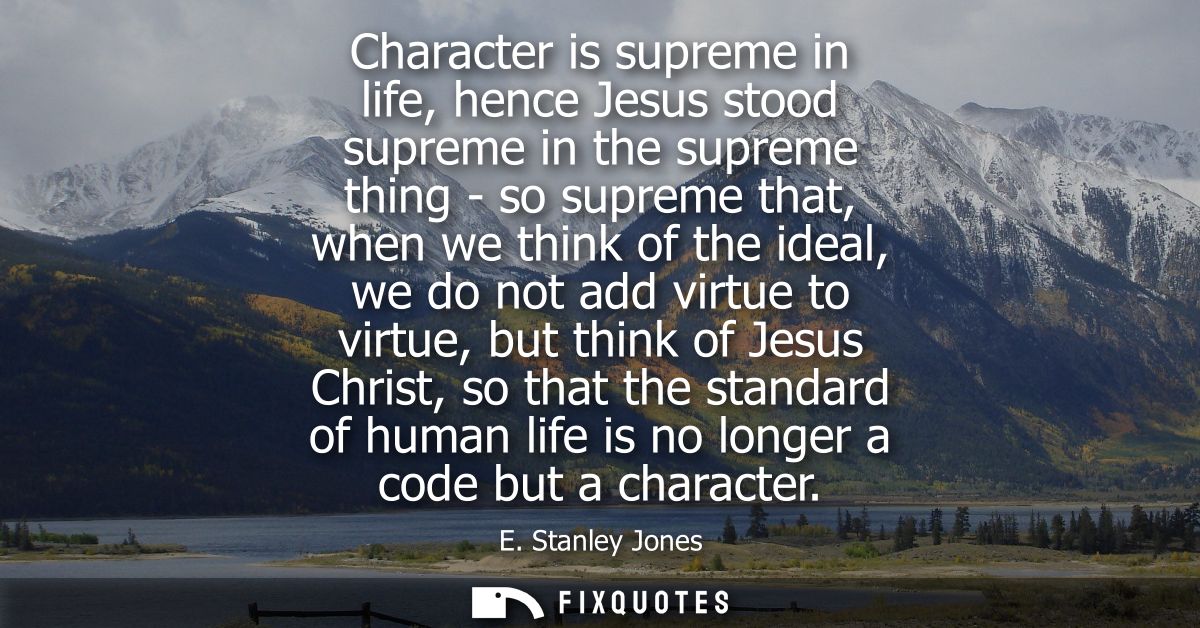
"Character is supreme in life, hence Jesus stood supreme in the supreme thing - so supreme that, when we think of the ideal, we do not add virtue to virtue, but think of Jesus Christ, so that the standard of human life is no longer a code but a character"
About this Quote
The subtext is an implicit critique of moral legalism, including the church’s temptation to reduce faith to a behavioral spreadsheet. When Jones says we "do not add virtue to virtue", he’s poking at the common modern (and very Protestant) instinct to treat holiness like self-improvement: stack enough traits and you’ll approximate goodness. He rejects that incremental model. Instead, he proposes a gestalt: the ideal coheres in a single life. That’s rhetorically savvy because it bypasses debate over which virtues matter most and relocates the argument in narrative, relationship, and imagination.
Context matters. Jones wrote and preached in the early-to-mid 20th century, when liberal moralism, revivalist fervor, and social upheavals all tugged Christianity toward either ethical uplift or doctrinal boundary-policing. His phrasing offers a third lane: a Christ-centered personalism shaped by missionary experience and an emerging interest in psychology and lived religion. The move from "code" to "character" also functions as a cultural strategy: it makes Christianity less like an institution issuing demands and more like a compelling human prototype. It’s persuasion by portrait, not by statute.
Quote Details
| Topic | Honesty & Integrity |
|---|---|
| Source | Help us find the source |
| Cite | Cite this Quote |
Citation Formats
APA Style (7th ed.)
Jones, E. Stanley. (n.d.). Character is supreme in life, hence Jesus stood supreme in the supreme thing - so supreme that, when we think of the ideal, we do not add virtue to virtue, but think of Jesus Christ, so that the standard of human life is no longer a code but a character. FixQuotes. https://fixquotes.com/quotes/character-is-supreme-in-life-hence-jesus-stood-9761/
Chicago Style
Jones, E. Stanley. "Character is supreme in life, hence Jesus stood supreme in the supreme thing - so supreme that, when we think of the ideal, we do not add virtue to virtue, but think of Jesus Christ, so that the standard of human life is no longer a code but a character." FixQuotes. Accessed February 3, 2026. https://fixquotes.com/quotes/character-is-supreme-in-life-hence-jesus-stood-9761/.
MLA Style (9th ed.)
"Character is supreme in life, hence Jesus stood supreme in the supreme thing - so supreme that, when we think of the ideal, we do not add virtue to virtue, but think of Jesus Christ, so that the standard of human life is no longer a code but a character." FixQuotes, https://fixquotes.com/quotes/character-is-supreme-in-life-hence-jesus-stood-9761/. Accessed 3 Feb. 2026.