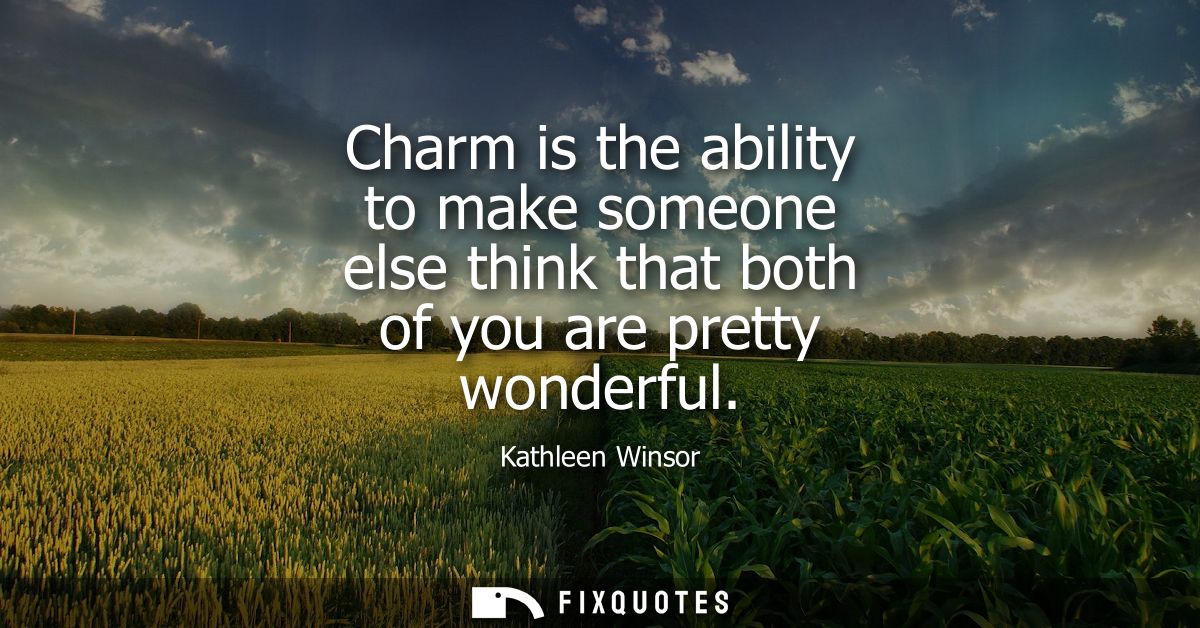
"Charm is the ability to make someone else think that both of you are pretty wonderful"
About this Quote
The subtext is mildly cynical but not cruel. Winsor reframes charm as a skill in managing perceptions, not a property of the self. That shift matters. It punctures the romantic myth that charisma is innate or mysterious and replaces it with something more practical: emotional choreography. "Both of you" is the tell. The charmer doesn't merely flatter; they create a shared story in which the other person is smart to be impressed and the charmer is modest enough to be impressed back. It's reciprocity staged so smoothly it reads as chemistry.
Context helps, too. Winsor built her career on sweeping historical melodrama and social maneuvering, worlds where status is negotiated in drawing rooms as much as in bedrooms. Her definition of charm fits a writer attuned to how people climb, survive, and seduce through conversation. There's also a gendered edge: for a woman writing in the mid-20th century, "charm" is both weapon and expectation, one of the few socially sanctioned forms of influence. Winsor's line acknowledges that reality while quietly demystifying it: charm works because it makes vanity feel like connection.
Quote Details
| Topic | Friendship |
|---|---|
| Source | Help us find the source |
| Cite |
Citation Formats
APA Style (7th ed.)
Winsor, Kathleen. (2026, January 15). Charm is the ability to make someone else think that both of you are pretty wonderful. FixQuotes. https://fixquotes.com/quotes/charm-is-the-ability-to-make-someone-else-think-170152/
Chicago Style
Winsor, Kathleen. "Charm is the ability to make someone else think that both of you are pretty wonderful." FixQuotes. January 15, 2026. https://fixquotes.com/quotes/charm-is-the-ability-to-make-someone-else-think-170152/.
MLA Style (9th ed.)
"Charm is the ability to make someone else think that both of you are pretty wonderful." FixQuotes, 15 Jan. 2026, https://fixquotes.com/quotes/charm-is-the-ability-to-make-someone-else-think-170152/. Accessed 6 Mar. 2026.