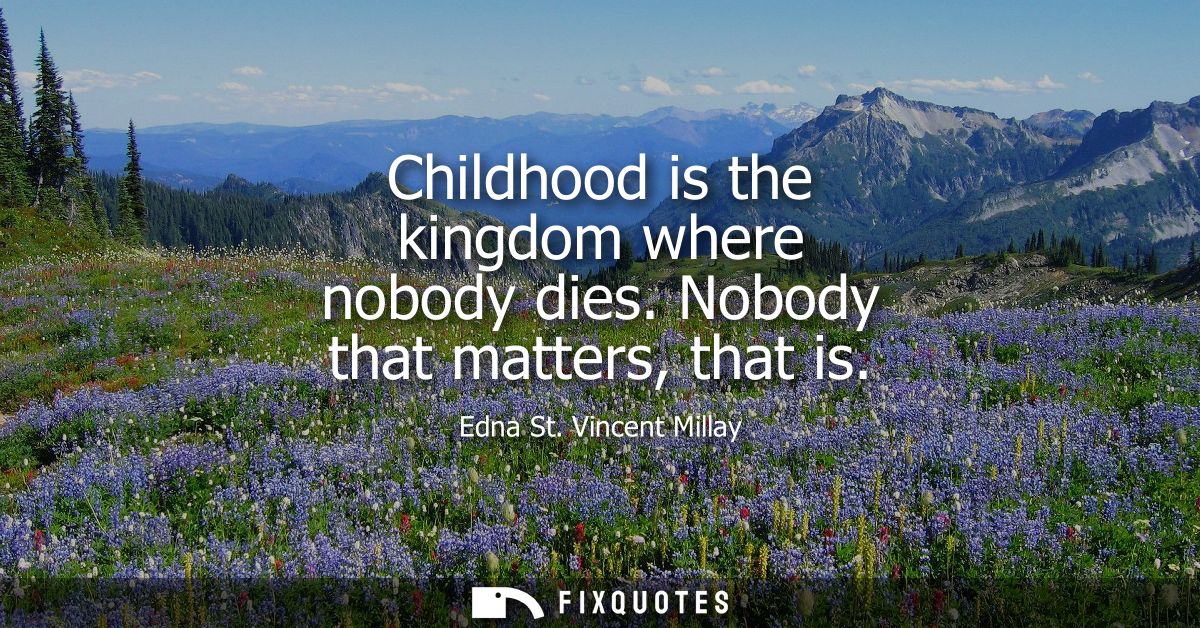
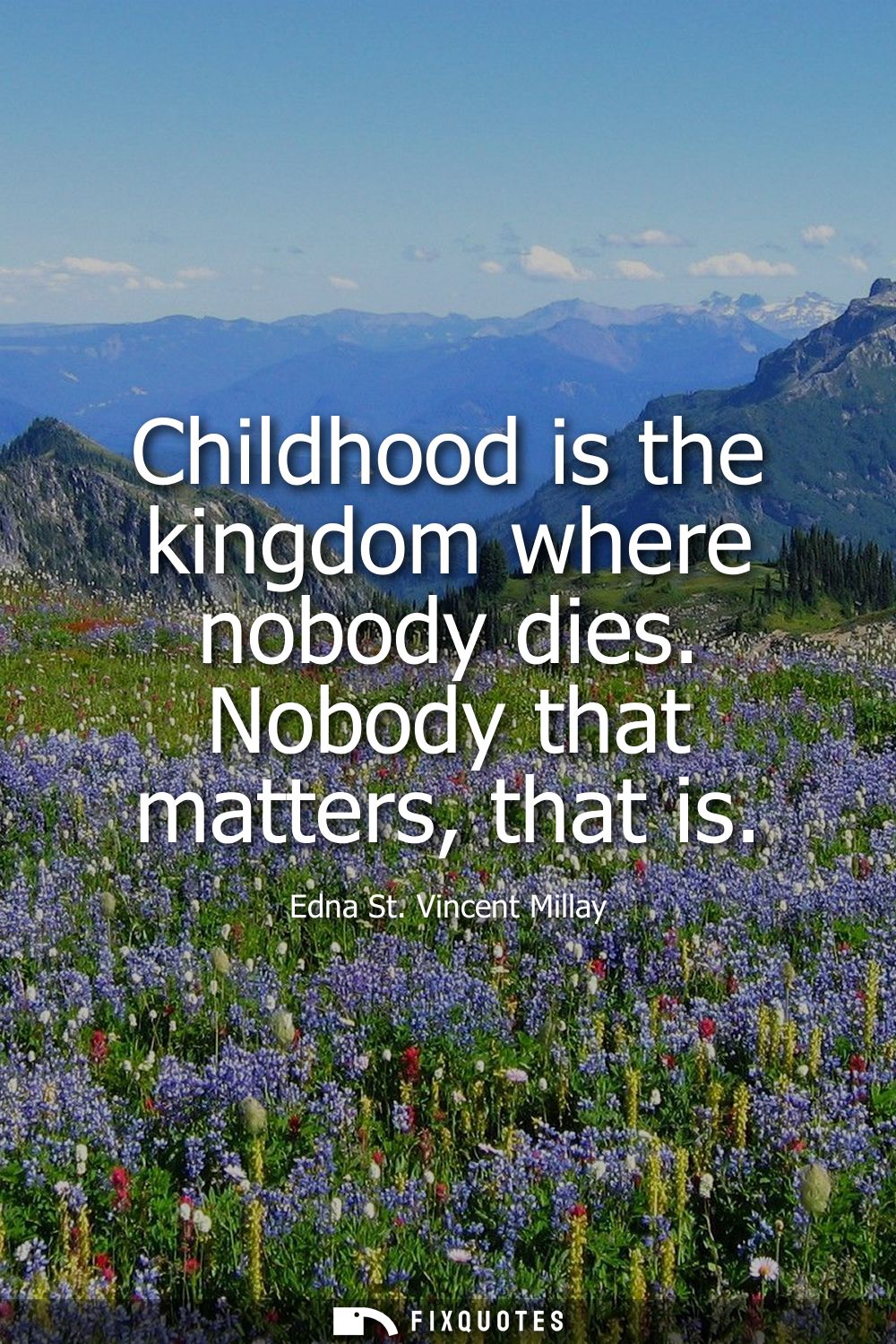
"Childhood is the kingdom where nobody dies. Nobody that matters, that is"
About this Quote
Then Millay delivers the real truth in a parenthetical twist: “Nobody that matters, that is.” It’s a small clause with a big moral accusation. Childhood, she suggests, isn’t innocence; it’s selective attention granted by privilege and caretaking. Pets die, distant relatives vanish, news drifts in from wars and epidemics, but the people who form the child’s universe are protected - or at least the child is protected from the full meaning of their fragility. The line exposes the quiet cruelty of that insulation: it teaches a hierarchy of grief before it teaches grief itself.
Context matters here. Millay’s era was thick with early death (World War I’s shadow, the 1918 flu, high infant mortality). Her modern sensibility doesn’t romanticize the past; it interrogates the stories we tell to survive it. The quote works because it mimics childhood’s own mechanism: sweeping certainty followed by an asterisk, the moment you realize the world has always been conditional.
Quote Details
| Topic | Nostalgia |
|---|---|
| Source | Help us find the source |
| Cite |
Citation Formats
APA Style (7th ed.)
Millay, Edna St. Vincent. (2026, January 17). Childhood is the kingdom where nobody dies. Nobody that matters, that is. FixQuotes. https://fixquotes.com/quotes/childhood-is-the-kingdom-where-nobody-dies-nobody-47694/
Chicago Style
Millay, Edna St. Vincent. "Childhood is the kingdom where nobody dies. Nobody that matters, that is." FixQuotes. January 17, 2026. https://fixquotes.com/quotes/childhood-is-the-kingdom-where-nobody-dies-nobody-47694/.
MLA Style (9th ed.)
"Childhood is the kingdom where nobody dies. Nobody that matters, that is." FixQuotes, 17 Jan. 2026, https://fixquotes.com/quotes/childhood-is-the-kingdom-where-nobody-dies-nobody-47694/. Accessed 12 Feb. 2026.