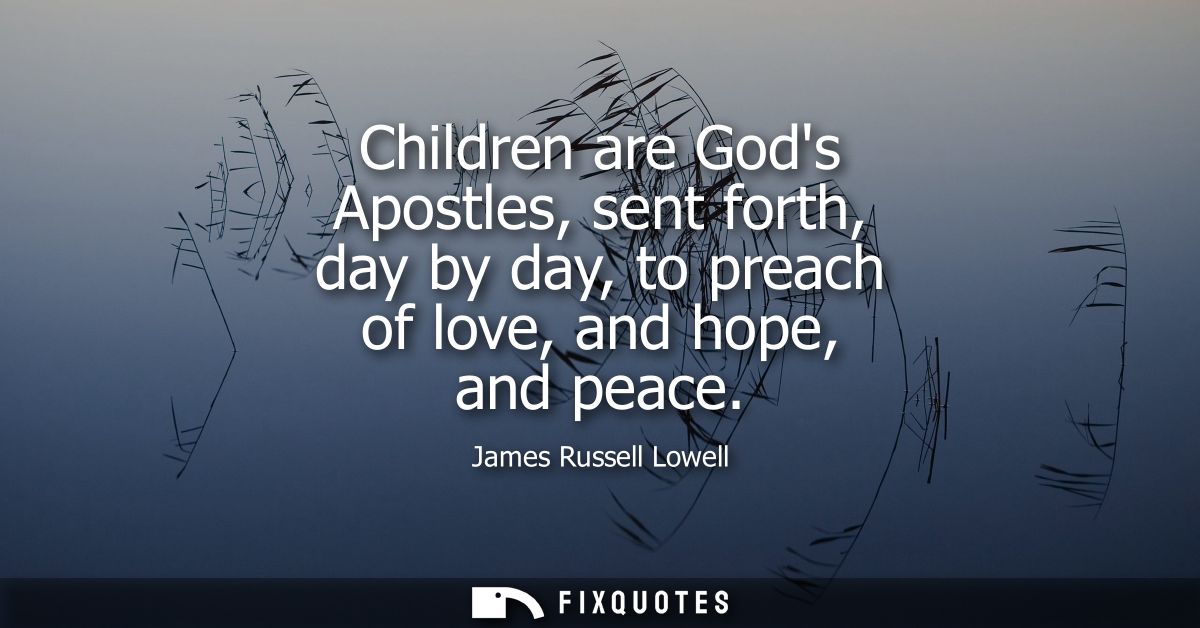
"Children are God's Apostles, sent forth, day by day, to preach of love, and hope, and peace"
About this Quote
Lowell turns childhood into a kind of daily dispatch from the divine, and the move is sneakier than it looks. By calling children "God's Apostles", he borrows the authority of Christianity’s most mission-driven figures, then swaps doctrine for a softer gospel: "love, and hope, and peace". The triad reads like a hymn refrain, but it’s also a rhetorical jailbreak. If the highest spiritual messengers are kids, then the adults who claim moral leadership - politicians, preachers, reformers - suddenly look secondhand. Innocence becomes a critique.
The line’s intent fits Lowell’s 19th-century moral imagination: a Protestant-inflected culture where sentiment, faith, and social reform braided together. Lowell was a poet with abolitionist sympathies and a public voice in an era that liked its ethics uplifted, legible, and emotionally compelling. This is uplift, but with a point: children don’t just symbolize the future; they pressure the present. They "preach" simply by existing, which implies that cruelty, cynicism, and violence are not inevitable features of human nature but adult habits that have calcified.
The subtext flatters and accuses at once. It invites adults to see children as sacred - then dares them to act like it. "Day by day" sharpens the demand: not a Christmas-card reverence for kids, but an everyday standard that keeps returning, small and relentless, to measure the world we’ve built.
The line’s intent fits Lowell’s 19th-century moral imagination: a Protestant-inflected culture where sentiment, faith, and social reform braided together. Lowell was a poet with abolitionist sympathies and a public voice in an era that liked its ethics uplifted, legible, and emotionally compelling. This is uplift, but with a point: children don’t just symbolize the future; they pressure the present. They "preach" simply by existing, which implies that cruelty, cynicism, and violence are not inevitable features of human nature but adult habits that have calcified.
The subtext flatters and accuses at once. It invites adults to see children as sacred - then dares them to act like it. "Day by day" sharpens the demand: not a Christmas-card reverence for kids, but an everyday standard that keeps returning, small and relentless, to measure the world we’ve built.
Quote Details
| Topic | God |
|---|
More Quotes by James
Add to List