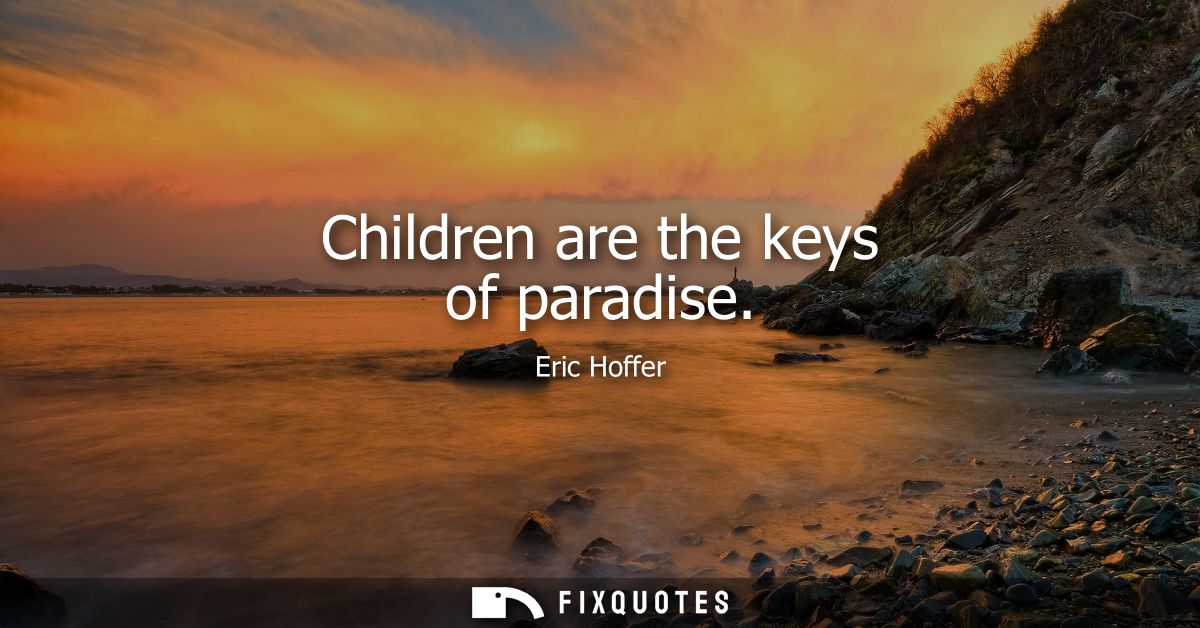
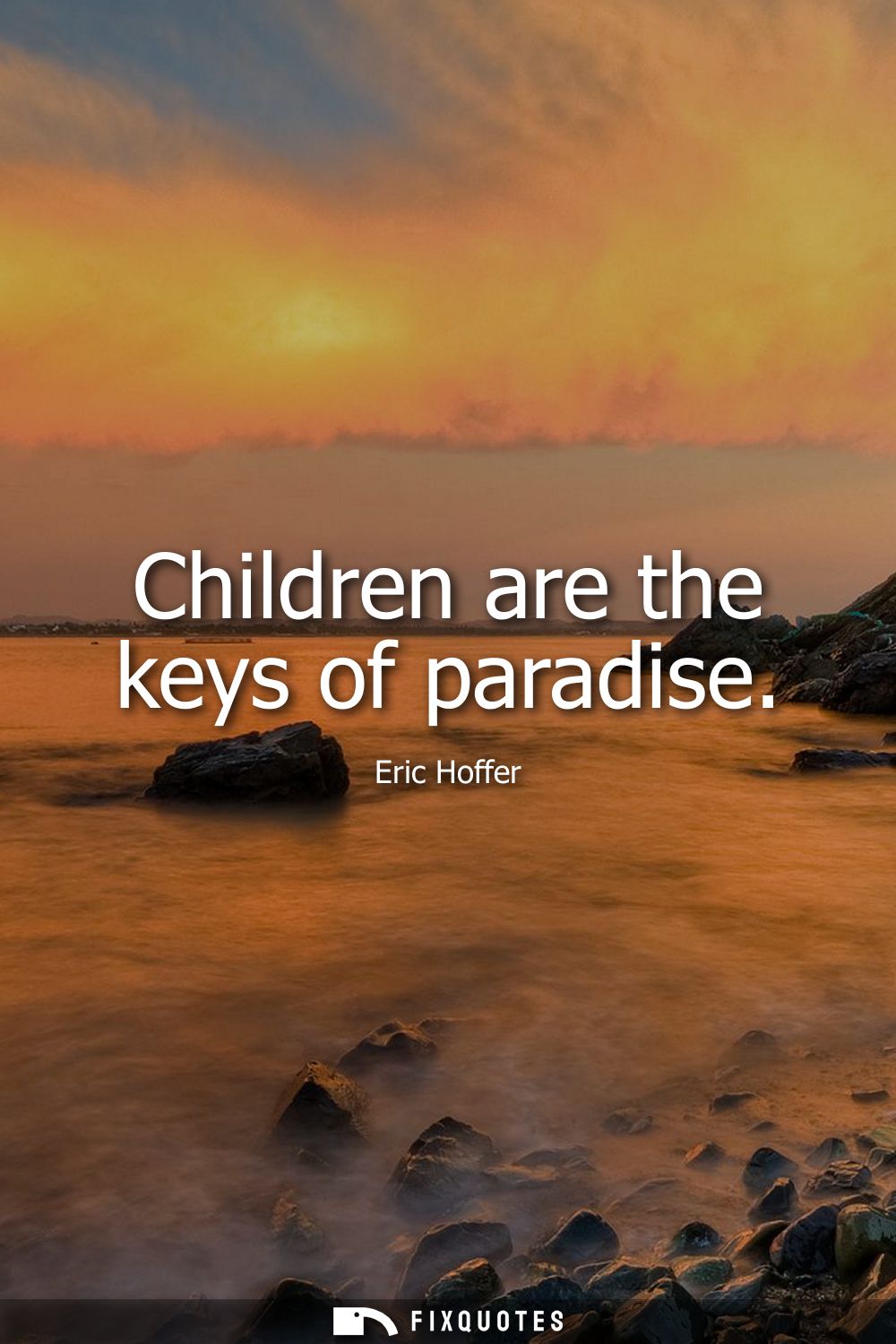
"Children are the keys of paradise"
About this Quote
“Children are the keys of paradise” lands like a proverb, but Hoffer isn’t doing Hallmark. He’s a hard-eyed thinker about mass movements and modern loneliness, and that background gives the line its bite. “Keys” implies access, not ownership: paradise isn’t a place you can purchase or conquer through ideology, work ethic, or national myth. It’s something you unlock, briefly, through a relationship that forces you out of the self.
The subtext is almost anti-utopian. Hoffer spent his life watching adults chase grand schemes that promise salvation and deliver conformity. By contrast, children represent a stubborn, inconvenient reality that can’t be fully instrumentalized. They demand patience, attention, humility, and a future-mindedness that doesn’t fit the dopamine loop of politics or ambition. If paradise is a state of grace, it’s not achieved by self-perfection but by responsibility for someone who is, by definition, unfinished.
The phrase also smuggles in a critique of the modern “serious person.” Adults like to believe they’re guided by reason; Hoffer suggests we’re more often guided by abstraction. Children puncture abstraction. They make you notice time, bodies, boredom, delight - the unglamorous textures that ideologues overlook. Calling them “keys” flips the hierarchy: the powerless open the door, the powerful stand outside jingling their credentials.
It’s sentimental on the surface, austere underneath. Paradise isn’t promised after death; it’s available in flashes, in the daily work of care, and it’s children who force the door open.
The subtext is almost anti-utopian. Hoffer spent his life watching adults chase grand schemes that promise salvation and deliver conformity. By contrast, children represent a stubborn, inconvenient reality that can’t be fully instrumentalized. They demand patience, attention, humility, and a future-mindedness that doesn’t fit the dopamine loop of politics or ambition. If paradise is a state of grace, it’s not achieved by self-perfection but by responsibility for someone who is, by definition, unfinished.
The phrase also smuggles in a critique of the modern “serious person.” Adults like to believe they’re guided by reason; Hoffer suggests we’re more often guided by abstraction. Children puncture abstraction. They make you notice time, bodies, boredom, delight - the unglamorous textures that ideologues overlook. Calling them “keys” flips the hierarchy: the powerless open the door, the powerful stand outside jingling their credentials.
It’s sentimental on the surface, austere underneath. Paradise isn’t promised after death; it’s available in flashes, in the daily work of care, and it’s children who force the door open.
Quote Details
| Topic | Parenting |
|---|---|
| Source | Help us find the source |
| Cite |
Citation Formats
APA Style (7th ed.)
Hoffer, Eric. (2026, January 15). Children are the keys of paradise. FixQuotes. https://fixquotes.com/quotes/children-are-the-keys-of-paradise-31073/
Chicago Style
Hoffer, Eric. "Children are the keys of paradise." FixQuotes. January 15, 2026. https://fixquotes.com/quotes/children-are-the-keys-of-paradise-31073/.
MLA Style (9th ed.)
"Children are the keys of paradise." FixQuotes, 15 Jan. 2026, https://fixquotes.com/quotes/children-are-the-keys-of-paradise-31073/. Accessed 7 Apr. 2026.
More Quotes by Eric
Add to List