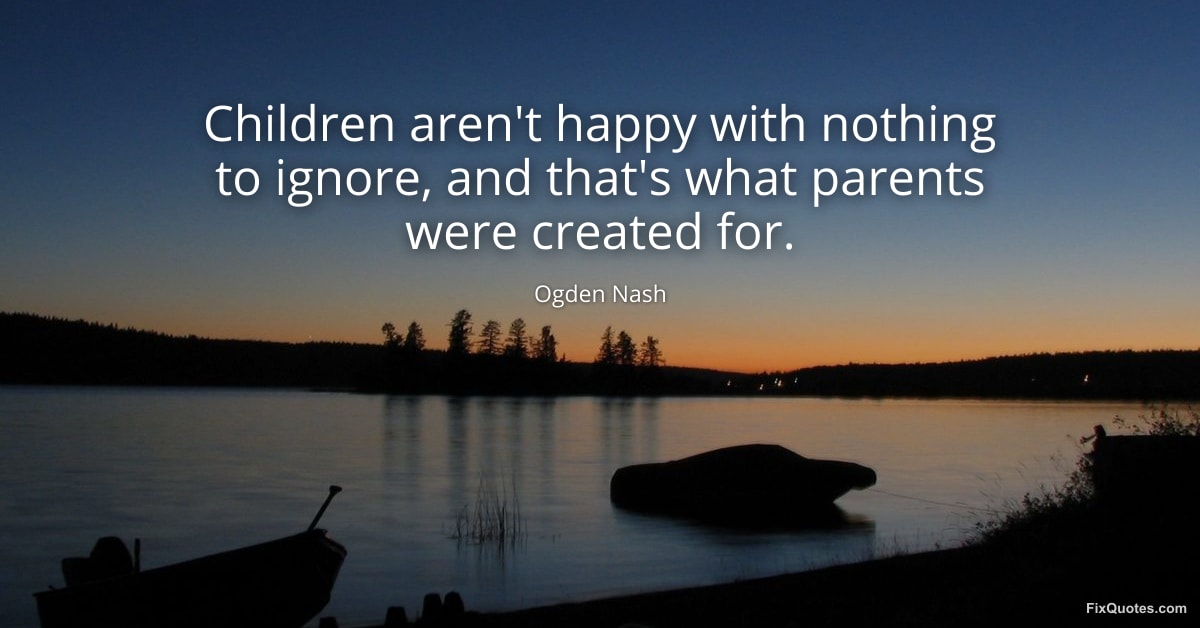
"Children aren't happy with nothing to ignore, and that's what parents were created for"
About this Quote
Leave it to Ogden Nash to turn the cozy myth of parenthood inside out with a single, jaunty barb. "Children aren't happy with nothing to ignore" lands like a nursery-room truth adults spend years pretending isn’t true: a child’s attention is a battlefield, and peace often arrives only when there’s a rule to break or a voice to tune out. Nash’s genius is the inversion. Parents, in the sentimental script, are protectors and guides; here they’re purpose-built scenery for defiance, the human equivalent of a "Do Not Touch" sign.
The line works because it’s both absurd and eerily accurate. It flatters children with a kind of anarchic agency - they don’t merely misbehave; they curate their own friction. Ignoring becomes less a failure of manners than an active pastime, a way to test the boundaries that make a world feel legible. In that sense, Nash is smuggling a developmental insight into a punchline: kids need resistance to locate themselves.
Context matters. Nash wrote in mid-century America, when domestic ideals were being aggressively polished into advertisements: the cheerful family, the competent mother, the stable father. His comic poetry routinely punctured that varnish by treating home life as a site of chaos managed through wit rather than authority. The subtext is sympathetic to parents and gently ruthless about the role they’re handed: not just to raise children, but to absorb their disregard without collapsing. It’s a joke that doubles as a small act of mercy.
The line works because it’s both absurd and eerily accurate. It flatters children with a kind of anarchic agency - they don’t merely misbehave; they curate their own friction. Ignoring becomes less a failure of manners than an active pastime, a way to test the boundaries that make a world feel legible. In that sense, Nash is smuggling a developmental insight into a punchline: kids need resistance to locate themselves.
Context matters. Nash wrote in mid-century America, when domestic ideals were being aggressively polished into advertisements: the cheerful family, the competent mother, the stable father. His comic poetry routinely punctured that varnish by treating home life as a site of chaos managed through wit rather than authority. The subtext is sympathetic to parents and gently ruthless about the role they’re handed: not just to raise children, but to absorb their disregard without collapsing. It’s a joke that doubles as a small act of mercy.
Quote Details
| Topic | Parenting |
|---|---|
| Source | Help us find the source |
More Quotes by Ogden
Add to List