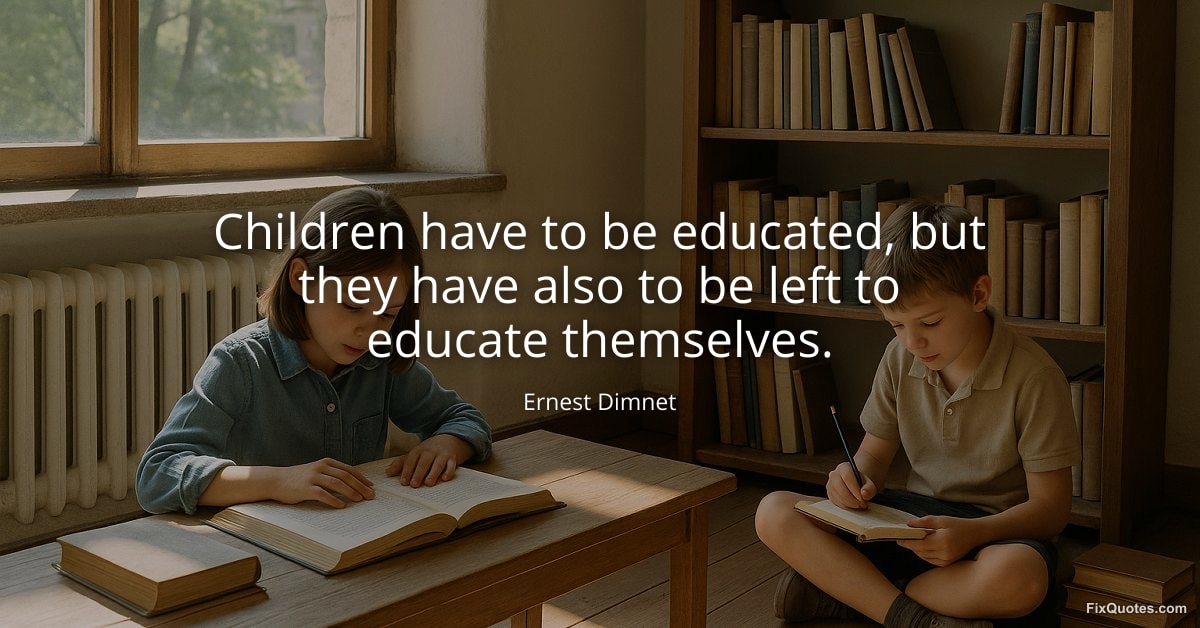
"Children have to be educated, but they have also to be left to educate themselves"
About this Quote
The first clause grants authority to institutions and elders. Children “have to be educated” is not optional, not trendy, not a lifestyle choice. It’s duty. The second clause flips that duty into restraint. “Left to educate themselves” isn’t a libertarian free-for-all; it’s an insistence that real learning can’t be outsourced. You can impose curriculum, discipline, and values, but you cannot impose understanding. The child’s interior life has to do the work.
The subtext is almost pastoral: an admission of limits. Adults can set the table, but they can’t digest the meal. And because Dimnet is a priest, “self-education” also carries a moral and spiritual edge: conscience must be formed, yes, but it must also awaken from within. Virtue coerced is just compliance with better branding.
What makes the sentence effective is its balanced construction. It’s a hinge, not a slogan. The repetition of “have to” frames freedom as something deliberately protected, not casually granted. Dimnet isn’t romanticizing childhood; he’s warning educators against confusing control with success, and reminding parents that the goal is not a well-managed child, but a self-directed person.
Quote Details
| Topic | Learning |
|---|---|
| Source | Later attribution: Ernest Dimnet (Ernest Dimnet) modern compilation
Evidence: t p 119 children have to be educated but they have also to be left to educate themselves attributed Other candidates (2) Inspiring Thoughts of Great Educational Thinkers (Dr. VIMAL KISHOR, 2015) compilation95.0% ... Children have to be educated, but they have also to be left to educate themselves. -- Ernest Dimnet Children must... Paul Bourget (Dimnet, Ernest, 1866-1954, 1913) primary40.0% n and varied to infinity by the collusion of imagination and leisure but they have to be abundantly |
| Featured | This quote was our Quote of the Day on August 26, 2025 |
| Cite |
Citation Formats
APA Style (7th ed.)
Dimnet, Ernest. (2026, February 7). Children have to be educated, but they have also to be left to educate themselves. FixQuotes. https://fixquotes.com/quotes/children-have-to-be-educated-but-they-have-also-127233/
Chicago Style
Dimnet, Ernest. "Children have to be educated, but they have also to be left to educate themselves." FixQuotes. February 7, 2026. https://fixquotes.com/quotes/children-have-to-be-educated-but-they-have-also-127233/.
MLA Style (9th ed.)
"Children have to be educated, but they have also to be left to educate themselves." FixQuotes, 7 Feb. 2026, https://fixquotes.com/quotes/children-have-to-be-educated-but-they-have-also-127233/. Accessed 27 Mar. 2026.