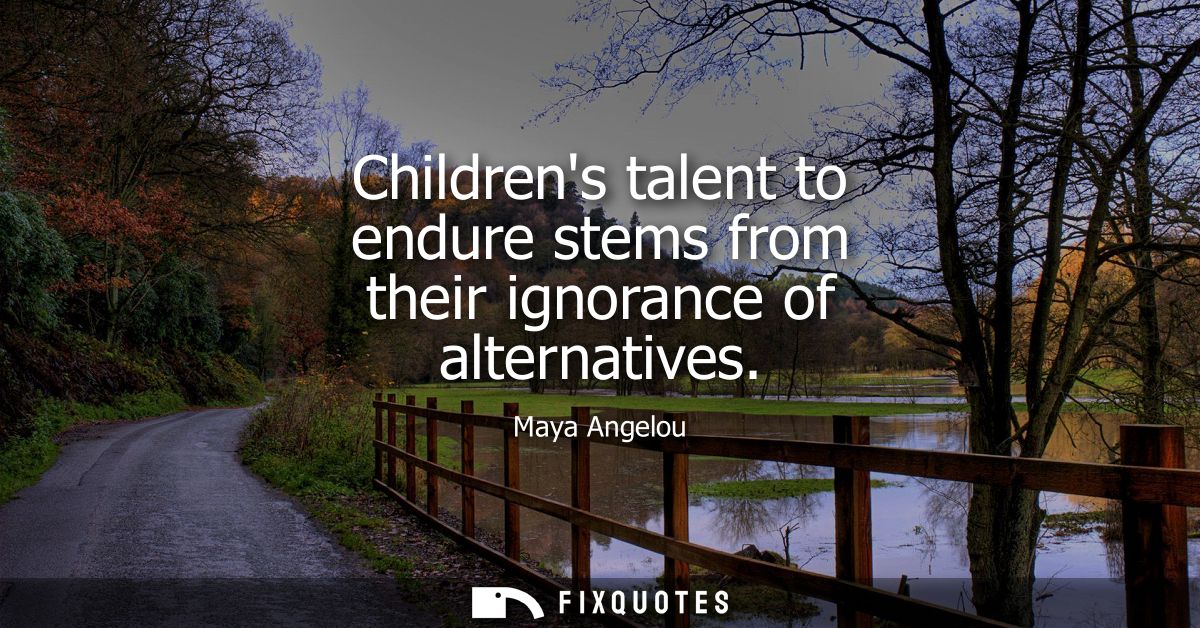
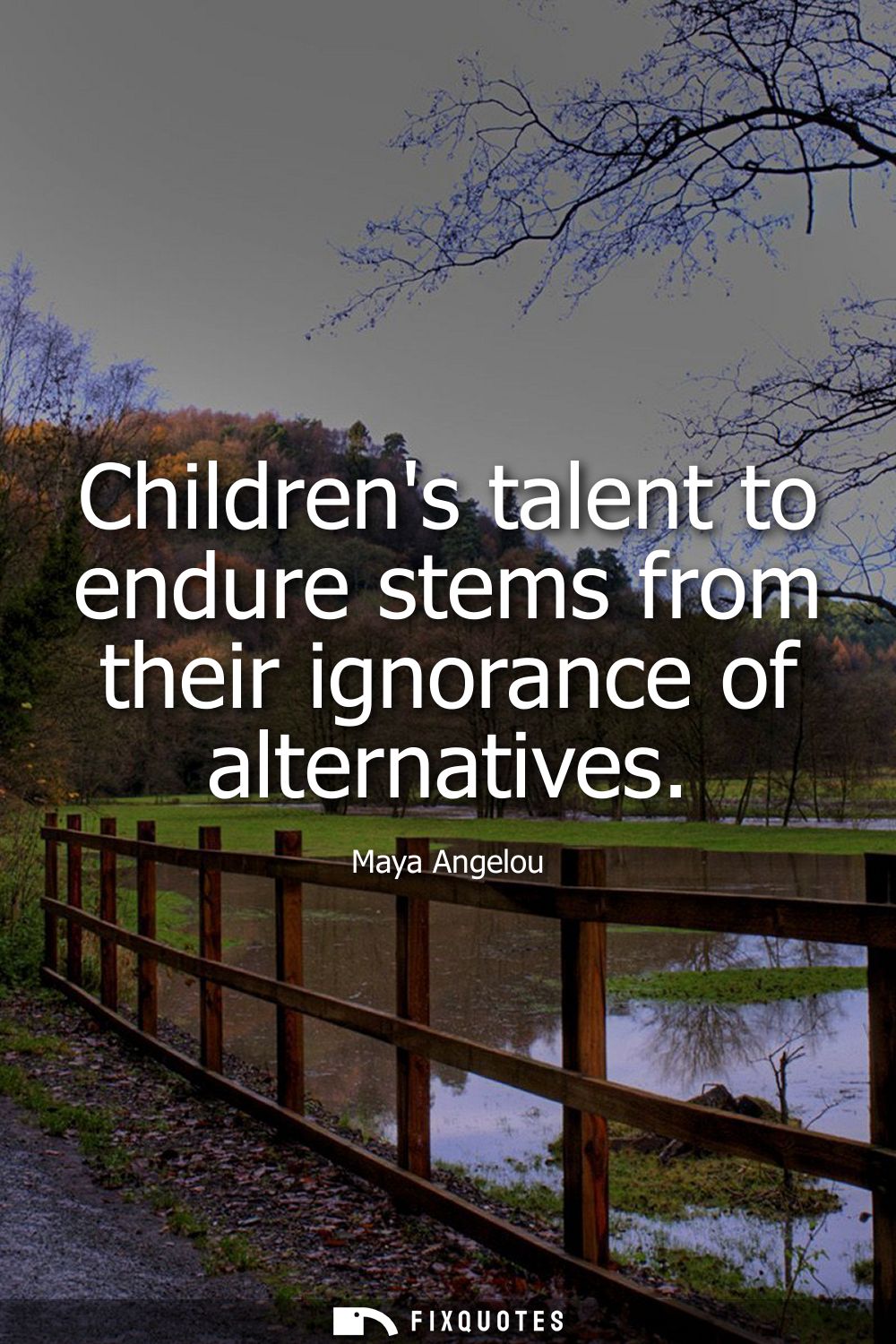
"Children's talent to endure stems from their ignorance of alternatives"
About this Quote
Endurance sounds noble until Angelou reminds you what it can actually be: a lack of options. The line flips a sentimental idea about childhood resilience into something sharper and more unsettling. Children, she suggests, don’t persevere because they’ve mastered grit; they persevere because they haven’t yet learned that life could be different. That’s not a compliment to suffering. It’s an indictment of the conditions that make suffering feel normal.
The intent sits in that loaded word “ignorance.” Angelou isn’t calling children stupid; she’s naming the brutal innocence that adults often romanticize. When you don’t know you can leave, complain, refuse, or demand better, you adapt. You “endure.” The subtext is about power: adults control the menu of alternatives. Families, schools, communities, and states can turn endurance into a quiet form of compliance by limiting what a child can imagine as possible.
Coming from Angelou, the context vibrates with lived history. Her work repeatedly returns to what it means to grow up inside structures that ration dignity by race, gender, and class. In that world, the celebrated toughness of the young can be a survival tactic forced by neglect, violence, or poverty. The line also warns the reader not to mistake a child’s calm for consent. If you praise endurance without asking what’s being endured, you risk becoming part of the system that requires it.
The intent sits in that loaded word “ignorance.” Angelou isn’t calling children stupid; she’s naming the brutal innocence that adults often romanticize. When you don’t know you can leave, complain, refuse, or demand better, you adapt. You “endure.” The subtext is about power: adults control the menu of alternatives. Families, schools, communities, and states can turn endurance into a quiet form of compliance by limiting what a child can imagine as possible.
Coming from Angelou, the context vibrates with lived history. Her work repeatedly returns to what it means to grow up inside structures that ration dignity by race, gender, and class. In that world, the celebrated toughness of the young can be a survival tactic forced by neglect, violence, or poverty. The line also warns the reader not to mistake a child’s calm for consent. If you praise endurance without asking what’s being endured, you risk becoming part of the system that requires it.
Quote Details
| Topic | Resilience |
|---|---|
| Source | Help us find the source |
| Cite |
Citation Formats
APA Style (7th ed.)
Angelou, Maya. (2026, January 14). Children's talent to endure stems from their ignorance of alternatives. FixQuotes. https://fixquotes.com/quotes/childrens-talent-to-endure-stems-from-their-24906/
Chicago Style
Angelou, Maya. "Children's talent to endure stems from their ignorance of alternatives." FixQuotes. January 14, 2026. https://fixquotes.com/quotes/childrens-talent-to-endure-stems-from-their-24906/.
MLA Style (9th ed.)
"Children's talent to endure stems from their ignorance of alternatives." FixQuotes, 14 Jan. 2026, https://fixquotes.com/quotes/childrens-talent-to-endure-stems-from-their-24906/. Accessed 4 Mar. 2026.
More Quotes by Maya
Add to List